
Most SaaS teams pick their database model before they understand their tenant isolation requirements. That single decision, made in week two of a project, ends up costing six to twelve months of re-architecture once the product hits 500 paying customers. The problem isn’t a lack of options. It’s making the wrong trade-off between cost efficiency and data safety too early.
The global SaaS market is forecast to hit $465.03 billion in 2026, and over 70% of modern SaaS vendors now use some form of multi-tenancy, per a 2024 report. That majority did not get there by accident.
Multi-tenant architecture SaaS is the only model where adding your 1,000th customer costs a fraction of adding your 10th. If your SaaS product still runs one instance per customer, you are scaling costs linearly while competitors scale logarithmically.
This guide will break down how multi-tenant architecture SaaS works, which database model fits your growth stage, and how to prevent common isolation and performance failures.
What is Multi-Tenant Architecture SaaS and Why It Matters in 2026
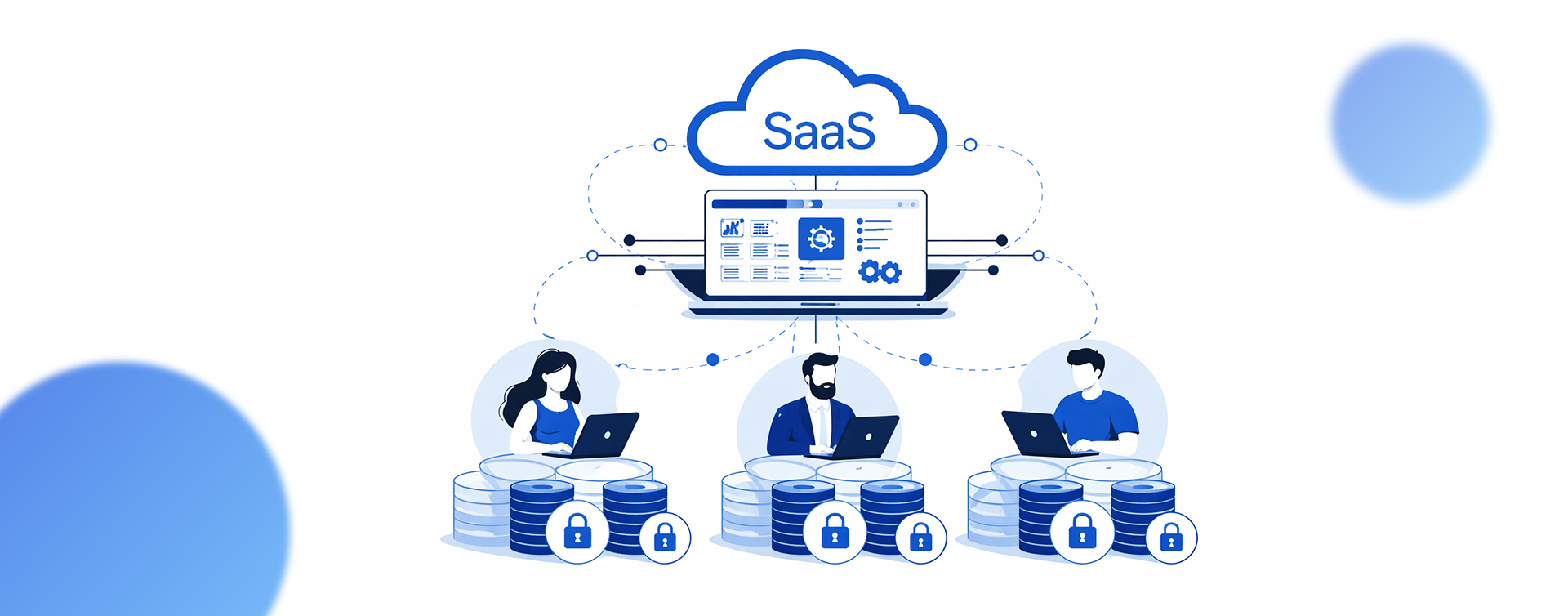
Multi-tenant architecture SaaS is a deployment model where one application instance serves multiple customers (tenants) from a single codebase SaaS setup, with each tenant’s data logically separated through database-level controls rather than physical infrastructure boundaries.
The financial case is straightforward. Shared infrastructure means shared costs. Updates deploy once, not per customer. Operational overhead stays flat while your customer count grows. That is the economic engine behind every SaaS platform generating more than $10M ARR.
1. Single-Tenant vs Multi-Tenant: Key Structural Differences
Single-tenant deployments give each customer a dedicated application instance and database, which simplifies isolation but multiplies infrastructure and maintenance costs at every new sign-up.
A 2025 WJARR (World Journal of Advanced Research and Reviews) study found that single-tenant deployments typically utilise only a fraction of available computing resources compared to higher utilisation rates in multi-tenant setups (WJARR, 2025). The average enterprise now manages 305 SaaS applications in 2026 (Zylo, 2026 SaaS Management Index). Running single-tenant instances for 305 products is financially impractical for any vendor.
Here is the breakdown:
- Infrastructure cost: Single-tenant scales linearly per customer. Multi-tenant keeps the base cost nearly flat.
- Maintenance overhead: Single-tenant requires patching and updating each instance separately. Multi-tenant deploys once.
- Update velocity: Multi-tenant ships features to all customers simultaneously. Single-tenant often requires staggered rollouts.
- Resource utilisation: Multi-tenancy maximises compute usage across tenants. Single-tenant leaves idle capacity per instance.
The trade-off is isolation complexity. Multi-tenancy demands more upfront engineering to prevent cross-tenant data exposure, which is where most teams underinvest.
2. Why Most SaaS Startups Default to Multi-Tenancy
Startups default to multi-tenancy because the shared database architecture transforms cost structures from linear to logarithmic. Adding customer number 1,000 costs a fraction of what customer number 10 costs.
“For SaaS founders evaluating whether multi-tenancy fits their product stage, our beginner-friendly breakdown in What is Multi-Tenancy? A Beginner-Friendly Guide for SaaS Product Owners covers the business case, cost savings, and architecture decisions from the ground up.”
The more interesting pattern emerging in 2026 is the hybrid tenancy model. Standard-tier users share pooled infrastructure. Enterprise clients with compliance requirements or heavy workloads get isolated environments. This lets startups capture both segments without committing to a single architecture.
Understanding the architecture model is one thing. Picking the right database design for it is where most teams make expensive mistakes early.
Multi-Tenant Database Design: Choosing the Right Model
Multi-tenant database design determines how tenant data is physically stored and logically separated. The three primary patterns are shared schema, schema-per-tenant, and database-per-tenant, each with distinct cost, compliance, and performance trade-offs.
Getting this decision wrong early is expensive. Migrating from shared schema to database-per-tenant after you have 500 customers is a 6-12 month re-architecture project. The right call depends on your tenant volume, compliance exposure, and growth trajectory.
1. Shared Database, Shared Schema (Row-Level Isolation)
All tenants share the same tables. A tenant_id column paired with row-level security (RLS) policies enforces access boundaries at the database layer.
This model has the lowest infrastructure cost and the simplest scaling path. One connection pool, one migration path, one backup strategy. The risk is straightforward: a single missed WHERE clause or a misconfigured RLS policy becomes a data leak.
Every query must include tenant context filtering, and that discipline needs to be enforced through code reviews and automated testing, beyond developer awareness.
Best for: early-stage SaaS with cost constraints and low regulatory exposure.
2. Shared Database, Schema-Per-Tenant
Each tenant gets a dedicated schema within the same database instance. This creates stronger isolation boundaries and makes per-tenant backup and restore operations straightforward.
The trade-off shows up at scale. Running schema migrations across thousands of tenants gets complex fast. Connection pooling becomes harder. This model works well for dozens to hundreds of tenants, not tens of thousands.
Best for: mid-stage SaaS products with moderate tenant counts and clients that need data-level separation for contractual or audit reasons.
3. Database-Per-Tenant (Silo Model)
Each tenant gets a fully dedicated database instance. This model completely eliminates noisy neighbour SaaS problems and simplifies compliance with standards like HIPAA, PCI-DSS, and SOC 2.
Costs rise linearly with every new customer. Operational overhead multiplies: backups, monitoring, patching, and connection management all scale per-tenant. This is the right model for regulated industries (healthcare, finance, government) or premium enterprise tiers where clients contractually require physical data separation.
4. Hybrid/Tiered Approach
The hybrid tenancy model is the bridge: free and standard-tier users sit on pooled, shared-schema infrastructure. Enterprise customers with compliance needs or heavy workloads get isolated schemas or dedicated databases.
This is now the most common pattern in mature SaaS applications. It lets you optimise unit economics for your volume segment while meeting enterprise procurement requirements. The engineering cost is maintaining two operational paths, but the revenue unlocked from serving both segments typically justifies it.
“Multi-tenant systems built on legacy architectures often break when AI workloads are introduced, a structural mismatch we analyze in AI Implementation Challenges: Why Legacy Architectures Break Modern AI Workloads.”
Choosing the right database model solves one half of the problem. The other half is making sure tenant data stays where it belongs, which brings us to isolation strategies.
SaaS Tenant Isolation Strategies: Preventing Data Leaks and Noisy Neighbours
SaaS tenant isolation strategies address two failure modes that kill trust fast: cross-tenant data exposure and performance degradation caused by resource-hogging tenants. Both are preventable with the right enforcement layers.
Quick-Glance: Tenant Isolation Strategy Comparison
| Strategy | Data Leak Risk | Noisy Neighbour Risk | Best For | Implementation Cost |
|---|---|---|---|---|
| Row-Level Security (RLS) | Medium. One missed WHERE clause = data leak. | High. All tenants share the computer and I/O. | Early-stage SaaS, low compliance exposure. | Low. Database-level config + query discipline. |
| Schema-Per-Tenant | Low. Schema boundaries enforce separation. | Medium. Shared database instance, separate schemas. | Mid-stage SaaS, dozens to hundreds of tenants. | Medium. Migration complexity grows per tenant. |
| Database-Per-Tenant (Silo) | Very Low. Complete physical separation. | None. Dedicated resources per tenant. | Regulated industries (HIPAA, PCI-DSS, SOC 2). | High. Linear cost increase per customer. |
| Kubernetes ResourceQuotas | N/A. Addresses performance, not data access. | Low. Hard CPU/memory caps per namespace. | Any multi-tenant K8S deployment at scale. | Low. Config-level enforcement. |
| Per-Tenant Rate Limiting | N/A. Addresses throughput, not data boundaries. | Low. Throttles request volume before compute. | API-heavy SaaS with variable tenant usage. | Low. API gateway configuration. |
| Hybrid (Pooled + Silo) | Low. Enterprise tenants get full isolation. | Low. Heavy tenants graduate to dedicated infra. | Mature SaaS with self-serve and enterprise tiers. | Medium-High. Two operational paths to maintain. |
1. Data Isolation Beyond Authentication
Authentication and authorisation alone do not achieve isolation. A user can be fully authenticated for their own tenant and still access another tenant’s data if isolation constructs are missing at the database and infrastructure layers.
Data partitioning (how you organise data) is not the same as data isolation (how you enforce access boundaries). Tenant data partitioning decides where rows live. Isolation decides who can read them. Conflating these two concepts is how cross-tenant data leaks happen.
Enforcement needs to exist at multiple layers: RLS policies at the database, middleware-level tenant context injection, API gateway tenant scoping, and automated integration tests that verify cross-tenant queries return zero results.
This is not theoretical. CVE-2024-10976, a PostgreSQL vulnerability disclosed in late 2024, showed that row-level security policies applied below subqueries could disregard user ID changes mid-session.
In a multi-tenant SaaS application using connection pooling, that flaw meant one tenant’s query could return rows belonging to another tenant. If your isolation relies entirely on RLS without additional middleware enforcement, a single database-level CVE can expose your entire customer base.
2. Fixing the Noisy Neighbour Problem
The noisy neighbour problem occurs when one tenant’s heavy workload (large imports, complex queries, batch processing) consumes a disproportionate share of shared CPU, memory, or I/O, degrading performance for every other tenant on the same infrastructure.
A 2025 WJARR study found that memory-intensive workloads cause more cross-tenant interference than CPU-bound workloads, which means memory allocation needs separate planning from compute scaling.
Practical fixes that work in production:
- Kubernetes ResourceQuotas: Set hard limits on CPU and memory per tenant namespace. Prevents any single tenant from starving others.
- Per-tenant rate limiting: Token bucket algorithms at the API gateway level throttle request volume per tenant before it hits compute.
- Auto-scaling based on tenant usage: HPA (Horizontal Pod Autoscaler) policies triggered by tenant-specific metrics instead of aggregate load.
- Tenant graduation: Move consistently heavy tenants to dedicated infrastructure automatically when usage crosses defined thresholds.
Isolation keeps your tenants safe. The next challenge is keeping your infrastructure efficient as the tenant count grows.
Scaling Multi-Tenant Architecture SaaS: Infrastructure and CI/CD
Scaling multi-tenant architecture SaaS beyond the first hundred tenants requires container orchestration, tenant-aware CI/CD pipelines, and per-tenant observability. Without these three layers, technical debt compounds with every new customer.
1. Container Orchestration and Tenant-Aware Deployments
Kubernetes multi-tenancy is the standard for running multi-tenant architecture SaaS at scale. The namespace-per-tenant pattern gives each tenant a logical boundary for resource quotas, network policies, and RBAC controls within a shared cluster.
As of Q3 2025, AWS holds 29% of the global cloud infrastructure market, Microsoft Azure holds 20%, and Google Cloud holds 13%, per Synergy Research Group. Regardless of provider, the pattern stays the same: define resource quotas per namespace, configure pod autoscaling with tenant-scoped metrics, and use network policies to prevent cross-namespace traffic.
The common mistake is running one large namespace for all tenants. This works for 20 tenants. At 200, you lose the ability to attribute costs, isolate failures, or enforce resource limits per customer.
2. CI/CD for Multi-Tenant Environments
Deploying updates across hundreds of tenants without downtime requires canary rollouts, tenant-specific feature flags, and parallel schema migrations.
GitHub Actions is a top CI/CD choice in 2026, with Actions Runner Controller (ARC) enabling self-hosted runners on EKS that can be tagged by tenant for cost-back or charge-back. The practical workflow: deploy to a canary tenant group (5-10% of traffic), validate metrics for 15-30 minutes, then progressively roll out to remaining tenants with automated rollback triggers.
Feature flags add another layer. Tools like LaunchDarkly or open-source Flagsmith let you enable new features per-tenant, which is critical for enterprise clients who need advance testing before production rollouts.
3. Per-Tenant Observability
Aggregate metrics hide tenant-specific problems. If your p99 latency looks healthy across all tenants but one enterprise client is experiencing 3-second response times, you will not catch it without tenant-segmented observability.
The minimum stack:
- Prometheus with tenant-tagged metrics: Add a tenant_id label to every custom metric. This lets you alert on per-tenant SLA violations.
- Grafana multi-tenant dashboards: Variable-driven dashboards filtered by tenant ID. Your support team needs this to troubleshoot without SSH access.
- Distributed tracing with tenant context (Jaeger): Propagate tenant_id through trace spans. This is the fastest way to identify which tenant is causing a noisy neighbour event.
Performance metrics must be segmented by tenant. It is the only way to catch noisy neighbour issues before they become customer escalations.
How Ariel Software Solutions Scales Multi-Tenant SaaS Without Multiplying Infrastructure Costs
Most SaaS teams hit the same wall: the architecture that got them to 50 tenants starts breaking at 500. Cross-tenant data leaks surface from missed query filters. Noisy neighbour complaints pile up because resource quotas were never configured.
Schema migrations that took minutes now block deployments for hours. These are not edge cases. They are the default outcome when multi-tenant architecture SaaS decisions are deferred past the MVP stage.
Ariel Software Solutions works with SaaS companies to prevent and fix exactly these problems:
- Tenant isolation audits and database model selection: Ariel evaluates your current RLS policies, schema design, and query patterns to identify cross-tenant exposure risks before they become data breaches.
- Kubernetes-native tenant deployment pipelines: Namespace-per-tenant setups with ResourceQuotas, HPA auto-scaling, and tenant-tagged observability that eliminates noisy neighbour blind spots.
- Zero-downtime migration from single-tenant to multi-tenant: Ariel consolidates legacy single-instance deployments into shared or hybrid architectures without disrupting live tenants.
If your SaaS product is approaching the point where infrastructure costs scale with every new sign-up, that is the right time to talk. Book a 15-minute architecture walkthrough with Ariel.
Conclusion
Multi-tenant architecture SaaS is the foundation that makes SaaS economics viable at scale. The right database model, isolation strategy, and observability setup depend on your tenant volume, compliance exposure, and growth trajectory. Getting these decisions right in the first 12 months saves six figures in re-engineering costs later.
The hybrid tenancy model (pooled for standard tiers, siloed for enterprise) is where most mature platforms land. Start there if your roadmap includes both self-serve and enterprise segments.
Talk to Ariel Software Solutions to design a multi-tenant architecture that scales with your product roadmap. Book a quick walkthrough.
Frequently Asked Questions
1. What is multi-tenant architecture in SaaS?
Multi-tenant architecture SaaS means one application instance serves multiple customers from a single codebase. Each tenant’s data stays logically separated through database-level controls like row-level security, schema isolation, or dedicated databases. This model reduces infrastructure costs and simplifies maintenance compared to running separate instances per customer.
2. What is the noisy neighbour problem in multi-tenant SaaS?
The noisy neighbour problem happens when one tenant’s heavy workload (large data imports, complex queries) uses a disproportionate share of shared CPU, memory, or I/O. This slows down performance for all other tenants on the same infrastructure. Fixes include per-tenant rate limiting, Kubernetes resource quotas, and auto-scaling.
3. Which multi-tenant database model is best for startups?
Shared database with shared schema (row-level isolation) works best for most early-stage SaaS startups. It has the lowest infrastructure cost and simplest maintenance. The trade-off: every database query must include tenant context filtering. Plan to graduate enterprise tenants to isolated environments as you scale.
4. How is tenant data isolation different from authentication?
Authentication confirms a user’s identity. Isolation ensures authenticated users can only access their own tenant’s data at the infrastructure level. Without proper isolation constructs like RLS policies or schema boundaries, a bug in application code could let one authenticated tenant read another tenant’s records.
5. Can you migrate from single-tenant to multi-tenant architecture?
Yes, but it requires careful planning. Start by making tenant identity a first-class concept in your data model, queries, and authorisation logic. Then consolidate infrastructure gradually. Many platforms use a hybrid approach: moving standard tenants to shared resources while keeping legacy enterprise tenants on dedicated infrastructure.
6. What compliance standards require tenant isolation in SaaS?
HIPAA (healthcare), PCI-DSS (payments), SOC 2 (security operations), and GDPR (data privacy) all require verifiable data isolation between tenants. Requirements may include encrypted per-tenant storage, separate database instances, audit logging, and documented access control policies. The silo (database-per-tenant) model is most common in regulated verticals.