A SaaS product development team that treats onboarding as an afterthought will watch 43% of SMB customers disappear before the first quarter ends. That is not a growth problem. That is a product design failure baked into the architecture.
The global SaaS market hit $315.68 billion in 2025 and is projected to reach $1,482.44 billion by 2034, growing at an 18.7% CAGR. Application development was the fastest-growing SaaS spending category in 2025, with a 176% year-over-year increase according to Zylo’s 2026 SaaS Management Index.
This guide will break down the architecture decisions, UX strategies, and SaaS scalability patterns that separate products with sticky retention from those that bleed users in the first quarter.
Core Features Every SaaS Product Development Team Should Prioritize in 2026
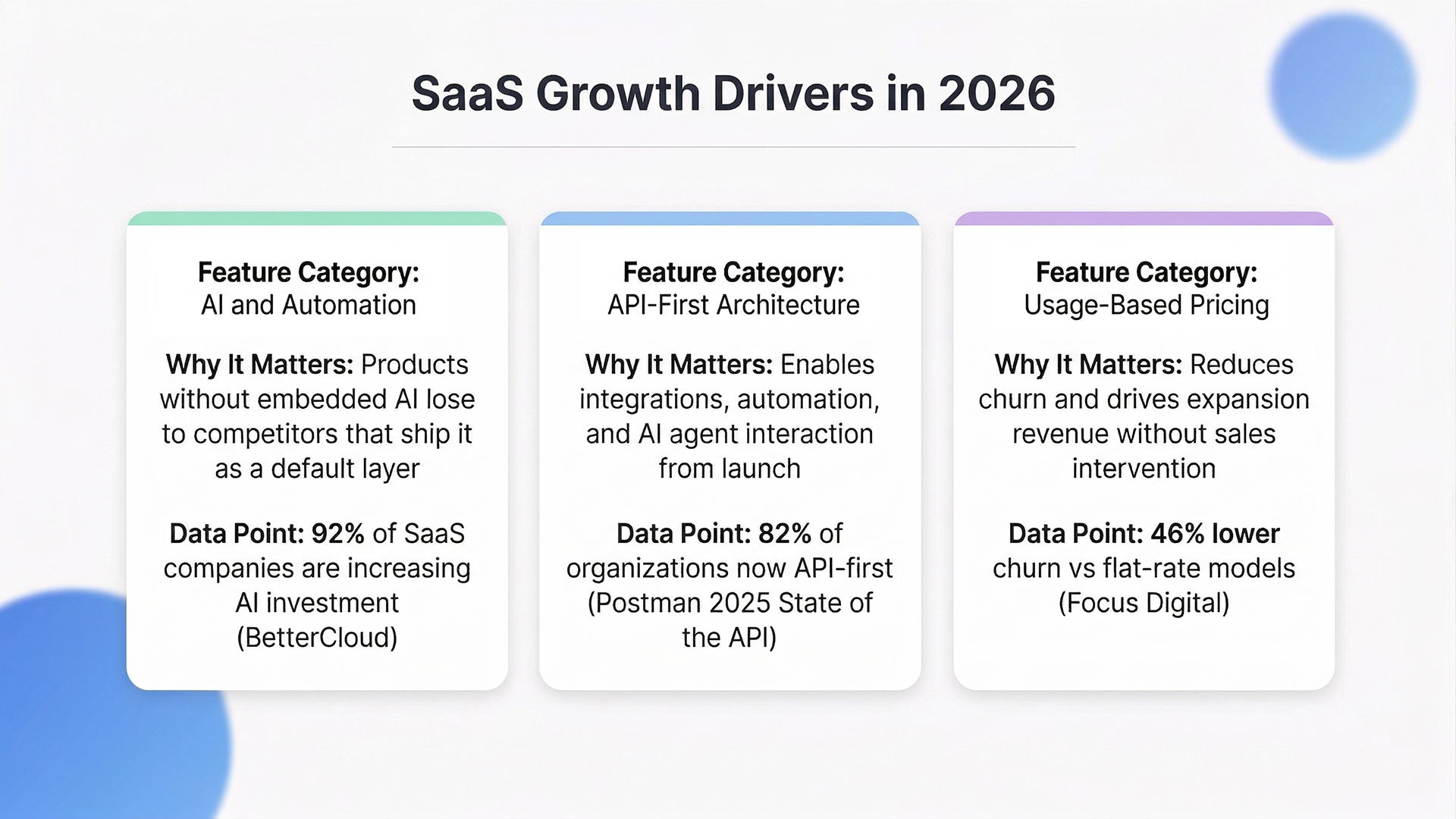
SaaS product development in 2026 requires AI-native capabilities, API-first architecture, and usage-based pricing infrastructure built into the product from day one, not layered on after launch. Teams that skip any of these three lose ground to competitors who ship them as defaults.
The feature decisions below are not a generic checklist. They represent the three categories where spending is accelerating fastest and where user expectations have shifted permanently.
Here is a glance breakdown before the deep dive.
1. AI and Automation as Default Product Capabilities
AI-powered SaaS is no longer a premium add-on. It is table stakes for any product shipping after 2025.
92% of SaaS companies plan to increase AI usage in their products, and the AI SaaS market is expected to grow at a 38.28% CAGR from $71.54 billion in 2024 to $775.44 billion by 2032. Gartner expects that by 2026, 80% of enterprises will have deployed GenAI-enabled applications.
The specific AI feature categories that matter right now:
- In-app AI assistants that guide users through complex workflows and reduce support tickets
- Predictive analytics that flag churn risk, usage drops, or upsell opportunities before a human spots them
- Automated workflow builders that let end users create rules without writing code
- Personalized content delivery that adapts dashboards, reports, and recommendations to individual usage patterns
Products that bolt on AI later face integration debt. Building AI as a core layer from day one compounds value with every feature shipped after it.
2. API-First Architecture
API-first design means every core capability is exposed through well-documented, versioned APIs before any frontend is built, enabling integrations, automation, and AI interaction from launch.
82% of organisations have adopted some level of an API-first approach, with 25% operating as fully API-first organisations, a 12% increase from 2024. This is not a niche engineering preference. It is the dominant development paradigm for scalable SaaS product development.
Key architecture decisions at this stage:
- REST vs GraphQL: REST for broad compatibility and caching, GraphQL for complex nested data queries. Most teams ship REST first and add GraphQL for power users
- API security: OAuth2 for authorization, JWT for stateless authentication, rate limiting per tenant to prevent abuse
- Backward compatibility: Versioned endpoints (v1, v2) with deprecation timelines so integrations don’t break during updates
An API-first approach also future-proofs the product for AI agent ecosystems where automated tools interact with SaaS products without a human in the loop.
1. Usage-Based Pricing Infrastructure
Subscription software development models are shifting from flat-rate to usage-based pricing. Products that build metering infrastructure early capture significantly more expansion revenue.
Usage-based pricing reduces churn by 46% compared to flat-rate models (2.1% monthly vs. 3.9% monthly) and generates 2.6x higher expansion revenue. This is not a billing preference. It is a retention mechanism.
“Knowing when to move from MVP to growth infrastructure is a timing problem, not just a technical one. Our When to Scale a Product Guide breaks down the decision framework.”
Building pricing flexibility into the product requires three infrastructure components:
- Real-time metering: Track API calls, storage, compute minutes, or active users at the event level, not at the end of a billing cycle
- Billing integration: Stripe, Chargebee, or Lago connected to the metering layer with automated invoice generation and proration logic
- Tiered plan logic: Self-serve plan upgrades and downgrades without requiring a sales call or manual migration
Teams that delay this end up rebuilding their billing stack after reaching product-market fit, which is one of the most expensive refactors in SaaS product development.
Architecture Decisions That Make or Break Growth (SaaS Scalability)
SaaS scalability depends on three architecture choices made before the first production deployment: tenancy model, service decomposition, and resource orchestration. Retrofitting any of these after launch costs 3-5x more than building them correctly from the start.
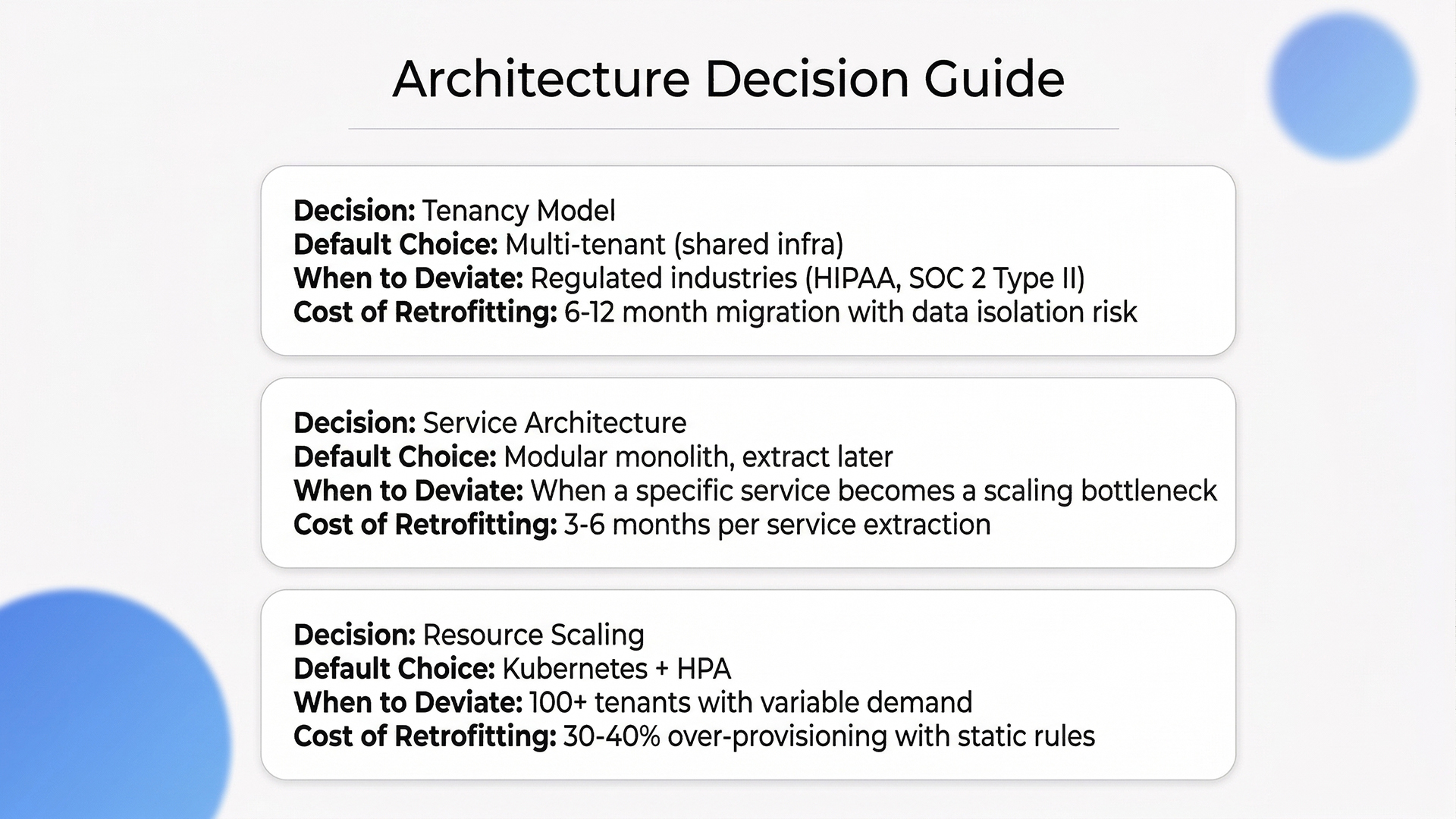
Most teams optimize for speed to market and treat scalability as a phase-two problem. That works until the product hits 500 concurrent users and the monolith starts choking. Here is a reference table for the key decisions.
1. Multi-Tenant vs Single-Tenant: When to Use Which
Multi-tenant architecture is the default for cost-efficient SaaS product development, but regulated industries often require single-tenant isolation for compliance.
Multi-tenant systems share infrastructure across customers, reducing per-tenant costs and simplifying maintenance. The adoption of public cloud solutions improves application development agility by over 30%, making cloud-native SaaS multi-tenancy the practical choice for most B2B and B2C products.
The decision framework:
- Multi-tenant: Standard for products serving SMBs and mid-market. Lower infrastructure costs, faster feature rollouts, simpler DevOps
- Single-tenant: Required for healthcare (HIPAA), financial services (SOC 2 Type II), and government contracts where data isolation is a contractual requirement
- Hybrid approach: Enterprise clients get dedicated infrastructure. Standard tiers share. This model works well for products selling to both segments.
- The best approach: design the data layer for multi-tenancy from the start, with tenant isolation at the database schema level. Adding single-tenant options later becomes a configuration change, not a rewrite.
“Strong architecture decisions mean little if the business-side execution fails early. Our guide to SaaS AI Startup Pitfalls covers the errors that kill products before they scale.”
2. Microservices and Container Orchestration
Microservices SaaS architecture decomposes the application into independent, deployable services, each owning its own data and scaling independently based on demand.
Production Kubernetes usage reached 82% of container users in the 2025 CNCF Annual Cloud Native Survey, up from 66% in 2023. Container orchestration is no longer experimental. It is the production standard for SaaS product development teams building for horizontal scale.
The infrastructure stack that works in production:
- Containerization: Docker for packaging, with multi-stage builds to minimize image size
- Orchestration: Kubernetes (EKS, GKE, or AKS) for auto-scaling, rolling deploys, and self-healing
- Service mesh: Istio or Linkerd for encrypted service-to-service communication, traffic management, and observability without modifying application code
- Event-driven communication: Kafka or RabbitMQ for async processing between services, reducing coupling and improving fault tolerance
Start with a modular monolith if the team is small (under 10 engineers). Extract microservices only when a specific service becomes a scaling bottleneck. Premature decomposition creates more operational overhead than it solves.
AI-Driven Resource Orchestration
AI-driven resource orchestration uses predictive models to dynamically allocate infrastructure across tenants based on real-time workload, replacing static auto-scaling rules with intelligent capacity planning.
Traditional Kubernetes auto-scaling (HPA) reacts to current demand, which means pods spin up only after a traffic spike is detected. AI-driven predictive scaling analyses historical patterns and forecasts demand before it arrives.
Research benchmarks show this approach achieves a 34% reduction in cloud infrastructure costs while maintaining 99.7% service availability.
This matters for two reasons:
- Predictable performance: Tenants get consistent response times regardless of traffic spikes from other tenants on shared infrastructure
- Cost efficiency: AI models right-size resources in real time, eliminating the 30-40% over-provisioning that static auto-scaling rules typically produce
Expert insight: Technavio’s analysis found that a unified data lakehouse architecture improves data processing efficiency by over 35% and is critical for powering generative AI and intelligent agents within core SaaS applications.
The practical takeaway for SaaS scalability: if the product serves more than 100 tenants, investing in AI-based resource management pays for itself within 6-12 months through reduced infrastructure spend.
User-Centric SaaS Design: The Retention Lever Most Teams Underinvest In
User-centric SaaS design directly controls churn, retention, and expansion revenue. Every $1 invested in UX yields a $100 return (9,900% ROI) according to Forrester Research, making it the highest-ROI investment in the entire product development cycle.
Most teams treat UX as a design exercise. It is a revenue function. The sections below cover the three UX decisions with the highest measurable impact on SaaS churn reduction.
1. Onboarding as the Highest-Leverage Retention Investment
SaaS onboarding quality determines whether users hit their first value moment or abandon the product. 43% of all SMB customer losses occur within the first 90 days post-purchase.
The 90-day window is where teams either earn long-term retention or fund a competitor’s growth. Effective onboarding is not a product tour. It is a structured path to the user’s first measurable outcome.
What works in practice:
- Progressive disclosure: Show only the features relevant to the user’s current task. Reveal advanced capabilities as they complete activation milestones.
- Guided tours tied to business outcomes: Instead of ‘click here to set up your profile,’ guide users to complete a task that delivers immediate business value
- Activation events: Define 3-5 specific actions that correlate with long-term retention. Track completion rates and trigger re-engagement if users stall
- The opinion that matters here: most onboarding failures happen because product teams design for feature coverage, not for time-to-value. Shorter paths to the first ‘aha’ moment beat comprehensive feature tours every time.
“For teams ready to move AI from roadmap to release, our Build an AI SaaS Product Checklist provides a phase-by-phase execution framework with zero guesswork.”
2. Personalization as a Revenue Driver
Personalization can improve customer satisfaction by up to 20% and lift sales conversions by 15%. Targeted calls-to-action produce a 42% higher submission rate than generic CTAs shown to all visitors.
For SaaS product development teams, this means personalization is not a nice-to-have feature. It is a revenue multiplier that compounds with usage. A well-crafted, frictionless UX can raise conversion rates by up to 400%.
Practical personalization patterns:
- Role-based dashboards: A sales manager and a support agent using the same product should see different default views, metrics, and shortcuts
- Behavioural recommendations: Surface features, reports, or integrations based on what similar users found valuable, not based on what the product team wants to promote
- Adaptive workflows: Simplify or expand interfaces based on user proficiency. Power users get keyboard shortcuts and bulk actions. New users get guided paths.
Personalization built into the user-centric SaaS design layer increases SaaS UX retention because users feel the product was built for their specific workflow, not for a generic audience.
3. Reducing Involuntary Churn Through UX
Involuntary churn from payment failures and expired cards makes up 0.8% of the 3.5% average B2B SaaS monthly churn rate, per the 2025 Recurly Churn Report.
That 0.8% is entirely preventable. For a product with 10,000 subscribers at $200/month ARPU, that is 80 lost customers per month and $192,000 in annual revenue lost to payment infrastructure failures, not product dissatisfaction.
UX-driven solutions that reduce involuntary churn:
- Smart dunning: Automated retry sequences with escalating communication (in-app banner, email, SMS) before subscription cancellation
- Automatic card updates: Integrate with payment processors that support network-level card updates (Visa Account Updater, Mastercard ABU) so expired cards refresh without user action
- In-app payment recovery: Surface a non-intrusive in-app prompt when a payment fails, with a one-click update flow instead of redirecting to a separate billing portal
Fixing involuntary churn is the single fastest way to improve net retention without changing the product’s core functionality.
How Ariel Software Solutions Builds SaaS Products With the Features That Actually Matter

Most SaaS product development projects fail for predictable reasons: monoliths that choke past 500 users, onboarding that loses 40%+ of signups within 30 days, and AI treated as a future roadmap item.
Ariel Software Solutions fixes these patterns across 1,100+ completed projects with a 95% satisfaction rate.
Our Special Capabilities:
- AI-First Architecture Assessment: Identifies where AI/ML reduces cost and speeds workflows before writing code.
- Scalable Multi-Tenant Infrastructure: Cloud-native, API-first systems with Kubernetes orchestration and tenant-level isolation from day one.
- 90-Day Retention Engineering: Onboarding redesigns and activation tracking targeting the churn window that kills most SaaS products.
Book a free product audit to see where your SaaS is losing users and revenue. Talk to Ariel’s team.
Conclusion
SaaS product development in 2026 comes down to three things: architecture that scales without linear cost increases, UX that delivers value before users hit the 90-day drop-off point, and AI capabilities baked into the core product layer.
The data backs this up: products with strong onboarding, usage-based pricing, and multi-tenant efficiency retain users at significantly higher rates. With 82% of organizations already API-first and 82% running Kubernetes in production, the infrastructure bar has moved. Products that do not meet it face a compounding disadvantage as competitors ship faster on modern stacks.
Talk to Ariel Software Solutions about a free architecture review and product audit built around your growth stage. Let’s connect.
Frequently Asked Questions
1. What is SaaS product development?
SaaS product development is the process of designing, building, and maintaining cloud-based software delivered on a subscription model. It covers architecture decisions (multi-tenant vs single-tenant), feature development, UX design, API integrations, security, and ongoing deployment through CI/CD pipelines.
2. How much does it cost to build a SaaS product in 2026?
A basic SaaS MVP costs $50,000 to $150,000. Mid-complexity products with AI features, integrations, and multi-tenant architecture run $150,000 to $500,000. Enterprise-grade platforms with compliance, advanced analytics, and custom workflows can exceed $500,000. Costs vary by team location and tech stack.
3. What is a good churn rate for a SaaS product?
For B2B SaaS, the 2025 average is 3.5% monthly (2.6% voluntary, 0.8% involuntary). Enterprise SaaS targets under 1.5% monthly. Established companies with mature customer success programs maintain sub-2% monthly churn. Anything above 5% monthly signals a product or onboarding problem.
4. Should I use multi-tenant or single-tenant architecture for my SaaS?
Multi-tenant is the default for most SaaS products since it lowers infrastructure costs and simplifies maintenance. Single-tenant is necessary for regulated industries (healthcare, finance) requiring strict data isolation. A hybrid approach works well for products serving both enterprise and standard-tier segments.
5. How does UX design reduce SaaS churn?
Poor UX is a direct churn driver. 43% of SMB customer losses happen in the first 90 days, usually from bad onboarding. Progressive disclosure, guided tours, personalized dashboards, and clear activation events shorten time-to-value. Every $1 invested in UX returns an estimated $100 in value according to Forrester Research.
6. What AI features should a SaaS product include in 2026?
At minimum: in-app AI assistants for user guidance, predictive analytics for usage patterns, automated workflow suggestions, and personalized content delivery. 92% of SaaS companies are increasing AI integration. Products priced above $250/month with embedded AI achieve retention rates matching traditional B2B SaaS benchmarks.