
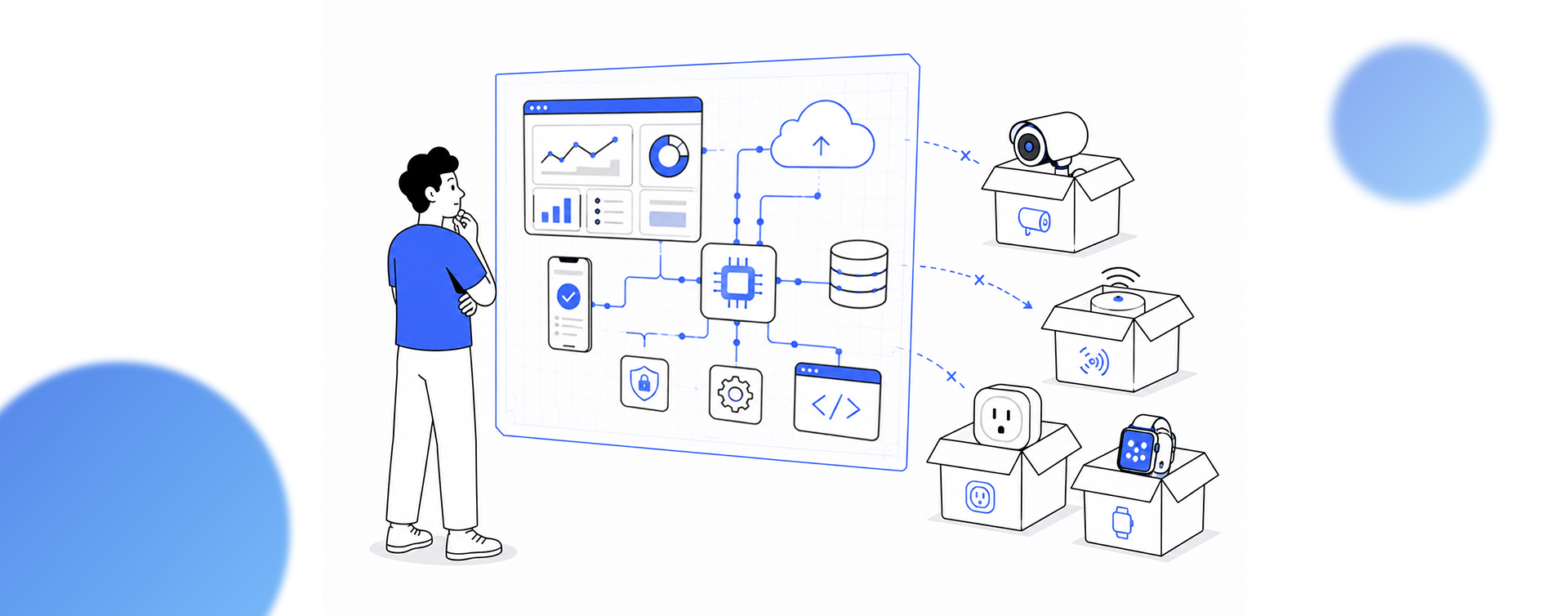
Most IoT projects make the same expensive mistake: they buy the hardware first.
It feels logical. Pick the sensors, order the devices, and start building. But by the time teams think about data flow, cloud architecture, security, integrations, and scalability, the hardware has already locked in decisions that software now has to work around.
An IoT app development company with experience understands the full IoT stack starts with the system architecture, not the hardware.
That approach matters more than ever. IoT Analytics estimates there were 21.1 billion connected IoT devices at the end of 2025, with the total projected to reach 39 billion by 2030. At that scale, success isn’t determined by the device itself. It’s determined by the architecture that connects, secures, manages, and updates every device over its lifetime.
This guide explains what to build before buying hardware, the IoT application architecture that should come first, and how to choose an IoT app development company that gets the order right.
Key Takeaways
- Successful IoT projects begin with system architecture, and then select hardware that meets those requirements.
- Hardware should support the software, not define it. Data flow, connectivity, cloud architecture, security, and scalability determine which devices are technically suitable.
- Early hardware selection may lead to firmware limitations, connectivity issues, security gaps, compliance delays, and scalability bottlenecks.
- Software decisions have a much larger impact than hardware decisions. Changes to APIs, data models, security frameworks, or communication protocols affect the entire IoT ecosystem, and not just individual devices.
- The Solution Architecture & System Design phase comes first. This is where teams define the data model, processing strategy, connectivity, power budget, security, backend platform, compliance requirements, and validation approach before procurement begins.
- A hardware-agnostic architecture protects future flexibility. Designing around open standards such as MQTT, HTTP, and CoAP makes it easier to upgrade or replace hardware without rebuilding the platform.
The Hardware-First Trap in IoT Development
Although IoT is as much a software system as it is a hardware product, many teams naturally begin with the hardware. Here’s why:
- Hardware feels like tangible progress. Selecting sensors, development boards, or gateways gives teams something they can prototype and demonstrate quickly, while architecture and system design feel more abstract.
- Development kits lower the barrier to entry. Platforms like ESP32, Arduino, and Raspberry Pi make it easy to build a proof of concept, creating the impression that hardware is the natural starting point.
- Traditional engineering workflows reinforce it. Organizations with an embedded or hardware engineering background often follow a hardware-first approach, where software is developed around the selected components.
- Cost pressures encourage early hardware decisions. Teams may try to lock the bill of materials (BOM) early to estimate manufacturing costs before the system requirements are fully defined.
The challenge? This approach reverses the engineering process. In successful IoT projects, hardware is the outcome of architectural decisions, not the starting point. The software architecture defines how devices communicate, process data, scale, and stay secure. It ultimately helps an IoT app development company determine which hardware is the right fit.
What Happens if the Hardware Commitments are Made Early?
If an IoT development project locks in physical components first, it could force the developers into software and connectivity dead ends, leading to the following consequences:
1. Firmware Constraints
Once the microcontroller, memory, or communication modules are finalized, firmware teams must work within those limitations. Insufficient processing power, memory, or storage can restrict functionality, increase optimization effort, or even require rewriting portions of the firmware later in the project.
For example, if a low-memory microcontroller is selected early, adding secure over-the-air (OTA) firmware updates later may not be possible because the device lacks enough flash memory to store both the existing and new firmware during the update process. What seemed like a cost-saving hardware decision can ultimately require a hardware redesign.
2. Connectivity Limitations
Selecting connectivity hardware too early may lock the product into protocols or network technologies that no longer align with business or deployment requirements. Migrating from Wi-Fi to LTE-M, NB-IoT, or LoRaWAN later often requires hardware redesigns alongside firmware changes.
3. Security Gaps
Hardware choices determine whether features such as secure boot, hardware-backed key storage, cryptographic acceleration, or trusted execution environments are available. If these capabilities aren’t considered early, implementing enterprise-grade security later can become difficult. Sometimes, it becomes impossible without replacing components.
4. Compliance and Certification Delays
Many industries require regulatory certifications such as FCC, CE, UL, or industry-specific compliance. Choosing uncertified modules or components prematurely can trigger additional testing, redesigns, and certification cycles, delaying product launches and increasing development costs.
5. Scalability Bottlenecks
Hardware selected for a proof of concept may perform adequately with a handful of devices but struggle in production. A gateway tested successfully with 20 devices during the pilot. When deployed across 2,000 devices, it couldn’t handle the volume of telemetry, causing delays and dropped messages. Limited memory, processing capacity, or communication bandwidth can restrict support for OTA updates, edge analytics, or large-scale device management.
Hardware problems only surface when moving from generous development boards to cheaper production hardware. This reveals hidden power management issues and unstable communication. The solution? A redesign that could have been avoided by defining requirements before committing to specific parts.
Why Are Software Decisions Harder to Change than Hardware Decisions?
In IoT, hardware can often be upgraded in future production runs, but software architecture forms the foundation of the entire ecosystem. Unlike hardware, software decisions become increasingly difficult to modify as the ecosystem grows, and here’s why:
1. Hardware Changes Are Local. Software Changes Are Systemic.
Replacing a sensor or microcontroller typically affects only future production units. Existing devices continue operating without disruption.
Software changes are different. Modifying a data schema, API contract, or messaging protocol impacts every deployed device, backend service, analytics pipeline, and integration that depends on it. A single architectural decision can require coordinated updates across the entire IoT ecosystem.
2. Data Models Become Long-Term Commitments
Once telemetry data is collected, it becomes embedded across databases, time-series platforms, dashboards, analytics models, and machine learning pipelines.
Changing the data model later often requires:
- Migrating historical data
- Versioning APIs and downstream consumers
- Running parallel data pipelines during the transition
Hardware upgrades do not create this type of historical dependency. Existing devices simply continue operating with their original components.
3. Large Device Fleets Make Software Updates Complex
Implementing a protocol or API change may require only a small code modification, but deploying it safely across thousands of connected devices is significantly more challenging.
IoT fleets often contain multiple firmware versions, devices with intermittent connectivity, and systems that may remain offline for extended periods. As a result, an IoT app development company maintains backward compatibility for legacy devices long after new software is released, making future architectural changes progressively more constrained.
4. Security Architecture Cannot Be Easily Retrofitted
Authentication models, device identities, certificate management, and provisioning workflows are architectural decisions that affect every connected device.
Changing these mechanisms after deployment may require re-provisioning devices, rotating credentials, or even physical intervention. Unlike replacing a hardware component in future manufacturing, security changes impact the trust relationship across the entire deployed fleet.
5. OTA Updates Introduce Operational Risk
Hardware revisions can be validated before devices leave the factory. Software updates, however, must be delivered to devices already operating in the field.
Over-the-air (OTA) updates must account for unreliable connectivity, limited battery capacity, interrupted downloads, and recovery from failed installations. A faulty deployment can disrupt thousands of devices simultaneously, making software releases significantly higher risk than hardware revisions.
6. Software Sits at the Center of the IoT Ecosystem
Every major IoT component, like firmware, cloud services, mobile applications, analytics platforms, and enterprise integrations, depends on shared software contracts such as APIs, communication protocols, identity models, and data schemas.
Because these layers are tightly coupled, modifying one architectural decision often requires coordinated updates throughout the entire system. Hardware, by comparison, remains a single implementation layer with a much narrower impact on the overall solution.
What to Build and Decide Before Buying Hardware?
Before ordering a single sensor, gateway, or microcontroller, an IoT app development company focuses on the Solution Architecture and System Design phase. This is where engineers translate business requirements into a technical blueprint that defines how the entire IoT ecosystem will operate. Rather than building the platform, the focus is on making the architectural decisions that determine which hardware is technically suitable.
During this phase, the following decisions are made:
| Architecture Decision | What Should Be Defined? | Why It Matters for Hardware |
|---|---|---|
| Data Model | Define the telemetry schema, payload size, transmission frequency, and QoS requirements. | Determines memory, bandwidth, and communication module requirements. |
| Processing Strategy | Decide whether processing occurs on the device, gateway, or cloud, and whether edge AI or real-time processing is required. | Assesses processor performance, RAM, and storage requirements. |
| Connectivity Architecture | Select communication protocols (MQTT, CoAP, HTTP) and network technologies (Wi-Fi, BLE, LoRaWAN, NB-IoT, LTE-M, 5G). | Ensures the selected hardware supports the required range, bandwidth, latency, and power profile. |
| Power Budget | Estimate battery life based on active/sleep cycles, transmission frequency, and expected deployment duration. | Helps eliminate hardware that cannot meet power and battery-life targets. |
| Security Architecture | Define device identity, secure boot, encryption, key management, and OTA update requirements. | Determines whether the hardware supports enterprise-grade security capabilities. |
| Platform & Data Pipeline | Design device provisioning, fleet management, data ingestion, APIs, and digital twins. | Ensures the hardware can support long-term scalability and lifecycle management. |
| Environmental & Compliance | Specify operating conditions, IP ratings, EMI/EMC requirements, and regulatory certifications. | Narrows hardware choices to components suitable for the deployment environment. |
| Architecture Validation | Validate the design through simulations or development boards before procurement. | Confirms architectural assumptions before investing in production hardware. |
Settle these, and hardware selection becomes a straightforward question of which device meets the requirements you have already defined. Skip them, and the hardware silently sets requirements you will discover the hard way.
How to Choose an IoT Development Company?
Picking an IoT development company isn’t like picking a web dev shop. Get the order of evaluation wrong, and you’ll end up with a vendor who’s great at firmware but blind to your data architecture, or one who talks a great cloud game but has never shipped a certified device.
Look for a team that:
- Takes an architecture-first approach, defining the system, connectivity, cloud, and security before recommending hardware.
- Has end-to-end expertise across firmware, connectivity, cloud infrastructure, and application development, so integration is managed by one team.
- Builds for security and scale from day one, with secure device provisioning, OTA updates, and fleet management planned into the architecture.
- Has proven production experience, including large-scale deployments, compliance requirements, and long-term device lifecycle management. Because a prototype that works for 10 devices tells you nothing about 10,000.
- Provides post-launch support, continuously monitoring, maintaining, and updating the IoT solution as the device fleet grows.
Evaluate in this sequence, and you avoid the classic trap of picking a vendor for their flashiest demo instead of their actual fit.
Ariel’s Approach to IoT App Development: Architecture First, Hardware Second
Every IoT project at Ariel begins with the same principle: validate the system before committing to the hardware. It is because an IoT product shouldn’t be hardware-dependent, like your platform can only work with ESP32 boards, and switching to Nordic, STM32, or another chipset would require a major rewrite for large parts of the software.
Rather, it needs to be hardware-agnostic, so your IoT platform can communicate using standard protocols like MQTT, HTTP, or CoAP. Whether the data comes from an ESP32, Raspberry Pi, or a custom PCB doesn’t matter, as long as the device follows the expected communication standards.
The hardware generates the data, but the software determines how that data is transmitted, processed, secured, visualized, and acted upon. Over 16 years of building IoT solutions, we’ve found that hardware can be replaced, but poor architecture is far more expensive to undo. That’s why every project begins with system design rather than component selection.
Once the software architecture is in place, future hardware upgrades or replacements become much simpler because the rest of the system doesn’t need to be redesigned.
Planning an IoT product? Design the system before you order devices.
We have built IoT systems across smart buildings, industrial, healthcare, and logistics for 16 years. We will design your architecture, connectivity, cloud, and security first, then recommend the hardware that fits, so you do not pay to work around the wrong device.
Frequently Asked Questions
1. Does IoT application development start with software architecture?
Yes, IoT application development should start with the system architecture because software determines how devices communicate, process data, integrate with cloud services, receive updates, and scale. Hardware should support these requirements, not dictate them.
2. What is the difference between IoT hardware development and IoT software development?
Hardware development focuses on the physical components, such as sensors, gateways, and embedded devices. IoT software development covers firmware, cloud platforms, APIs, data processing, analytics, mobile applications, security, and device management. While hardware enables data collection, software delivers the functionality and user experience.
3. Can an IoT platform support different hardware devices?
Yes. A well-designed IoT platform is hardware-agnostic. As long as devices communicate using supported protocols such as MQTT, HTTP, or CoAP, the platform can integrate with different sensors, gateways, or microcontrollers without major architectural changes.
4. Should I consider the deployment environment before selecting IoT hardware?
Yes, because the operating environment directly influences hardware requirements. Factors such as temperature, humidity, vibration, network availability, power sources, and regulatory requirements determine which sensors, communication modules, and enclosures are suitable. Ignoring these constraints during the planning stage can result in unreliable performance, increased maintenance, or hardware replacements after deployment.
5. Does industrial IoT require a different development approach than consumer IoT?
Yes. Industrial IoT (IIoT) projects typically require higher reliability, deterministic communication, stronger cybersecurity, and integration with existing industrial systems such as PLCs, SCADA, and MES platforms.
6. Can Ariel build our IoT application?
Yes. We design and build IoT systems end-to-end: architecture, connectivity, cloud platform, application, and security, then recommend the hardware that fits the design. The review covers your use case, data needs, scale targets, and existing infrastructure before any hardware commitment. Get in touch for a delivery-grade conversation about your IoT product.
7. Which communication protocols are commonly used in industrial IoT?
Industrial IoT solutions often combine operational technology (OT) protocols such as Modbus, OPC UA, and PROFINET with IoT messaging protocols like MQTT for secure data exchange between industrial equipment and cloud platforms.
8. Does every connected device need a mobile app?
No. A connected device app is useful when users need to monitor, configure, or control devices remotely. However, some IoT solutions rely primarily on web dashboards, industrial control systems, or backend integrations instead of mobile applications.
9. How do IoT development services ensure industrial IoT solutions can scale?
Experienced IoT development services providers design the architecture to support secure device provisioning, fleet management, OTA firmware updates, cloud integration, and future hardware upgrades. This allows organizations to expand from pilot deployments to production-scale environments without redesigning the platform.
Design the System, Then Buy the Device
Building IoT in the right order is the difference between a product that scales and one that drains budget. The hardware is the visible part, but the architecture, connectivity, cloud, and security decisions are what determine whether the system works, and those should all be made before a single device is bought. A capable IoT app development company designs the system architecture first and lets the hardware follow.
Define the use case and data goals, design the system architecture, choose the connectivity protocol and cloud platform, build security and scale in from day one, and only then select the device that fits.
When architecture comes first, the integration layer becomes a planned part of the system, and not a problem to solve after deployment.
Ready to build your IoT product in the right order?
Book a free consultation with Ariel’s IoT team. We will design your architecture, connectivity, cloud, and security first, then recommend the hardware that fits, so your IoT product scales without expensive rework.