One Platform, Fifty States, Zero Hardcoded Rules
- Automotive Technology
- Workflow Automation Platform
- 10 min read

Stat Strip
The Setup, Summarized
One Transaction, Fifty Rulebooks
Vehicle title and registration workflows involve dealerships, lenders, auctions, fleet operators, lienholders, customers, DMV agencies, shipping providers, payment processors, and document services. Every state has different requirements for forms, fees, taxes, validations, signatures, and supporting documentation. Software in this industry must standardize operations while adapting to changing state-specific rules. True scale is not just managing a single process; it’s absorbing countless regulatory permutations without letting the codebase collapse under its own weight.
Vehicle title and registration is one of the most paperwork-heavy jobs in the automotive industry. Every transaction touches multiple parties. Every state sets its own forms, taxes, fees, and approval steps.
The client needed a platform that could absorb that variation without a developer rewriting code every time a rule changed. Operational teams needed to make those changes themselves.
The Cost of Doing This the Old Way
- Manual data entry everywhere: Staff typed the same details from paper documents into multiple systems, again and again.
- Developer dependency for every change: A new state, a new fee, or a new form meant a development request, not a configuration change.
- Slow onboarding: Adding a new state or a new customer took real engineering time before anyone could process a single transaction.
- Disconnected systems: Intake, verification, payment, and shipping each lived in their own tool, with no shared view of a transaction’s status.
- High cost, low visibility: More volume meant more staff, not more efficiency, and nobody could see where a transaction actually stood.
Rules as Data, Not Code
We built the platform around one core decision. Business rules live in configuration, not in code. Admins change what the software does. Developers do not have to.
- A form builder that thinks in states, not templates: Administrators configure state-specific forms, validations, conditional fields, required documents, fee structures, and generated outputs through metadata rather than software changes.
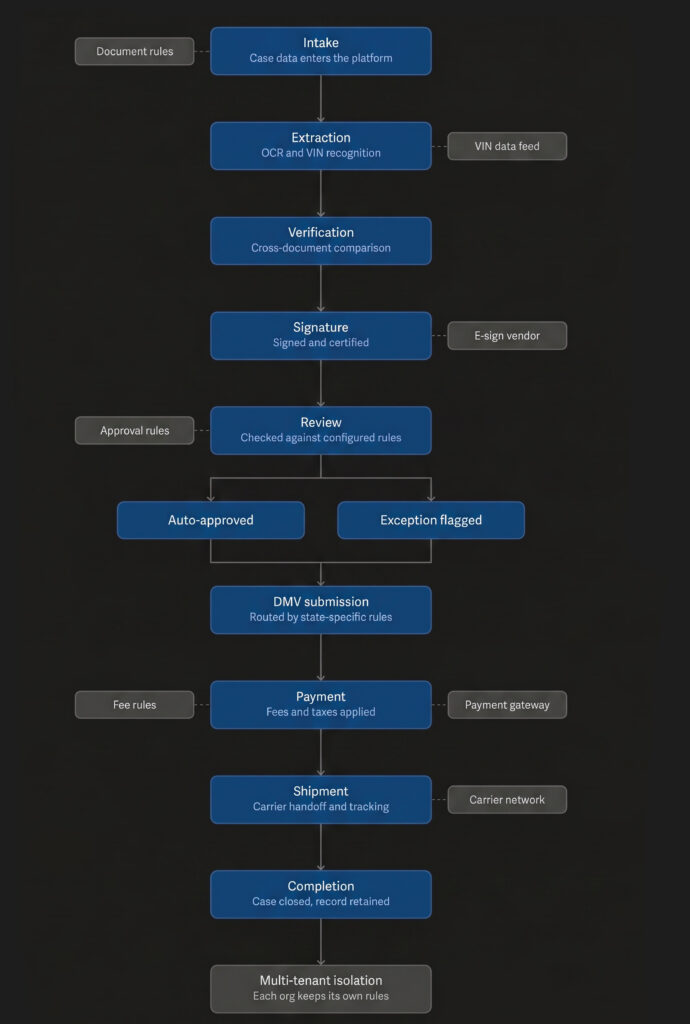
- A workflow engine that runs the full lifecycle: The workflow engine manages the end-to-end process, including intake, document extraction, validation, signature collection, DMV submission, payment processing, shipping, exception handling, and completion through configurable stages. Business users can adjust processing logic without software releases.
- AI-powered document processing: Uploaded titles, registrations, and supporting paperwork get read automatically: OCR, VIN recognition, field extraction, and cross-document comparison, mapped without touching application code.
- Business rules without a developer: Field visibility, required documents, fee and tax calculations, auto-approvals, and exception handling all live in configurable rule engines.
- True multi-tenant isolation: Every organization operates with isolated users, rules, identity providers, pricing, documents, and integrations while sharing a common platform.
- A deep bench of integrations: Payments, e-signature, shipping and tracking, vehicle title verification and automotive-data providers connect through the same platform instead of a patchwork of manual steps.
This configuration-first approach enabled the platform to evolve with changing regulations and customer requirements without creating long development cycles.
Configuration-Driven Rules Engine
Operational logic no longer litters the codebase. We centralized business behavior into configurable rule engines, enabling administrators to manage system actions entirely independent of development teams.
- Fee calculations: Every fee ties to state and transaction type, calculated automatically instead of pulled from memory or a spreadsheet.
- Tax rules: State and local tax logic lives in configuration, so a rate change never waits on a release.
- Document requirements: Required documents shift by state, transaction type, and organization, without touching code.
- Approval workflows: Multi-step approvals route by rule, matching how each state or customer actually reviews a transaction.
- State-specific exceptions: Edge cases and one-off state rules get handled as configuration, not special-case code.
- Auto-approvals: Transactions that meet defined criteria clear automatically, without waiting on a person.
- Validations: Field-level and cross-field checks catch errors before a transaction ever reaches a state agency.
The Engine Room
- A layered enterprise architecture keeps business rules, data access, and delivery in separate layers, so a change in one does not ripple through the rest.
- Read-replica databases keep reporting and high-volume reads off the primary transaction path.
- Distributed caching and background processing keep the platform responsive under real transaction load, beyond what a demo ever tests.
- Queue-based integrations through Azure Service Bus mean a slow third-party response never blocks a user on screen.
Keeping Every Organization's Data Its Own
- Role-based access control scoped to each organization’s own users and policies.
- Full logical isolation between tenants, on one shared codebase.
- API authentication, IP allow-listing, and signed webhooks on every external integration.
- Rate limiting and comprehensive audit trails, with a full change history on every significant action.
- Secrets held in secure, managed storage, never in source or plain configuration.
The Payoff
- Transaction volume grows without a matching increase in headcount.
- Manual data entry drops, since documents feed the system directly instead of being retyped.
- New customers and new states onboard in configuration time, not development time.
- Processing accuracy improves, since validation and cross-checks run automatically on every submission.
- Operational costs fall since the same team handles more volume more effectively.
- Regulatory changes are implemented through configuration rather than code, allowing the business to respond quickly without waiting for software releases.
Tell Us What You're Trying to Automate
Regulated, document-heavy operations rarely fail from a lack of effort. They fail from software that cannot keep up with changing rules. Ariel builds platforms where operators change the rules themselves, not the engineering team. We have done it for a nationwide title and registration business, we can do it for yours.
From vehicle title and registration platforms to lending, fleet management, document-intensive operations, and other regulated workflow systems, we build platforms that evolve as business rules change.