Business Messaging That Doesn’t Live or Die by One Carrier
- Business communication
- Messaging Platform
- 6 min read

Stat Strip
The Build, Boiled Down
Texting Customers Stopped Being Optional
Business messaging stopped being a nice-to-have. Customers expect to reach a business over SMS and MMS, on their own terms, while the business still needs oversight inside its own tools, like Microsoft Teams.
The platform’s original infrastructure could not keep up. It did not integrate deeply with modern enterprise stacks, and it ran on manual administrative work behind the scenes. The goal was a centralized portal for messaging, automated billing, and carrier connections that actually held up.
Four Problems One Platform Had to Solve at Once
- API fragmentation: Managing concurrent connections across two carriers, Twilio and Vonage, while keeping deliverability high and latency low for clients around the world.
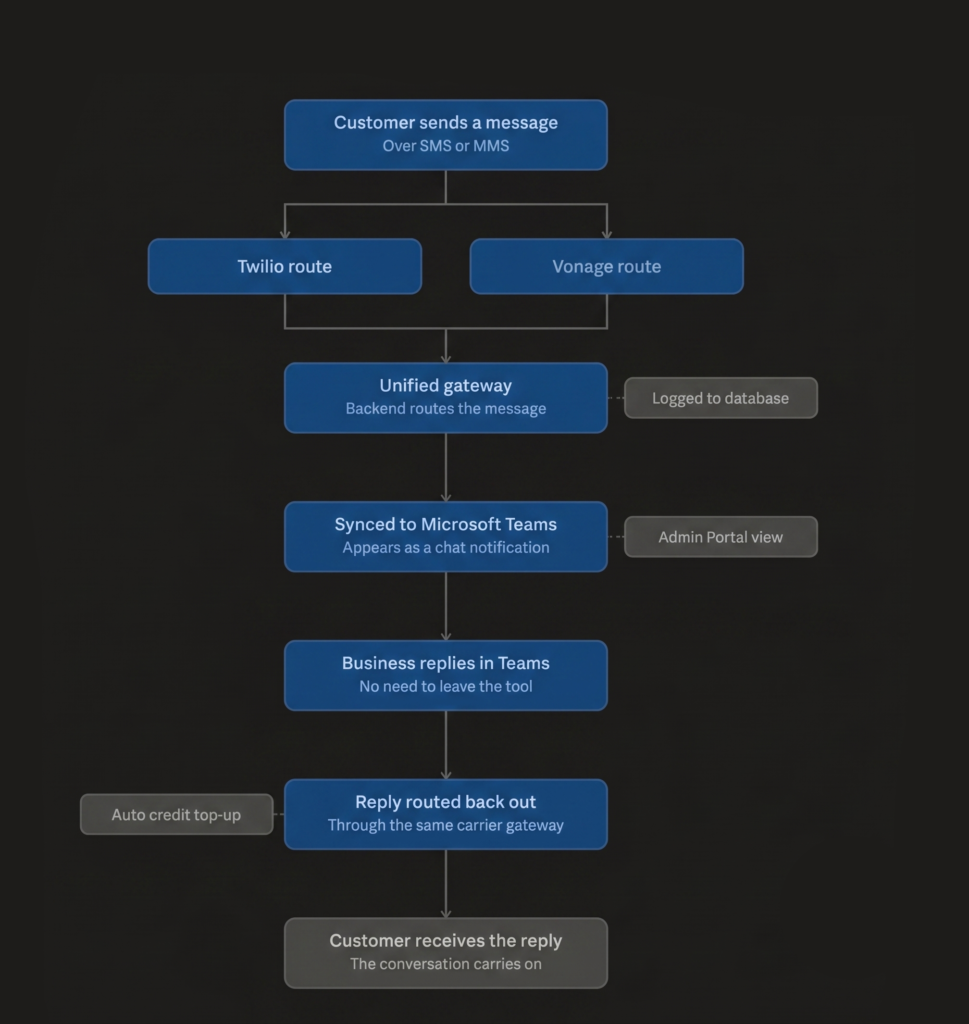
- Enterprise integration: Bridging SMS and MMS channels into Microsoft Teams, so a business could answer a customer without leaving its own collaboration tools.
- Monetization complexity: Building a secure subscription and usage-based billing system that fit cleanly into existing account management.
- Operational visibility: Giving IT managers a real way to monitor message volume, manage access, and oversee billing, without needing database-level access.
One Inbox for Every Channel and Carrier
The platform separates a high-performance messaging backend from an interactive React frontend, so each side can move at its own pace.
- Admin Portal: A role-based console where administrators provision business accounts, manage tenant settings, monitor delivery rates and volume, and manage carrier API credentials.
- Teams sync: A direct bridge into Microsoft Teams lets a user receive and reply to SMS messages the same way they handle an internal chat notification.
- Unified messaging gateway: A custom abstraction layer switches between Twilio and Vonage automatically, so a single carrier outage never breaks message delivery.
- Automated billing: Stripe Checkout and webhooks handle subscription events and credit top-ups in real time, so a business never runs short of balance mid-send.
Decoupled by Design
Splitting the messaging backend from the frontend this cleanly means the two can scale, deploy, and fail independently of each other.
Keys Nobody Can See, Data Nobody Can Cross
- Carrier API keys for Twilio and Vonage stay encrypted at rest, pulled from environment-level secret management instead of sitting in source code.
- Multi-factor authentication protects the Admin Portal, with JWT tokens securing every API call.
- A multi-tenant, database-level design keeps one business’s messaging data fully isolated from every other account.
What Changed Once the Rebuild Shipped
- Faster message processing: The move to a .NET and SQL Server architecture cut latency across the messaging pipeline.
- Faster account operations: The Admin Portal cut the time it takes to provision an account or troubleshoot an issue.
- Reliable delivery: The carrier abstraction layer kept messages flowing at high uptime, even when one provider had problems.
Bring Us Your Messaging Problem
Ariel modernizes messaging and communication platforms built to run on more than one carrier, one integration, and one billing model. It replaced a legacy system with something that scales, bills itself, and talks directly to Microsoft Teams. If your platform needs the same kind of rebuild, our team is ready to scope it.