
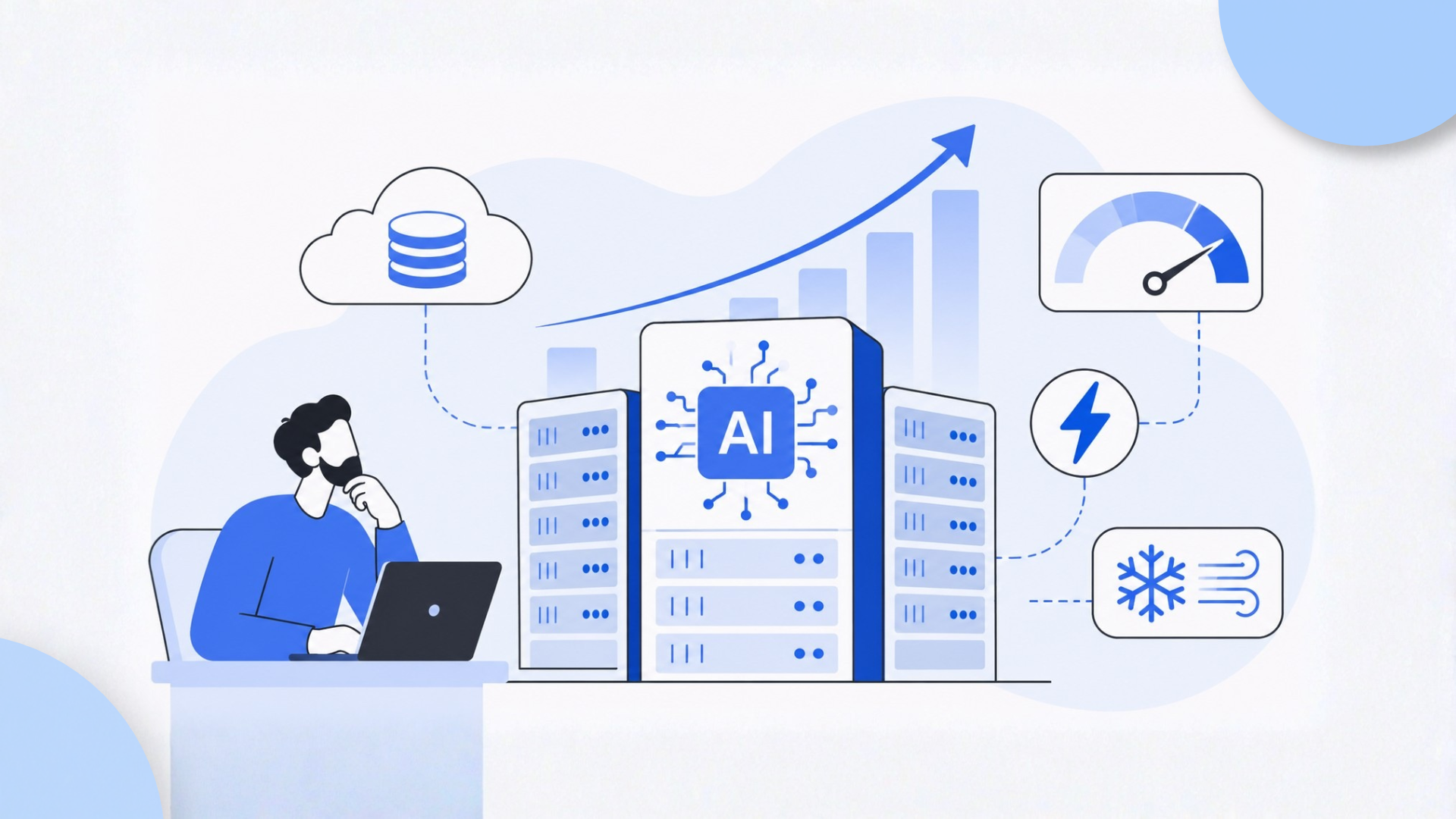
Artificial intelligence feels almost effortless. A customer gets an instant answer, a team summarises hundreds of documents, and software completes work that once took hours. Yet every interaction depends on physical infrastructure that needs electricity, cooling, and an increasingly capable power grid.
That is why data center energy consumption has become one of the most important questions surrounding AI’s expansion. According to the International Energy Agency (IEA), global data centres used approximately 485 terawatt-hours (TWh) in 2025, a figure projected to reach 950 TWh by 2030.
Meanwhile, some of the world’s biggest technology companies are reporting rising emissions despite major investments in cleaner energy.
Is AI creating an energy crisis, or revealing how unprepared our infrastructure is for its growth? The answer matters not only to governments and technology giants, but also to businesses deciding how to build and scale AI responsibly.
How High Is Data Center Energy Consumption Today?
The scale of AI data center energy consumption is growing quickly, but the figures require context. Data centres support everything from online payments and cloud storage to enterprise applications and AI models. Not all of their electricity use comes from artificial intelligence.
According to the IEA, total data-centre electricity demand grew 17% in 2025, considerably faster than the roughly 3% growth in global electricity demand. AI-focused facilities grew faster still, and their electricity consumption is projected to triple between 2025 and 2030.
| Global data-centre electricity | 2025 | Projected 2030 |
|---|---|---|
| Annual consumption | 485 TWh | 950 TWh |
| Share of worldwide electricity demand | Around 1.7% | Around 3% |
Source: IEA, Key Questions on Energy and AI (2026). These totals include AI and non-AI workloads.
A worldwide share of around 3% may sound manageable. The difficulty is that new facilities are concentrated in particular places. For a city already facing grid constraints, several large AI projects arriving together can be far more disruptive than the global percentage suggests.
Why Does AI Need So Much Power?
Traditional business software often retrieves stored information and follows predefined instructions. Generative AI can require extensive calculations to produce text, analyse documents, generate images, or plan a sequence of actions.
Three factors help explain rising AI energy consumption.
Training: Developing large models can involve thousands of specialised processors operating for extended periods. Training is intensive, although it is not the only source of demand.
Inference: Once a model is available, each user request requires computation. A single chatbot answer may use relatively little energy, but millions of conversations, searches, and enterprise workflows add up. More elaborate applications can also make several model calls to complete one task.
Supporting infrastructure: High-performance processors generate heat, so facilities need cooling, networking, storage, and electrical equipment. Data center power consumption therefore goes beyond the processors running the models themselves.
This changes the economics of computing. The relevant question is no longer simply how many servers a business needs, but how much useful work its chosen architecture delivers for the resources consumed.
Is AI Really Creating an Energy Crisis?
It would be misleading to predict a worldwide electricity shortage caused by AI alone. The more immediate concern is where new demand appears and whether local grids can accommodate it.
Data centres often cluster near strong connectivity, existing technical infrastructure, and investment hubs. Electricity networks, however, cannot always expand at the same speed. New generation facilities, transmission lines, and substations may take years to develop.
The IEA’s Electricity 2026 report identifies data-centre growth as an important driver of rising electricity demand, particularly in the United States. This can create grid connection delays and pressure for additional infrastructure investment.
That does not mean every new facility automatically increases household energy bills. Effects on electricity prices depend on utility regulation, grid capacity, generation choices, and who pays for upgrades.
The concern around data centre electricity usage is therefore increasingly regional. The central risk is concentrated demand growing faster than infrastructure. For policymakers, this is a planning challenge. For technology companies, it is a question of where and how to build. And for enterprises, it is another reason to examine whether every AI workload genuinely needs the computing resources allocated to it.
The AI Environmental Impact Goes Beyond Electricity
Electricity is only part of the AI environmental impact. Water use, carbon emissions, construction, and location can all change the footprint of a data centre.
Water: the overlooked resource
Some facilities use water directly for cooling. Electricity generation can also have an indirect water footprint. As AI infrastructure expands, the impact can become especially important in regions experiencing water stress.
The United Nations has highlighted research estimating that AI-related water demand could approach the equivalent of the annual basic domestic needs of 1.3 billion people by 2030. This is a projected comparison, not a claim that this amount of water is being taken from those people.
It also does not apply equally to every facility. Cooling methods, local climate, water availability, and electricity sources all matter. The same technology can create very different environmental pressures depending on where it operates.
Carbon: cleaner electricity matters
An AI workload powered by a relatively low-carbon grid has a different emissions profile from one supplied mainly by coal or gas. The IEA projects that emissions associated with data centres could roughly double by 2035, even while efficiency improves.
Buying renewable-energy certificates also does not necessarily mean a facility operates on carbon-free electricity every hour. The timing and location of electricity generation matter, particularly when companies make ambitious climate commitments.
Reducing data center energy consumption per task is valuable, but assessing sustainability requires looking at both total usage and the source of the power.
What Microsoft, Google, Amazon, and Meta Reveal
The companies building AI infrastructure are also investing in efficiency and clean energy. Their latest disclosures show why the transition is difficult: progress in one area can coexist with increased demand elsewhere.
| Company | Reported development | Why it matters |
|---|---|---|
| Microsoft | Reported a 25% annual increase in total Scope 1, 2, and 3 emissions in FY2025, citing data-centre expansion and changes in renewable-certificate accounting. | Growth can outweigh some emissions improvements. |
| Reported a 2% reduction in operational emissions in 2025 despite a 37% rise in electricity demand; supply-chain emissions increased. | Operational gains do not tell the whole story. | |
| Amazon / AWS | Reported improvements in facility power and water efficiency, including a global data-centre PUE of 1.14 for 2025. | Efficiency measures can improve infrastructure performance. |
| Meta | Reported a 45% increase in its net carbon footprint for 2025 while expanding clean-energy investments and reconsidering its 2030 net-zero timetable. | Fast expansion tests climate targets. |
Sources: Microsoft, Google, Amazon, and Meta. The companies use different reporting boundaries, so these figures are not directly comparable.
These disclosures should not be read as proof that sustainability efforts have failed. They illustrate a harder problem: energy efficiency can improve while total electricity consumption and emissions still rise if infrastructure expands faster than those gains.
The broader AI environmental impact cannot be judged using a single efficiency metric or corporate announcement. Assessments must distinguish a company’s total footprint from the performance of an individual facility.
Can Technology Make AI More Sustainable?
Better chips, more efficient model architectures, liquid cooling, and cleaner electricity are helping address parts of the problem. Smarter data-centre locations can also reduce strain on constrained power and water systems.
But there is a catch. When computing becomes cheaper, organisations may use more of it. This rebound effect means improved efficiency per request does not necessarily reduce overall demand.
That is why solving the problem requires two approaches at once: improving the infrastructure that powers AI, and making the applications running on it more efficient. The second is where businesses have direct influence.
What Should Businesses Do Before Scaling AI?
A successful AI pilot can conceal expensive architectural decisions. A feature that handles 100 requests a day may behave very differently when it processes 100,000. Rising API usage, repeated context, unnecessary model calls, and oversized cloud resources can quietly increase costs.
The following checks offer a practical starting point.
- Choose the model for the task, not the hype. Document classification or routine enquiries may not need the same model as complex reasoning. Compare accuracy, latency, reliability, and cost on representative business tasks before choosing.
- Reduce processing that adds no value. Repeated prompts, redundant tool calls, excessive context, and preventable retries consume resources. Remove unnecessary work before buying more capacity.
- Design for efficient inference. Caching, batching, retrieval optimisation, and model routing can help, provided quality, privacy, and responsiveness remain acceptable. A cheaper response is not useful if it creates more errors or requires extra attempts.
- Right-size cloud infrastructure. Match provisioned resources to actual workload needs. Review idle environments, continuous-running services, and capacity assumptions as usage changes.
- Measure cost per successful outcome. Track what it costs to resolve an enquiry, process a document, or complete a workflow rather than monitoring only token prices or request counts.
Consider a document-processing assistant: a single user request may trigger extraction, retrieval, model reasoning, validation, and a second model call after an error. Measuring only the price of the first model response misses much of the real workload. Mapping the full sequence exposes opportunities to remove duplication without weakening the result. This is an important part of managing data center energy consumption through better software design.
These choices will not solve grid congestion on their own. They can, however, prevent a business from contributing unnecessary demand while improving its AI economics.
For a deeper technical perspective, Ariel’s FinOps analysis explains how repeated context, multi-step agents, and retries affect production costs. A well-planned cloud approach also helps align infrastructure with actual business demand.
Before expanding an AI system, ask: Are we adding computing power because the business needs it, or because the application has not been designed efficiently?
The Future of AI Depends on How We Build It
The rapid rise in data center energy consumption does not mean organisations should abandon AI. It means the industry needs more responsible energy planning, and businesses need more deliberate software engineering.
The challenge is not simply to make AI models faster or data centres larger. It is to create systems that deliver useful outcomes without unnecessary processing, infrastructure, or expense.
At Ariel Software Solutions, we approach AI projects by examining the business process first, then assessing model selection, integrations, deployment requirements, and long-term scalability. Efficient architecture begins with knowing what the technology needs to achieve.
Is your AI solution ready to scale without avoidable costs?
Explore Ariel’s development capabilities and discuss your AI architecture with our team. We can help evaluate the next steps for an existing application or a new AI initiative.
Frequently Asked Questions
1. How much electricity do data centres use worldwide?
Global data centres consumed approximately 485 TWh in 2025, according to the IEA. Total consumption is projected to rise to about 950 TWh by 2030, including AI and non-AI workloads.
2. Is AI responsible for an energy crisis?
AI is intensifying electricity demand, especially around major data-centre clusters. The immediate concern is local grid capacity and the speed of infrastructure expansion, not an inevitable worldwide shortage.
3. What drives AI data center energy consumption?
Training large models, serving user requests through inference, and operating supporting cooling and electrical infrastructure all contribute. Actual usage varies by model, workload, hardware, and facility.
4. What is the biggest AI environmental impact?
There is no single answer. Electricity-related emissions, direct and indirect water use, and infrastructure construction all matter. Their relative importance depends heavily on location and technology choices.
5. How can businesses reduce AI energy consumption?
Businesses can evaluate smaller task-appropriate models, remove unnecessary calls, improve caching and retrieval, right-size cloud resources, and measure cost per successful business outcome. Environmental gains require separate energy and emissions measurement.