Rebuilding a Legal Filing Platform the Courts Couldn’t Afford to Pause
- Legal technology
- Court Filing Platform
- 11 min read

Stat Strip
The System at a Glance
A Legacy System Running Live Court Cases
Court filing is not standardized in the United States. Every state, and often every county, runs its own procedure for documents, deadlines, and filing methods. Court filing software built for this reality has to flex with each jurisdiction, not fight it. Legal-tech software development for this kind of operation has to standardize around that reality, not work around it.
The starting point was not a blank slate. Ariel took over a legacy legal-tech platform already running live court operations. The system held years of sensitive case data. Its codebase was old. Data structures varied from state to state and county to county. UI, business logic, and court-specific rules were tangled together in one layer.
None of that could pause. Every active eviction case, every filing deadline, and every client relationship depended on the system staying up while it was rebuilt underneath them.
Five Constraints With No Room for Trade-Offs
Modernizing a Regulated Business Workflow Platform this size meant satisfying five constraints at once, not choosing between them.
- Modernize without downtime: Live eviction and court workflows could not stop for the rebuild.
- Preserve every case’s history: Refactoring the code could not put a single historical case at risk.
- Normalize data across jurisdictions: Every state and county structured its filing data differently.
- Add real access control: Role-based security and audit trails had to fit into a structure that never had them.
- Scale without starting over: The platform needed room to grow into new counties and courts, without a full rewrite.
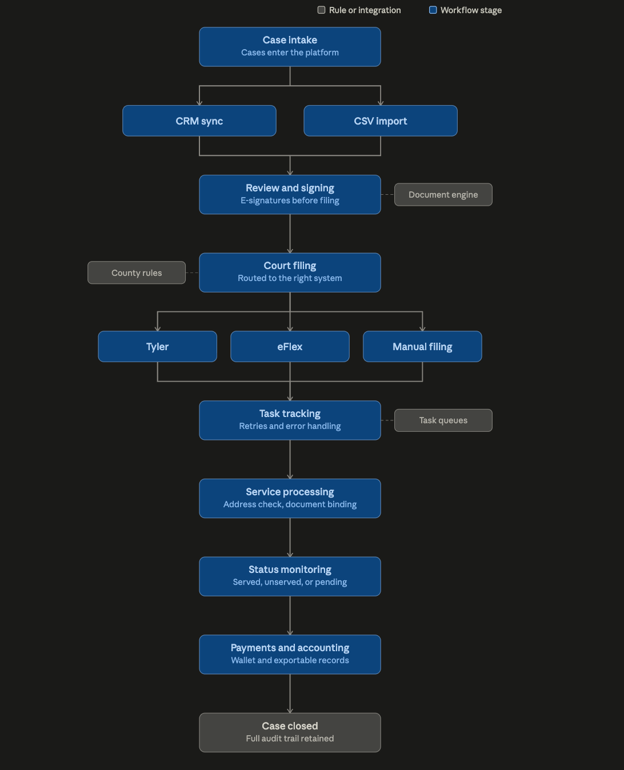
Every Filing, One Path
The result is court workflow automation across every jurisdiction the platform touches, backed by legal document automation instead of static templates.
- Centralized case lifecycle: Every eviction case moves through one structured, auditable path, from filing to service to close-out.
- Two intake paths: Cases sync automatically from CRM systems, or load through CSV import for legacy and external cases, fully editable after import.
- Role-based review and signing: Authorized signers review court-ready documents and apply compliant electronic signatures before anything reaches a court.
- Automated court filing: Signed filings route to the correct court system. Every submission generates a task for tracking, retries, or error handling.
- Service tracking built in: Filed cases move to process servers with address verification, document binding, and email delivery, all inside the platform.
- Task-driven queues: Filings separate by court, county, submission method, and processing stage. Operations teams prioritize work, recover failed submissions, and keep visibility across thousands of active cases.
- Service and status monitoring: Dedicated views track served, unserved, and pending cases, so compliance teams catch delays fast.
- Payments and accounting: Integrated payments, a company wallet, and exportable accounting records replace manual reconciliation.
- Full eviction action support: Evictions, dismissals, writs of possession, and amendments each follow their own validation rules inside one consistent workflow.
Jurisdiction Rules Engine
Rather than hardcode workflows per court, county-specific rules and validation logic live inside a configuration-driven jurisdiction engine. New counties plug into the same core application instead of forking it. The system stays consistent, scalable, and easier to maintain as jurisdictions get added.
Electronic Court Filing Integration
- Tyler: Electronic filing directly into supported county systems, with submission confirmation and filing status synchronization returned straight to the case record.
- eFlex: Filing transmission and status updates for eFlex-connected counties, kept in sync with the case timeline.
- Manual filing: A structured path for jurisdictions without an electronic filing API, so no county gets left out of the system.
Legal Document Automation
- Court-ready PDFs: Every filing renders into a properly formatted, court-accepted PDF, ready to submit without manual formatting.
- Dynamic document assembly: Documents build themselves from case data, instead of staff filling out static templates by hand.
- Amendment generation: Amended filings mark exactly what changed, so a court can see the edit against the original.
- Signature placement: Electronic signatures land in the exact spot a court expects, not a scanned-in approximation.
- Oath handling: Court-required oath language attaches automatically wherever the filing type requires it.
- Document version consistency: Every version of a filing stays traceable, so nobody works off an outdated copy.
- Supporting attachments: Exhibits and supporting documents bind to the correct filing automatically, instead of sitting as loose files.
Property and Accounting Integrations
- Yardi: Property management integration, syncing case activity with property records.
- RealPage: Property and tenant synchronization, keeping case data aligned with tenancy records.
- Google Address Verification: Address normalization, applied at intake and throughout the filing lifecycle.
- QuickBooks: Accounting and reconciliation sync, connecting case-level payments to the general ledger.
Electronic Court Filing Integration
The result is court workflow automation across every jurisdiction the platform touches, backed by legal document automation instead of static templates.
- Centralized case lifecycle: Every eviction case moves through one structured, auditable path, from filing to service to close-out.
- Two intake paths: Cases sync automatically from CRM systems, or load through CSV import for legacy and external cases, fully editable after import.
- Role-based review and signing: Authorized signers review court-ready documents and apply compliant electronic signatures before anything reaches a court.
- Automated court filing: Signed filings route to the correct court system. Every submission generates a task for tracking, retries, or error handling.
- Service tracking built in: Filed cases move to process servers with address verification, document binding, and email delivery, all inside the platform.
- Task-driven queues: Filings separate by court, county, submission method, and processing stage. Operations teams prioritize work, recover failed submissions, and keep visibility across thousands of active cases.
- Service and status monitoring: Dedicated views track served, unserved, and pending cases, so compliance teams catch delays fast.
- Payments and accounting: Integrated payments, a company wallet, and exportable accounting records replace manual reconciliation.
- Full eviction action support: Evictions, dismissals, writs of possession, and amendments each follow their own validation rules inside one consistent workflow.
The Court Integration Platform Behind It
The platform was designed as a modular legal-tech application where workflow orchestration, document generation, court integrations, and jurisdiction-specific business rules operate independently. This separation enabled incremental modernization while keeping the platform available throughout the migration.
Together, these pieces form a Legal Workflow Platform built to add new jurisdictions without a rewrite.
Regulated Workflow Software Built to Hold Up in Court
- Role-based access for Signers, Non-Signers, and Super Admins.
- Audit-friendly workflow transitions at every step.
- Secure document generation and storage.
- Court-compliant signature and oath handling.
- A clear line between preparing a filing and authorizing it.
Where the Real Engineering Happened
- No downtime during modernization: The platform was modernized piece by piece. Each piece shipped and stabilized before the next one moved. Active filings never stopped.
- Preserving case history while refactoring: Manual import kept every legacy case editable after load. Nothing had to be re-entered or lost in the transition.
- Normalizing data across jurisdictions: A centralized case lifecycle absorbed state and county differences. Jurisdiction-specific rules stayed local. The experience stayed consistent everywhere else.
- Adding access control to an aging structure: Role-based access and audit-friendly transitions were layered into the platform without disrupting how it already worked.
- Scaling without a rewrite: The modular architecture lets new counties and courts plug in as they’re added. No full rewrite required.
- Handling live production data throughout: Every change shipped against real, active cases. There was no safe copy to break instead. Rollouts moved behind feature flags and reversible migrations, so a bad deploy never touched a live filing.
The Result
Across the full Court Operations Platform, the change showed up everywhere at once.
- Manual preparation, submission, and reconciliation activities were significantly reduced through workflow standardization and automation.
- Court submission turnaround got faster.
- Rejection and rework rates fell.
- Operations teams gained consistent visibility into every filing regardless of jurisdiction or submission method.
- The platform now scales into new courts and counties without a rebuild.
Let's Modernize What You're Running On
Legacy legal systems rarely get the luxury of downtime. Ariel took over a live, multi-state filing platform and rebuilt it underneath active cases, without missing a deadline. If you are modernizing a legal-tech platform, integrating with court systems, or replacing legacy case management software, our team has experience delivering regulated, enterprise-grade solutions without disrupting live operations.