The Only Workflow That Moves People, Not Paperwork
- Affordable Housing
- AI-powered
- 6 min read

Stat Strip
Eleven Hundred Households, One System of Record
The Highest-Liability Work in Affordable Housing Still Runs on Paper
Rehabilitating occupied affordable housing means temporarily moving families out of their homes and moving them back. Every household is a legal obligation with statutory notice periods, documented consent, protected possessions, and a right to return.
A phased rehabilitation of 1,180 occupied units generates work that no leasing system was ever designed to hold.
Seven Problems No Leasing System Was Built to Hold
- Two rounds of survey, in the field: Needs, accessibility, medical equipment, pets, language, storage requirements, and unit condition, captured in the apartment, usually on a clipboard, often photographed on someone’s personal phone.
- Statutory notices on a moving schedule: Notices tie to construction phases that slip. Every slip re-triggers notice obligations, and a missed notice can halt a phase or invite litigation.
- Consent documents per household: Temporary move agreements, alternative accommodation acknowledgements, storage access waivers, resident-items inventories, and move acknowledgements: six to eight legally significant documents per family, each populated from survey data by hand.
- Logistics at scale: Movers, slots, keys, storage, inspections, and unit-condition evidence, coordinated across buildings, phases, and vendors.
- Evidence that must survive years of scrutiny: Relocation disputes surface long after the crews leave. Whoever cannot show what a household was told, when, and what they agreed to, loses.
- No live picture: Which households are surveyed, noticed, agreed, scheduled, moved, and returned: that answer is a spreadsheet three people maintain differently.
- A relocation failure outranks a construction delay: It stops the phase, triggers regulatory attention, and puts the financing behind the rehabilitation at risk.
From Clipboard to Controlled System
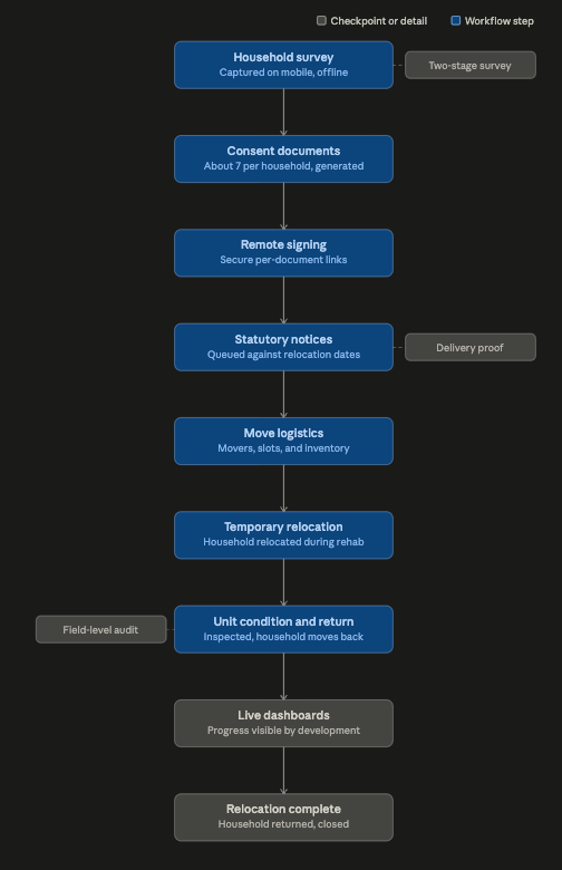
The survey gets captured once in the field, and every document, notice, schedule, and report downstream gets produced from it.
- Mobile, offline-capable surveys: Two-stage household surveys get completed in the apartment on a mobile device, including photographs and unit-condition media, and work without a signal, syncing when connectivity returns. Templates stay configurable per development.
- Every consent document generated from survey data: Temporary move agreements, relocation agreements, alternative accommodation acknowledgements, storage access waivers, resident-items inventories, and move acknowledgements get produced automatically from the household’s own answers, around seven documents per family, with no re-keying and no transcription errors.
- Token-based remote signing: Households sign through secure per-document links instead of a scheduled office visit. Signature events get recorded against the case with time, identity, and integrity information.
- Scheduled statutory notices with delivery proof: Notices get queued against building and unit relocation dates and dispatched by email, text, and physical mail with per-recipient delivery evidence, so a shifted construction phase re-drives the notice schedule instead of catching the team out.
- Move scheduling, movers, and inventory: Move slots, mover companies, bookings, household inventory, and storage get tracked as structured records, with move-checklist templates and due dates computed per household instead of tracked in someone’s head.
- Inspections and unit-condition media: Inspections and photographic unit-condition records get captured through the field app and attached to the case, the evidence base that settles damage disputes on return.
- Field-level audit trail: Every survey change gets logged individually: the field, its previous value, its new value, who changed it, when, and on which write path, including photo uploads, deletions, and signature events. A dedicated change-history view reconstructs any household’s record as a timeline.
- Live dashboards and weekly planning: Manager dashboards show survey progress, notice status, move acknowledgements, and temporary-move summaries by development and building, with weekly plans, per-specialist statistics, and automated reminders for approaching move dates.
- One-click evidence packages: Bulk survey downloads, spreadsheet exports, per-development reports, and secure token-based report links replace the week of assembly work that used to precede every agency or ownership request.
Every Step of the Move, Before and After
| Relocation step | Manual process | With the platform |
|---|---|---|
| Household survey | Paper in the field, retyped at the office | Captured once on mobile, offline-capable, with photos |
| Consent documents | About 7 documents per household populated by hand | Generated automatically from survey answers |
| Signatures | Office appointments and chased paperwork | Secure remote signing links, recorded per document |
| Statutory notices | Tracked on a spreadsheet against a moving schedule | Queued against relocation dates with delivery proof |
| Move logistics | Movers, slots, and keys coordinated by phone | Structured bookings, checklists, and computed due dates |
| Unit condition | Photos on personal phones, rarely filed | Captured in-app and attached to the case |
| Progress reporting | Competing spreadsheets, reconciled weekly | Live dashboards by development, building, and specialist |
| Audit and disputes | Reconstructed from files months later | Field-level change history, available immediately |
A Ten-Person Relocation Team Down to Three
A 1,180-unit phased relocation is conventionally staffed with ten relocation specialists and coordinators. With capture, generation, and tracking automated, three people run it.
| Conventional team, 10 people | 1 relocation manager, 4 field survey specialists, 2 document preparers, 1 notice and mail clerk, 1 move coordinator, 1 reporting analyst |
| AI-enabled team, 3 people | 1 relocation manager, 1 field specialist, 1 tenant-relations and exceptions specialist |
| Role | Manual load across the project | Absorbed by |
|---|---|---|
| Field survey specialists (3) | 2,360 surveys captured on paper, then retyped | Mobile capture with photos, no transcription step |
| Document preparers (2) | About 8,300 legal documents populated by hand | Automatic generation from survey data plus remote signing |
| Notice and mail clerk (1) | Statutory notices tracked and posted manually | Scheduled notice queue with delivery evidence |
| Reporting analyst (1) | Weekly progress reconciliation across spreadsheets | Live dashboards, exports, and automated reminders |
The one field specialist who remains is not doing a tenth of the surveys. They are doing the visits, while the platform removes the retyping, the document preparation, and the chasing that used to surround each visit. The people who stay are the ones a household actually needs to meet.
What Eight Thousand Documents Are Actually Worth
- 70% reduction in relocation staffing.
- About 8,300 legal documents generated, not typed.
- 0 transcription steps between field and file.
- 100% of survey changes individually attributed.
- Relocation delay is construction delay: Rehabilitation phases cannot start until the households in them are surveyed, noticed, agreed, and moved. Relocation sits on the critical path of the entire capital project. Every week removed from the relocation cycle is a week removed from the construction schedule, against a project where a week of delay gets measured in carrying costs, escalation, and lost subsidy timelines.
- The liability case is the strongest one: Relocation disputes get decided on records. With field-level change history, timestamped signature events, delivery-tracked notices, and photographic unit-condition evidence, an owner can show exactly what a household was told, what they agreed to, and what condition their unit was in, years later, in minutes. That is a direct reduction in litigation exposure and in the reserve typically held against it.
- Tenant experience becomes a regulatory outcome: Households that get clear notices, sign from home, and can see their own move date complain less, to the owner, to the agency, and to the press. In a sector where the next allocation depends on the last project’s reputation, a quiet relocation is a commercial asset.
- Institutional memory survives the project: Relocation teams get assembled per project and dissolved afterward, taking the knowledge with them. Here, the process, templates, rules, and evidence stay in the platform, so the next phase, and the next building, start competent.
- Demand is guaranteed: Every rehabilitation of occupied affordable housing needs this, and the national pipeline of aging subsidized stock guarantees demand.
- Templates and surveys are configurable: A new jurisdiction’s notice regime gets set up, not built.
- It shares the platform’s infrastructure with the other modules: The same document, signature, notification, and audit infrastructure runs underneath lease-up, recertification, and re-rentals: one system of record across the entire tenant lifecycle.
Move a Thousand Households Without Losing a Single Record
Ariel builds the systems affordable housing teams run their highest-liability work on. If you are planning or midway through a rehabilitation of occupied housing, our team can show you the full relocation lifecycle: field survey, generated agreements, remote signing, notice scheduling, move logistics, and the audit trail, running against your own templates and phase plan.
Figures in this case study model a reference phased rehabilitation of 1,180 occupied units. They illustrate the operating leverage of the module rather than one named client’s result. Actual outcomes vary with project size, phasing, jurisdiction, and notice regime.