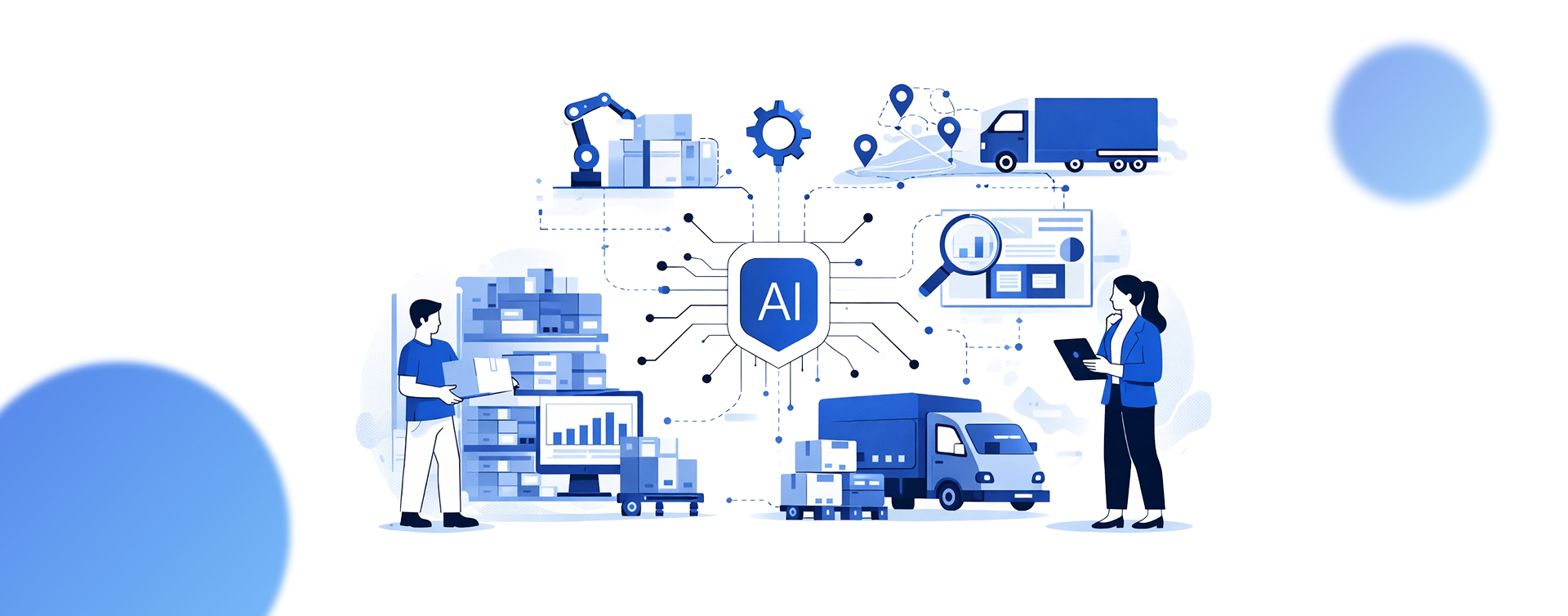
Key Takeaway: AI in supply chain management reduces forecast errors by 20-50% and logistics costs by 5-20% for companies that fix data quality and workflows before deploying models. The global AI supply chain market was valued at $5.05 billion in 2023 and is projected to reach $51.12 billion by 2030 at a 38.9% CAGR.
Supply chain AI spending is about to explode. SCM software with agentic AI capabilities will grow from under $2 billion in 2025 to $53 billion by 2030, according to Gartner’s April 2026 forecast.
That money is chasing proven results. McKinsey’s research shows AI-driven forecasting reduces supply chain errors by 20-50%, cuts lost sales by up to 65%, and lowers warehousing costs by 5-10%. And 64% of supply chain leaders now say AI and Gen AI capabilities are important or very important when evaluating new technology investments.
This guide will break down the top supply chain AI use cases producing real results, the benefits backed by data, and a practical AI supply chain implementation path for 2026.
Top 5 Supply Chain AI Use Cases That Are Producing Measurable Results
AI in supply chain management delivers measurable ROI across five operational areas: demand forecasting, inventory control, logistics routing, supplier risk monitoring, and warehouse automation. The common thread is that each use case works best when the underlying data is clean, and the workflow is well-documented before any model is deployed.
1. Demand Forecasting and Planning
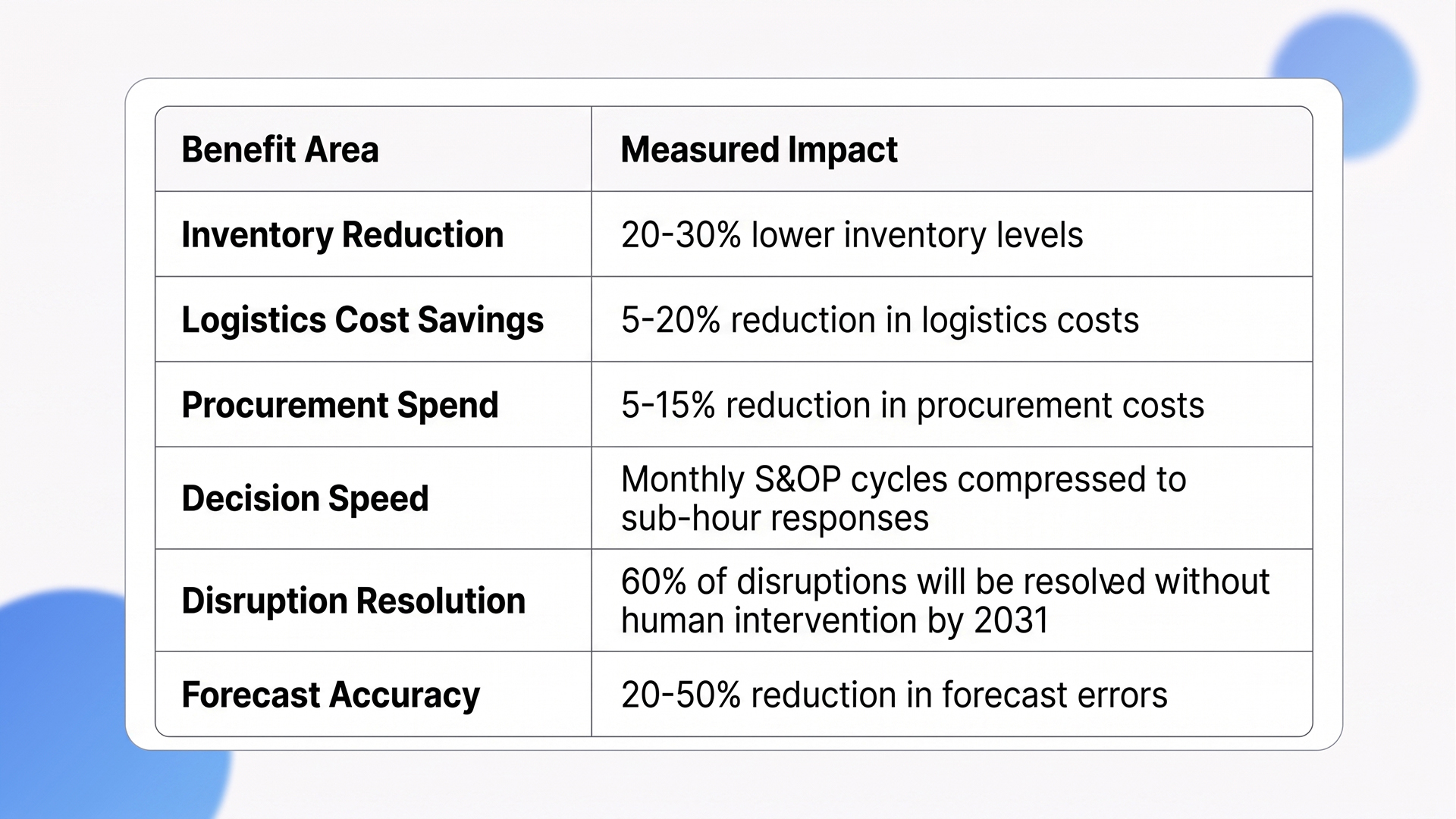
AI-driven demand forecasting reduces forecast errors by 20-50% compared to traditional spreadsheet methods, according to McKinsey. The same research found that this accuracy improvement translates into up to a 65% reduction in lost sales and product unavailability.
The performance gap between AI and traditional methods comes down to variable processing. Spreadsheet-based models use 3-5 inputs: historical sales, seasonality, and manual adjustments. AI models process 20-40 variables simultaneously: weather patterns, social sentiment shifts, competitor pricing changes, promotional calendars, and regional demand signals. One agribusiness used C3 AI to convert weekly data into daily forecasts across 88 SKUs, improving gross margin by $30 million.
That shift from weekly to daily granularity is what separates functional demand forecasting AI from spreadsheet guesswork. It is also where the ROI concentrates fastest for first-time AI deployments.
2. Inventory Optimization
AI-driven inventory systems continuously recalculate safety stock levels based on three inputs that traditional methods handle poorly: real-time sell-through rates, lead time variability from each supplier, and supplier reliability scores weighted by recent performance. The result is a dual-sided correction. Overstocking drops because the system detects slowing demand before excess accumulates. Stockouts drop because the model adjusts reorder triggers based on actual lead-time distributions rather than fixed averages. McKinsey data confirms AI reduces inventory levels by 20-30% for distributors that deploy these systems at scale.
3. Route Optimization and Logistics
McKinsey’s research on AI in distribution operations shows logistics cost reductions of 5-20% through AI-powered route optimization and load consolidation.
AI in supply chain management recalculates delivery paths using live traffic data, fuel cost fluctuations, weather disruptions, and delivery window constraints. The difference from static routing is speed: when a port delay or weather event hits, AI recalculates routes for entire fleets in seconds rather than hours. At enterprise scale, a 5-20% logistics cost reduction translates to tens of millions annually. That is not optimization at the margins. That is a structural cost advantage.
4. Autonomous Supplier Risk Management
76% of supply chain professionals see clear potential for agentic AI logistics in supplier relationship management, making it the top-ranked use case for autonomous AI agents.
Supply chain automation through agentic AI compresses the traditional quarterly supplier audit cycle to continuous monitoring. AI agents extract supplier data, pre-populate risk assessments, and flag remediation needs without human intervention. They detect financial instability signals, compliance gaps, and delivery pattern deterioration in real time.
The practical value: instead of discovering a supplier is failing during a quarterly review, the system flags the risk weeks earlier, giving procurement teams time to qualify alternatives before the disruption hits production.
5. Warehouse and Fulfillment Automation
Warehouse AI adoption is accelerating. AI-powered picking robots and autonomous mobile robots grew from 14% adoption in 2022 to 32% by 2026 in warehouse settings, making robotics one of the fastest-growing technologies in material handling.
AI in warehouse operations goes beyond physical automation. Computer vision systems handle quality control and error detection. Digital twin models simulate facility layouts and labor allocation on an hour-by-hour basis, improving capacity utilization without new real estate. A major logistics provider used an AI-powered digital twin to increase warehouse capacity by nearly 10%, analyzing the labor and assets needed to complete operations on an hourly basis and predicting the impact of changes in material flows.
“Beyond logistics, AI-driven automation is transforming broader corporate workflows, an evolution we explore in AI-Powered Automation in Business Processes, detailing how intelligent systems eliminate manual overhead and optimize productivity throughout the entire enterprise.”
From forecasting to warehouse automation, these supply chain AI use cases share one pattern: the highest ROI comes from use cases with clean, structured input data and well-documented workflows.
Benefits of AI in Supply Chain Management (With Numbers)
The measurable benefits of AI in supply chain management cluster into three categories: cost structure improvement, decision speed, and disruption absorption. The data below focuses on outcomes distinct from the use case metrics covered above.
Benefits at a Glance:
1. Cost Reduction and Revenue Gains
Predictive analytics supply chain models also open a revenue-side benefit that cost metrics miss. They identify demand signals from search trends, social sentiment, and competitor pricing that manual planning overlooks. These signals convert into captured revenue: products positioned in the right warehouse before demand spikes, promotional inventory sized correctly before campaigns launch, and stockouts prevented at distribution points where historical data shows the highest lost-sale rates.
2. Faster Decision-Making
AI is compressing supply chain decision cycles from monthly reporting lags to sub-hour responses. The old model relied on monthly S&OP cycles where decisions were already outdated by the time they reached execution. Supply chain visibility powered by real-time analytics flips that sequence.
AI flags anomalies within minutes, recommends corrective action, and in some systems, executes low-risk adjustments autonomously. That speed difference is what separates companies that absorb disruptions from those that get buried by them.
3. Disruption Resilience
Gartner predicts 60% of supply chain disruptions will be resolved without human intervention by 2031. A Gartner survey of 509 supply chain leaders found that changes in ways of working driven by AI and agentic AI will be the most influential driver of future supply chain performance over the next two years.
AI-powered risk monitoring detects supplier failures, port congestion, and geopolitical risks before they hit operations. The practical value: automated early-warning systems that trigger contingency plans while human operators still have time to act. Companies building this resilience layer now are the ones that will absorb the next major supply shock without scrambling for manual workarounds.
The benefits are proven. The question is why most organizations fail to capture them.
Why Most AI Supply Chain Implementation Projects Fail
Most AI supply chain implementation projects fail not because the technology underperforms, but because companies deploy models on top of broken processes, fragmented data, and untrained teams. The gap between AI adoption and AI value is wide and well-documented.
1. Data Governance Is the Real Constraint, Not Model Capability
Up to 95% of GenAI initiatives struggled to deliver sustained ROI, with fragmented data, siloed systems, and undocumented workflows as root causes. However, this figure has drawn criticism from several analysts who questioned its methodology and sample scope.
Regardless of the exact number, the directional finding holds: the majority of AI pilots stall. Data governance supply chain readiness is the actual bottleneck. Companies that automate broken processes instead of redesigning workflows first get faster broken processes. That is not a technology problem. It is an operational problem.
2. The Trust Gap Is Blocking ROI
A quarter of executives say trust gaps are their biggest hurdle to ROI from AI. Organizations that skip change management and employee training end up with tools nobody uses.
Planners who do not trust AI recommendations override them, and the system becomes expensive shelfware. Trust is not built by buying better software. It is built by involving end users from the pilot stage onward and demonstrating accuracy on low-risk decisions before widening the scope.
3. Scaling From Pilot to Production
Only 10% of logistics companies have fully scaled generative AI beyond the pilot stage. BCG’s research shows the differentiator is not the technology itself but how planners apply capabilities when evaluating tradeoffs and responding under pressure.
“Implementing supply chain AI requires a robust backend capable of processing real-time signals, an evolution explored in our guide, Future of ERP 2025: AI & Machine Learning, for smarter enterprise resource management.”
Gartner’s own analysis echoes this concern. Enterprise deployments of AI-driven SCM lag behind the general availability of AI capabilities from software providers, primarily because of gaps in data management, operations management, and workforce AI-readiness. Scaling requires organizational readiness: clean data pipelines, trained operators, and clear success metrics. Without those, a successful pilot stays a pilot.
Understanding failure patterns is step one. Building the right implementation path is step two.
A Practical AI Supply Chain Implementation Roadmap for 2026
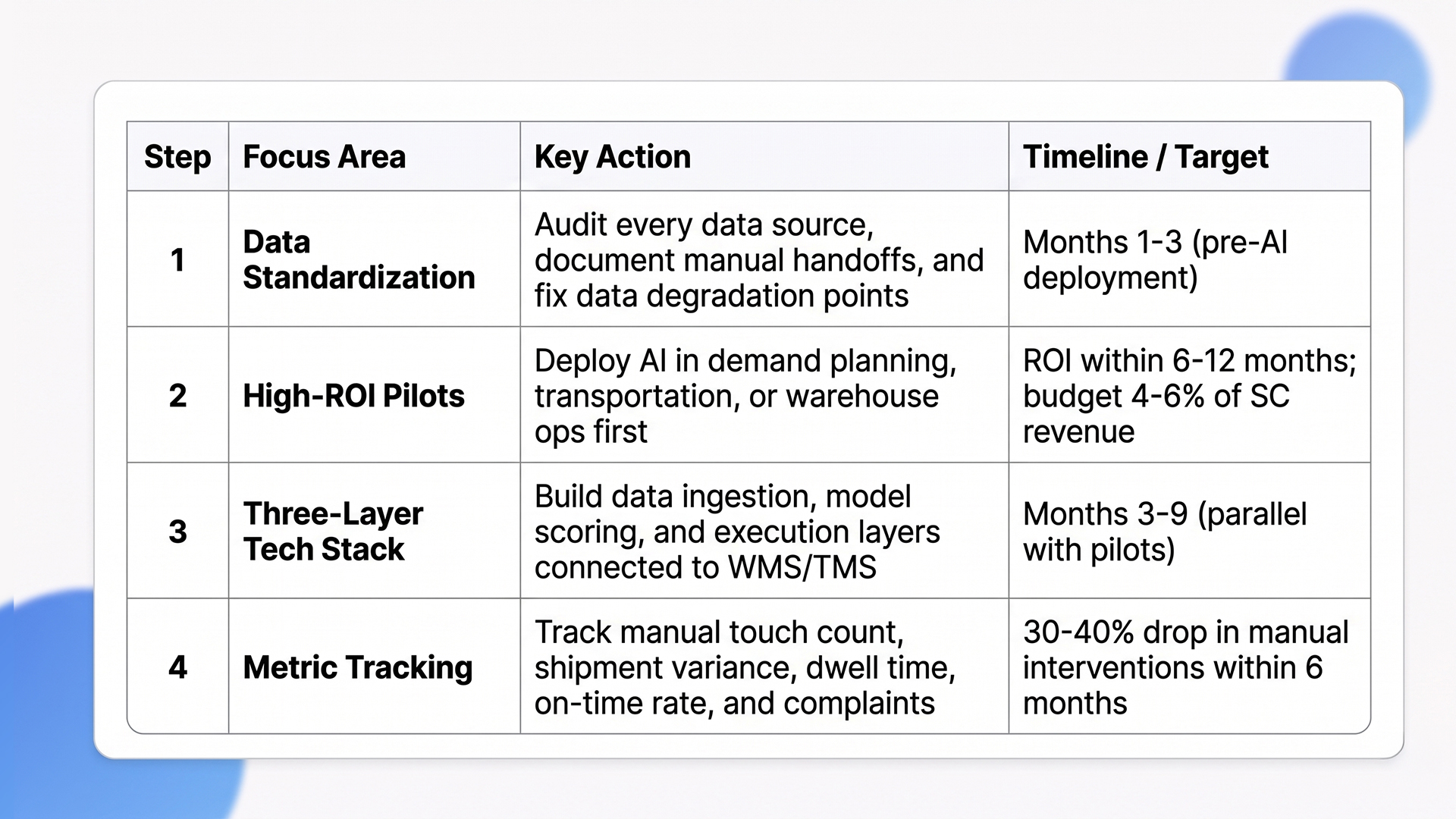
A successful AI supply chain implementation follows four stages: data standardization, high-ROI pilots, tech stack architecture, and metric tracking from day one. Each stage has a clear objective and timeline, and skipping any one of them is how the 90% failure rate happens.
Implementation Roadmap at a Glance
Step 1: Standardize Data and Processes Before Automation
Map every data source. Document every manual handoff. Identify where data degrades between systems. This step is not optional. It is the difference between the 10% of projects that scale and the 90% that stall.
Gartner’s guidance is explicit: leaders should focus change management investments on data management, operations management, and workforce AI-readiness before increasing AI autonomy. Companies that skip data normalization deploy AI on top of a broken foundation. The model learns the wrong patterns, and every downstream decision inherits those errors.
Step 2: Start With High-ROI Pilots
Prioritize pilots in demand planning, transportation management, and warehouse AI operations. These three functions generate the fastest ROI within a 6-12 month window because they have the most structured data, the clearest success metrics, and the least organizational resistance to AI-driven recommendations.
“To transform supply chain complexity into a strategic advantage, firms need more than off-the-shelf tools, a concept we explore in Custom AI Solutions for Business Growth to drive long-term expansion.”
Budget guidance: allocate 4-6% of annual supply chain revenue for pilot-year AI investment. For a $1 billion company, that means $40-60 million in year one. Start with one function, prove ROI within two quarters, then expand.
Step 3: Build a Three-Layer Tech Stack
The architecture for production-grade AI in supply chain management requires three layers:
- Data ingestion layer: Captures IoT and telematics signals from across the supply network, normalizes them into a common schema, and feeds them into a central data lake.
- Model scoring layer: Runs prediction, anomaly detection, and scenario modeling. This is where demand forecasting, risk scoring, and route optimization models operate.
- Execution layer: Connects to WMS/TMS for automated action on model outputs. The model recommends that the execution layer act, and the system logs outcomes for continuous learning.
Digital twins sit across all three layers, simulating supply chain scenarios before committing resources. The logistics provider that increased warehouse capacity by 10% without new real estate used exactly this architecture.
Step 4: Track Five Operational Metrics From Day One
Measure what matters from the first deployment:
- Manual touch count (target: 30-40% reduction within six months)
- Shipment variance (target: 15-25% reduction)
- Dwell time
- On-time delivery rate
- Customer complaint volume
If you are not tracking these metrics from day one, you have no way to prove the system is working. And without proof, you lose the executive support needed to scale from pilot to production.
With the roadmap clear, the next question is who builds the infrastructure behind it.
How Ariel Software Solutions Turns Supply Chain Complexity Into a Competitive Advantage

The #1 failure point in supply chain AI is deploying models on dirty data and broken processes. Ariel Software Solutions addresses this head-on. Our engineering teams start every engagement with a data quality audit and workflow mapping exercise before writing a single line of AI code. That sequence matters because it eliminates the root cause behind 90% of failed AI pilots.
With 15+ years of production-grade delivery across logistics, healthcare, and financial services, We have built over 1,100 projects for 800+ clients across 6 continents. Our process connects fragmented supply chain data into a unified, AI-ready infrastructure by integrating real-time analytics, predictive models, and automated workflows directly into existing ERP, WMS, and TMS systems.
Three capabilities make this work for AI in supply chain management:
- Legacy system modernization: Migrates outdated architectures to cloud-native, AI-ready infrastructure without disrupting live operations.
- AI-first architecture: Assesses where AI, ML, or generative AI can reduce cost or improve accuracy before development begins.
- Post-launch optimization: Ongoing model tuning, performance monitoring, and security patches keep systems accurate after deployment.
Talk to Ariel’s engineering team about building your AI supply chain foundation.
Conclusion
AI in supply chain management is no longer a pilot-stage experiment. The companies extracting real value are the ones that standardize data, redesign workflows before deploying models, and start with use cases that return measurable ROI within 6-12 months.
The technology works. The gap is in execution, data readiness, and organizational trust. Organizations that fix the foundation first will outperform those chasing tools without structure.
Ready to assess your supply chain data readiness? Let’s talk. Ariel Software Solutions builds AI-ready supply chain infrastructure from the data layer up.
Frequently Asked Questions
1. How is AI used in supply chain management?
AI is used across demand forecasting, inventory optimization, route planning, supplier risk assessment, and warehouse automation. Over 80% of enterprises plan to use AI across these functions, with demand forecasting and inventory management as the most common starting points. The primary application is decision support, where AI generates recommendations based on real-time and historical data. (ABI Research, 2025)
2. What is the ROI of AI in the supply chain?
McKinsey’s research shows AI reduces forecast errors by 20-50%, inventory levels by 20-30%, and logistics costs by 5-20% for companies that deploy at scale. (McKinsey, 2024) 95% of AI pilots fail to deliver measurable returns when data governance, supply chain readiness, and process redesign are skipped.
3. What are the biggest challenges of implementing AI in supply chains?
The top three challenges are fragmented data across systems, a lack of standardized workflows, and insufficient employee training. A quarter of executives cite trust gaps as the primary barrier to ROI, and 54% prefer AI to recommend rather than decide autonomously. (SCMR, March 2026) Only 10% of logistics companies have scaled generative AI beyond the pilot stage. (BCG, February 2026)
4. What is agentic AI in the supply chain?
Agentic AI logistics refers to autonomous AI agents that perform tasks like supplier evaluation, shipment rerouting, and reordering without human oversight. Gartner forecasts that by 2030, 60% of enterprises using SCM software will have adopted agentic AI features, up from 5% in 2025. Supplier relationship management is the top-ranked use case, with 76% of professionals seeing clear potential. (Gartner, April 2026)
5. How much should a company invest in AI for the supply chain?
Industry benchmarks suggest allocating 4-6% of annual supply chain revenue for pilot-year AI funding, scaling to 8-12% during multi-site rollout. For a $1 billion company, that means $40-60 million in year one. Demand planning, transportation, and warehouse AI operations offer the fastest ROI within 6-12 months. (GetTransport Survey, 2025)
6. Can small businesses use AI in supply chain management?
Yes. A Researchscape survey of 514 supply chain leaders shows growing adoption at all company sizes, with cloud-based AI tools and pre-configured SaaS models lowering the entry barrier. (DC Velocity / Researchscape, 2026) Small businesses typically start with demand forecasting, AI, and inventory optimization, which require the least infrastructure investment and deliver returns within months.