

The global SaaS market is on track to hit 375.57 billion in 2026 at a 18.7% CAGR. That growth is pulling thousands of new products into an already crowded market, and founders who underestimate SaaS development costs run out of runway before they find product-market fit.
Here’s the problem: most initial vendor quotes cover development hours only. Design, QA, DevOps, and post-launch maintenance together add 40-60% on top of the base build. A project quoted at $80,000 can easily land at $130,000-$150,000 once those line items surface.
This guide breaks down SaaS development cost by stage, team model, and hidden expenses, with 2026 rate data and verified sources for every number.
Note: The cost ranges mentioned in this blog are industry-wide estimates based on publicly available data and market benchmarks. They do not represent the actual pricing of Ariel Software Solutions. Every SaaS project is scoped individually based on complexity, compliance needs, integrations, and delivery model. For an accurate estimate, [book a free consultation].
What Determines SaaS Development Cost in 2026?
SaaS development cost depends on three primary drivers: product complexity, compliance requirements, and technology stack choices. These factors shift a project from a $25K MVP to a $500K+ enterprise build.
1. Product Complexity and Feature Scope
A basic SaaS with login, storage, and dashboards costs a fraction of a platform that requires AI, real-time analytics, or multi-tenancy. A production-ready SaaS with polished dashboards and billing systems costs $40,000-$120,000 with a 6-9 month timeline.
The gap between “basic” and “production-ready” is where most founders miscalculate. They budget for core features but forget that payment processing, role-based access, and notification systems each add weeks to the timeline and thousands to the SaaS development cost.
2. Compliance and Security Requirements
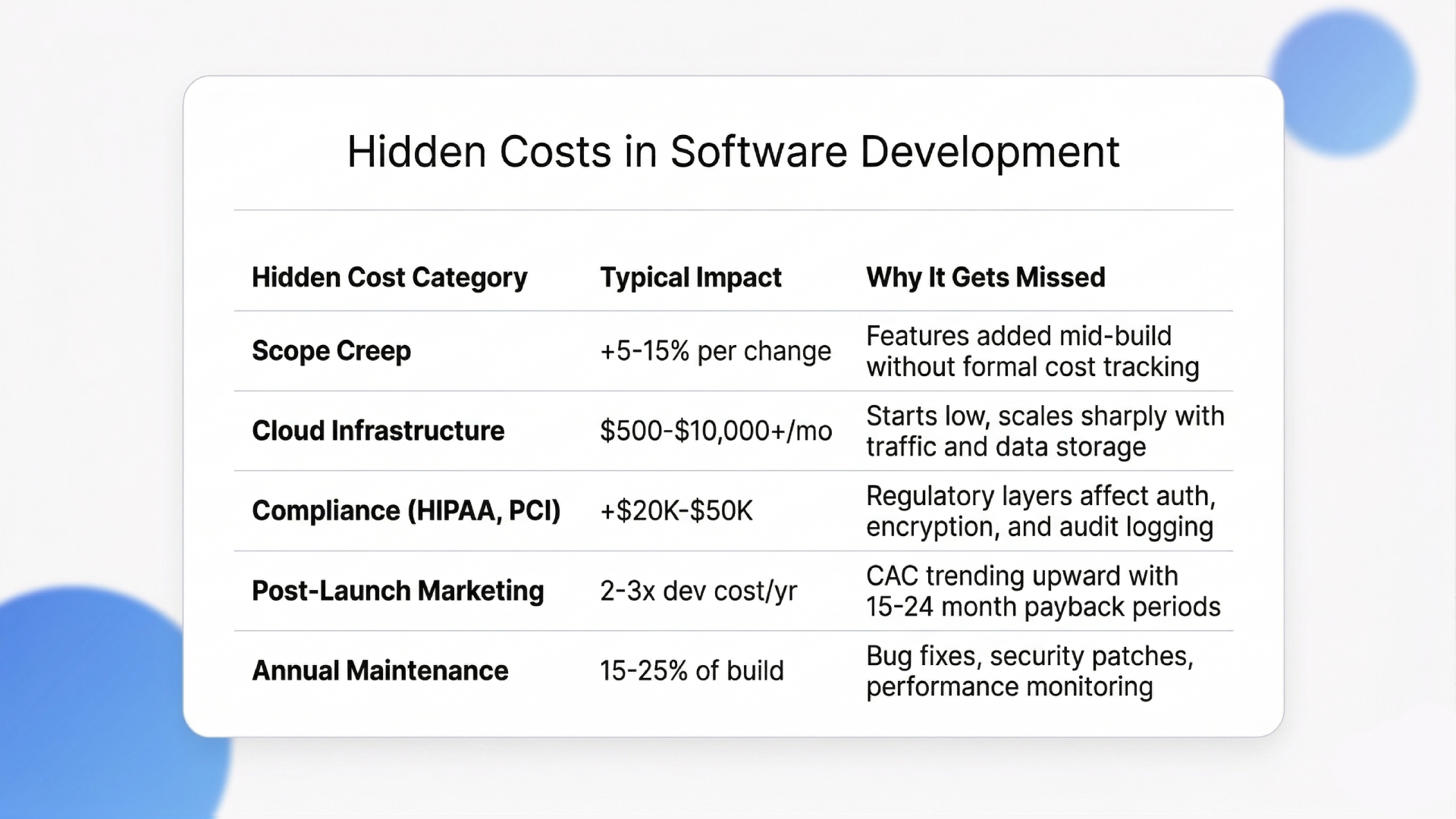
HIPAA, GDPR, and PCI-DSS compliance can add $20,000-$50,000 to the base SaaS development cost. FinTech SaaS rarely comes in below $75,000 for a lean MVP because regulatory layers touch authentication, data storage, encryption, and audit logging.
Skipping compliance upfront and retrofitting later costs 2-3x more. If your product handles health, financial, or personal data, bake the compliance budget into your SaaS project estimation from day one.
3. Technology Stack and Third-Party Integrations
Choosing between AWS, Azure, and GCP affects both upfront setup and long-term SaaS infrastructure pricing. Each third-party API integration (payment gateways, CRMs, communication tools) adds complexity and recurring costs.
Lock your stack decisions during discovery, not mid-build. Switching providers after development starts is one of the fastest ways to inflate your SaaS development cost and SaaS project estimation with zero feature progress to show for it.
“Before locking your SaaS budget, make sure your product roadmap covers every critical step. Our Build an AI SaaS Product Checklist breaks down the full pre-development process.”
Understanding cost drivers helps, but you also need to know where your money goes at each project stage.
SaaS Development Cost Breakdown by Project Stage
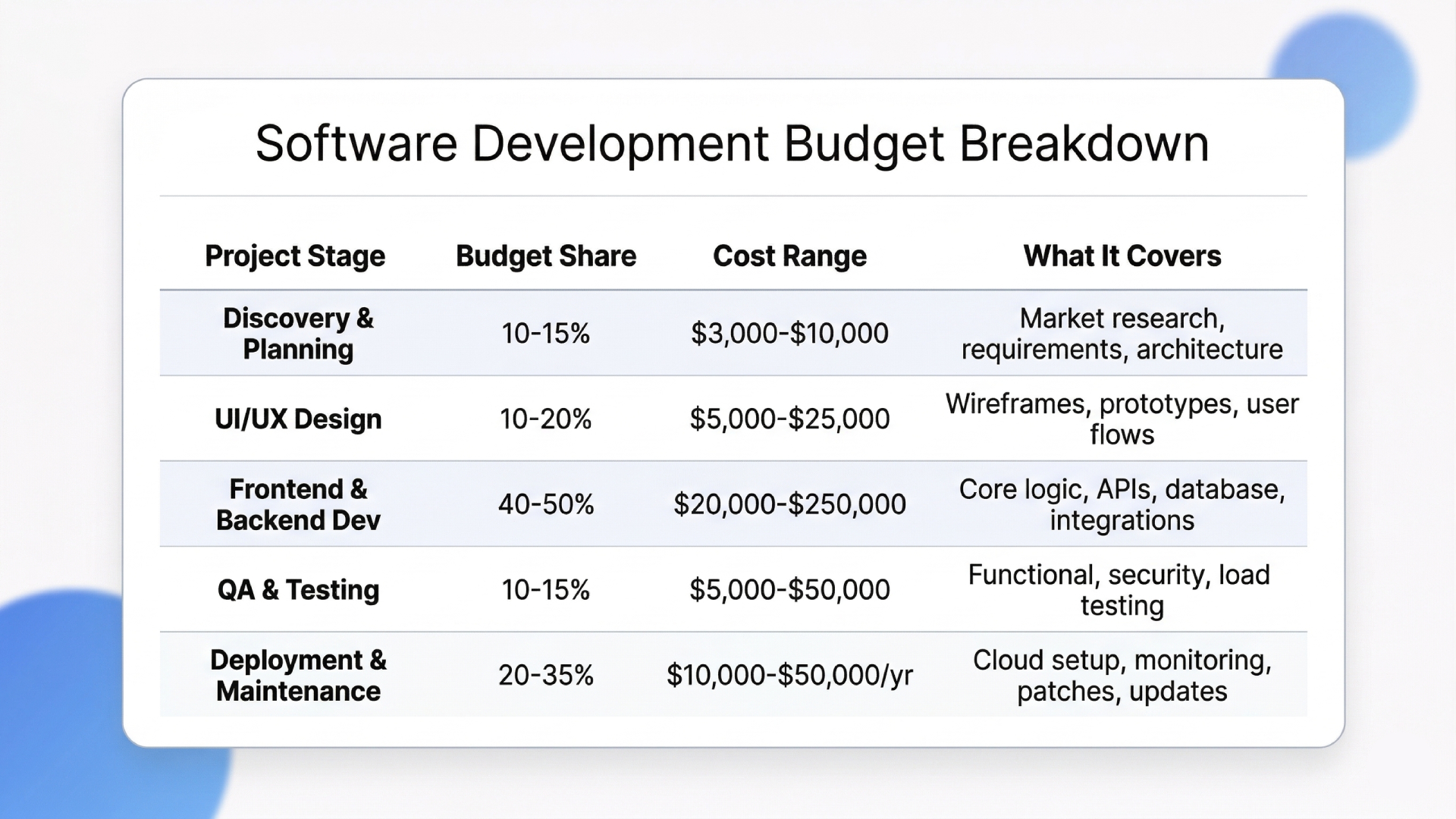
A typical SaaS development cost splits across five phases: discovery (10-15%), design (10-20%), development (40-50%), QA (10-15%), and deployment plus maintenance (20-35%). Knowing these ratios prevents budget surprises.
Quick Cost Glance: SaaS Development by Stage
Project Stage #1. Discovery and Planning (10-15% of Budget)
A discovery phase costing $3,000-$10,000 upfront typically prevents rework that costs 3x that amount later. This phase covers market research, requirements documentation, and architecture planning. For teams evaluating the full cost to build a SaaS platform, discovery is the highest-ROI budget line.
Founders who skip discovery to save $5,000 end up spending $15,000-$30,000 on mid-build pivots. The SaaS MVP costs balloons when requirements are unclear from the start.
Project Stage #2. UI/UX Design (10-20% of Budget)
Wireframes, prototypes, and user flows eat 10-20% of your SaaS product budget. Poor UX drives churn, and monthly support and maintenance alone can range $10,000-$20,000 post-launch. Investing in design upfront reduces those downstream costs.
Project Stage #3. Frontend and Backend Development (40-50% of Budget)
Core logic, APIs, and database architecture consume the largest share of SaaS development cost. This is where your cloud software development expense concentrates. For a mid-complexity platform, expect 3-5 months of active development with a team of 4-6 engineers. Teams building a lean product can keep SaaS MVP cost lower by shipping core features first and adding integrations in phased releases.
Project Stage #4. Testing, Deployment, and Post-Launch Maintenance
QA takes 10-15% of the budget. Deployment and cloud setup add another 5-10%. Annual SaaS maintenance cost runs 15-25% of total build cost. A $200,000 build means $30,000-$50,000 per year in ongoing expenses.
“For teams building beyond SaaS, the same budgeting logic applies to custom software. Our Software Development Cost Estimation guide covers the full methodology.”
Key figure: A $200,000 SaaS build carries $30,000-$50,000 in annual maintenance. Over a 3-year cycle, post-launch costs can exceed the original SaaS development cost.
With stage-level budgets mapped, the next variable is who actually builds it.
How Team Model Affects SaaS App Development Pricing
SaaS app development pricing varies by 40-200% depending on whether you hire in-house, outsource to an agency, or use a hybrid model. The right team structure directly controls your per-hour burn rate and total project spend.
1. In-House Teams vs. Outsourcing Agencies
The fully loaded cost of an in-house developer in 2026 is 40-60% more than an equivalent agency project when factoring in ramp-up time. Average US SaaS developer salary sits at $109,905/year, roughly $52.84/hr. Add benefits, equipment, and management overhead, and the true hourly cost exceeds $75.
2. Offshore and Nearshore Developer Rates by Region
Regional SaaS development team rates in 2026:
- North America: $70-$200+/hr (Dominated the global market with a share of 46.9% in 2025)
- Eastern Europe: $30-$65/hr
- Latin America: $35-$45/hr (mid-level)
- South/Southeast Asia: $15-$40/hr
US companies hiring in Latin America achieve 30-70% cost savings vs. domestic hiring. For offshore SaaS development, Latin America offers the best overlap with US time zones and strong English proficiency.
3. Blended/Hybrid Team Strategy
Vendor-reported data from Index.dev suggests the hybrid model (senior US-based architects plus offshore implementation teams) can reduce technical debt by 28-35% and accelerate time-to-market by 22%. Independent benchmarks vary, but the directional advantage of hybrid structures on SaaS app development pricing is consistent across hiring platforms.
For most startups with a $50K-$150K budget, the hybrid model delivers the strongest ROI on SaaS development cost.
Team costs are predictable. The next category is not.
Hidden Costs That Inflate Your Cost to Build a SaaS Platform
The real cost to build a SaaS platform is 40-80% higher than the initial development quote. Scope creep, cloud scaling, and marketing are the three biggest budget items that most founders miss entirely.
1. Scope Creep and Mid-Build Feature Additions
Scope creep is the top reason SaaS projects exceed initial estimates. Features added mid-build expand timelines and budgets without formal tracking. Every “quick addition” that bypasses the original scope document adds 5-15% to total SaaS development cost.
“Spending the right amount still fails if the product strategy is wrong. Our breakdown of SaaS AI Startup Pitfalls identifies the biggest non-budget risks founders face.”
Fix this by freezing feature scope after discovery and tracking every change request with a cost impact tag. Every SaaS project estimation should include a formal change request process with dollar-value tracking.
2. Cloud Infrastructure Scaling Costs
AWS or GCP hosting may start at $500/month but increases sharply with traffic and storage. Dropbox famously moved off AWS and saved $75 million over two years by building its own infrastructure. For most startups, right-sizing your SaaS infrastructure pricing from day one prevents bill shock at scale.
3. Post-Launch Marketing Budget
Industry benchmarks peg annual SaaS marketing budgets at 2-3x the initial development cost. Customer Acquisition Cost (CAC) for subscription software development products has trended upward significantly over the past five years, with average payback periods stretching to 15-24 months across multiple SaaS benchmark reports. Budget for marketing from the start, not after launch.
Quick Hidden Costs Glance:
With hidden costs mapped, the question shifts from “how much” to “who can keep the budget honest.”
How AI Integration Changes SaaS Development Cost in 2026
AI/ML integration adds 15-30% to total SaaS development cost through data pipeline setup, model training or API licensing fees, and ongoing monitoring. But skipping AI in 2026 carries its own cost: Gartner predicts 80% of enterprises will have used GenAI APIs or deployed GenAI-enabled applications by year-end. Launching a SaaS product without AI capabilities puts you behind competitors from day one.
The cost breakdown looks different depending on your approach. Using third-party AI APIs (OpenAI, Anthropic, Google) adds $500-$5,000/month in usage fees but keeps initial SaaS development cost lower. Building custom ML models in-house increases upfront spend by $50,000-$150,000 but reduces long-term API dependency.
The practical play for most startups: start with API-based AI features in your MVP to validate demand, then invest in proprietary models after product-market fit. This approach keeps SaaS MVP cost manageable while still shipping an AI-enabled product.
How Ariel Software Solutions Keeps SaaS Development Costs Tied to Real Business Outcomes

Most SaaS projects bleed money because of vague requirements, zero phase-level cost visibility, and scope changes that go untracked. Ariel Software Solutions, with 1,100+ completed projects and a 95% client satisfaction rate across 400+ verified reviews, structures every engagement to fix these gaps.
Our process starts with a dedicated discovery phase where compliance requirements (HIPAA, GDPR, PCI-DSS), AI integration opportunities, and infrastructure scaling projections are scoped and budgeted before development begins.
Phase-gated budget tracking maps spending across discovery, design, development, QA, and launch with client checkpoints at every transition. Every mid-build scope change gets a documented cost-impact assessment before approval.
Flexible engagement models (fixed-price, dedicated teams, or time-and-material) let you pick the contract structure that fits your runway and product stage.
If your current estimates keep missing the real number, book a 15-minute walkthrough with Ariel’s SaaS team.
Conclusion
SaaS development cost in 2026 falls between $25,000 and $500,000+. The final number depends on complexity, team model, compliance needs, and post-launch expenses. The biggest budget mistakes happen when founders skip discovery, underestimate maintenance, or ignore CAC.
Plan for 20-30% contingency above your base estimate. That buffer separates projects that ship from projects that stall.
If you want a SaaS development cost estimate that covers the full picture, not just dev hours, sit down with Ariel’s expert team and walk through the numbers together.
Frequently Asked Questions
1. How much does it cost to build a SaaS MVP in 2026?
A basic SaaS MVP cost runs between $25,000 and $80,000 in 2026. Feature-heavy MVPs with payment integrations or real-time features can exceed $150,000. The final price depends on your feature scope, tech stack, and whether you hire in-house or outsource.
2. What is the average monthly maintenance cost for a SaaS product?
Monthly SaaS maintenance cost typically runs $10,000-$20,000, covering bug fixes, security patches, server monitoring, and incremental feature updates. Annual maintenance costs are usually 15-25% of the original build cost.
3. Is it cheaper to outsource SaaS development or build in-house?
Outsourcing is usually 40-60% cheaper than in-house teams for the same SaaS development cost scope. Eastern European developers charge $30-$65/hr, while US-based developers average $100-$200/hr. Hybrid models (US architect plus offshore team) offer the best cost-to-quality ratio.
4. What hidden costs should I budget for in SaaS development?
Common hidden costs include cloud infrastructure scaling, compliance certifications ($20K-$50K for HIPAA/PCI-DSS), scope creep, QA/DevOps setup, and marketing. Add a 20-30% contingency buffer above your base SaaS development cost estimate.
5. How long does it take to build a SaaS product?
An MVP takes 3-6 months. A full-scale SaaS platform with integrations, billing, and multi-tenancy requires 6-12 months. FinTech and healthcare SaaS products often take longer because compliance and security testing extend the timeline.
6. Does adding AI features increase SaaS development cost?
Yes. AI/ML integration adds 15-30% to total SaaS development cost because of data pipeline setup, model training or API licensing, and ongoing model monitoring. Gartner predicts 80% of enterprises will have used GenAI APIs or deployed GenAI-enabled applications by end of 2026, making AI integration a near-standard line item in SaaS project estimation.