

TLDR: The benefits of predictive analytics show up in hard numbers: 20-30% lower forecast variance, up to 30% operational cost reduction, and retention interventions that trigger weeks before churn. The global market reached $23.9 billion in 2025. This is now standard infrastructure, not a competitive edge.
Most predictive analytics implementations we audit share the same structural problem: the model works, but nothing downstream is built to act on what it produces. The predictive analytics market reached $23.9 billion in 2025, but market size says nothing about deployment maturity. The benefits of predictive analytics only materialize when the model, the data pipeline, and the decision workflow are engineered as a single system.
Finance teams running integrated architectures have cut forecast variance by 20-30%. Teams running the same models on fragmented data are not seeing those returns. This guide breaks down where the benefits of predictive analytics actually originate, where implementations fail, and what the engineering requirements look like in 2026.
Core Benefits of Predictive Analytics in Production Systems
The core benefits of predictive analytics are demand precision, early anomaly detection, and prescriptive resource allocation, each dependent on pipeline quality, not model complexity alone.
What separates production-grade predictive systems from prototypes is not algorithm sophistication. It is the ability to ingest real-time data streams, retrain on customer behavior patterns, and push outputs into the operational tools where decisions actually happen. At Ariel, we see this disconnect in over 60% of the implementations we are asked to fix.
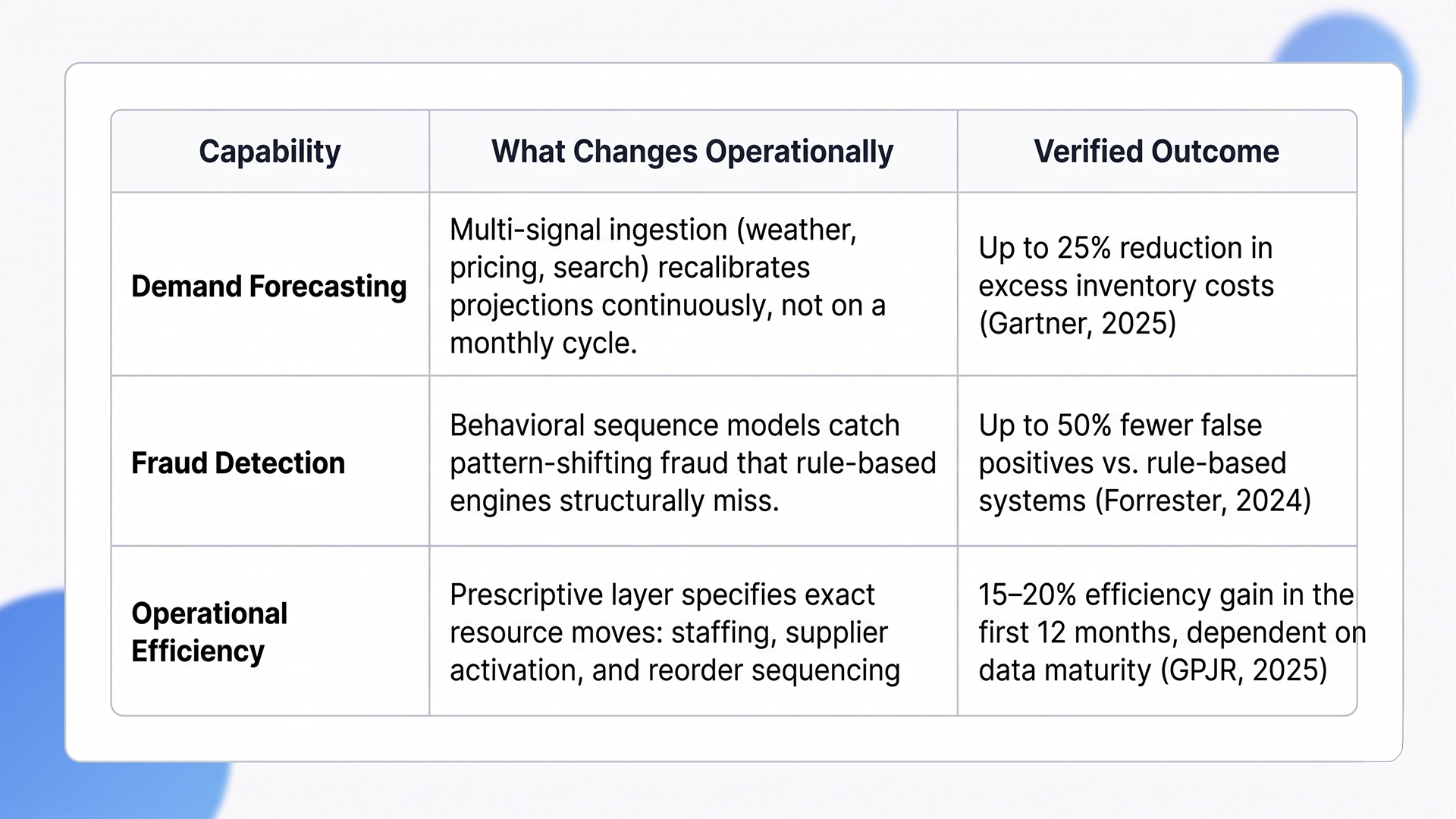
Core Capabilities at a Glance
1. Precision Demand Forecasting to Protect Margins
Machine learning algorithms for demand forecasting ingest search trends, competitor pricing, weather data, and logistics signals simultaneously, recalibrating projections as each input updates.
The result is a continuously correcting forecast, one that gets more precise as conditions shift rather than less. This approach reduces excess inventory losses by up to 25%. The precision scales across every product line, including long-tail SKUs where traditional methods are weakest.
2. Proactive Risk Mitigation and Fraud Detection
Rule-based fraud engines match known patterns. Machine learning algorithms trained on behavioral sequences flag anomalies that no static rule would catch because the fraud pattern itself is new. Financial institutions using ML detection report up to 50% fewer false positives.
Risk mitigation through predictive maintenance follows the same logic: consistent pre-failure data patterns allow intervention before downtime occurs, cutting unplanned stoppages by 30-50% in heavy industry.
“The foundational shifts behind these capabilities are documented in AI Predictive Analytics 2025: What Changed and What It Means for Scalable Business Intelligence.”
3. Improving Operational Efficiency through Automation
Prescriptive analytics specifies exactly what to do with a predictive signal: which shift to staff, which supplier to activate, which SKU to reorder first. Companies layering prescriptive recommendations on predictive outputs report 15-20% efficiency gains within 12 months, dependent on data maturity. This is where the benefits of predictive analytics translate directly into margin improvement: the gain comes from shortening the decision cycle, not reducing headcount.
The same benefits of predictive analytics apply directly to customer-facing revenue functions, where the speed of signal detection determines competitive advantage.
Scaling Revenue with Predictive Modeling for Business
Revenue scales when predictive modeling for business reduces churn before cancellation, personalizes at the individual level, and identifies demand pockets competitors have not reached.
The benefits of predictive analytics on the revenue side are not about spending more on acquisition. They are about concentrating spend where conversion probability is highest and retaining the customers whose lifetime value justifies the investment.
1. Reducing Customer Churn with Behavioral Insight
Predictive modeling for business surfaces churn signals weeks before cancellation: declining login frequency, shrinking feature adoption, and rising support ticket volume. Each signal is individually predictive; together they are diagnostic. The critical variable is intervention timing.
A retention action triggered 4-6 weeks pre-churn outperforms post-cancellation win-back campaigns on both conversion rate and cost per save, making churn rate reduction one of the fastest ROI optimization paths for subscription businesses.
2. Hyper-Personalization for Higher Conversion
Predictive personalization models individual customer behavior patterns to rank the next best action per user, per channel, per moment. The output is not a segment; it is a decision per individual. Retailers applying this approach report 10-15% conversion lifts without increasing ad spend.
For high-consideration purchases, timing the offer relative to the decision window matters more than the creative itself, which makes personalization one of the highest-conversion benefits of predictive analytics available today.
“For teams implementing predictive workflows without deep engineering overhead, the practical approach is covered in AI Automation for Business: Low-Code Strategies That Reduce Build Time Without Sacrificing Accuracy.”
3. Identifying Untapped Market Opportunities
Data-driven forecasting using demographic clustering, search demand indices, and economic mobility data identifies segments where purchasing intent is growing, but supply-side competition is low. This remains the most underused benefit of predictive analytics in mid-market strategy.
Executing on these capabilities consistently requires a specific infrastructure blueprint, and the window to build it is narrowing.
The 2026 Blueprint for Data-Driven Forecasting
The 2026 blueprint for data-driven forecasting requires three layers: first-party data loops, real-time data streams, and a human-in-the-loop workflow. Each compound is the layer below it.
Organizations that built this infrastructure between 2022 and 2024 now operate at a forecasting maturity that new entrants need 18-24 months to replicate. The performance gap shows up in forecast precision, response speed, and retention simultaneously.
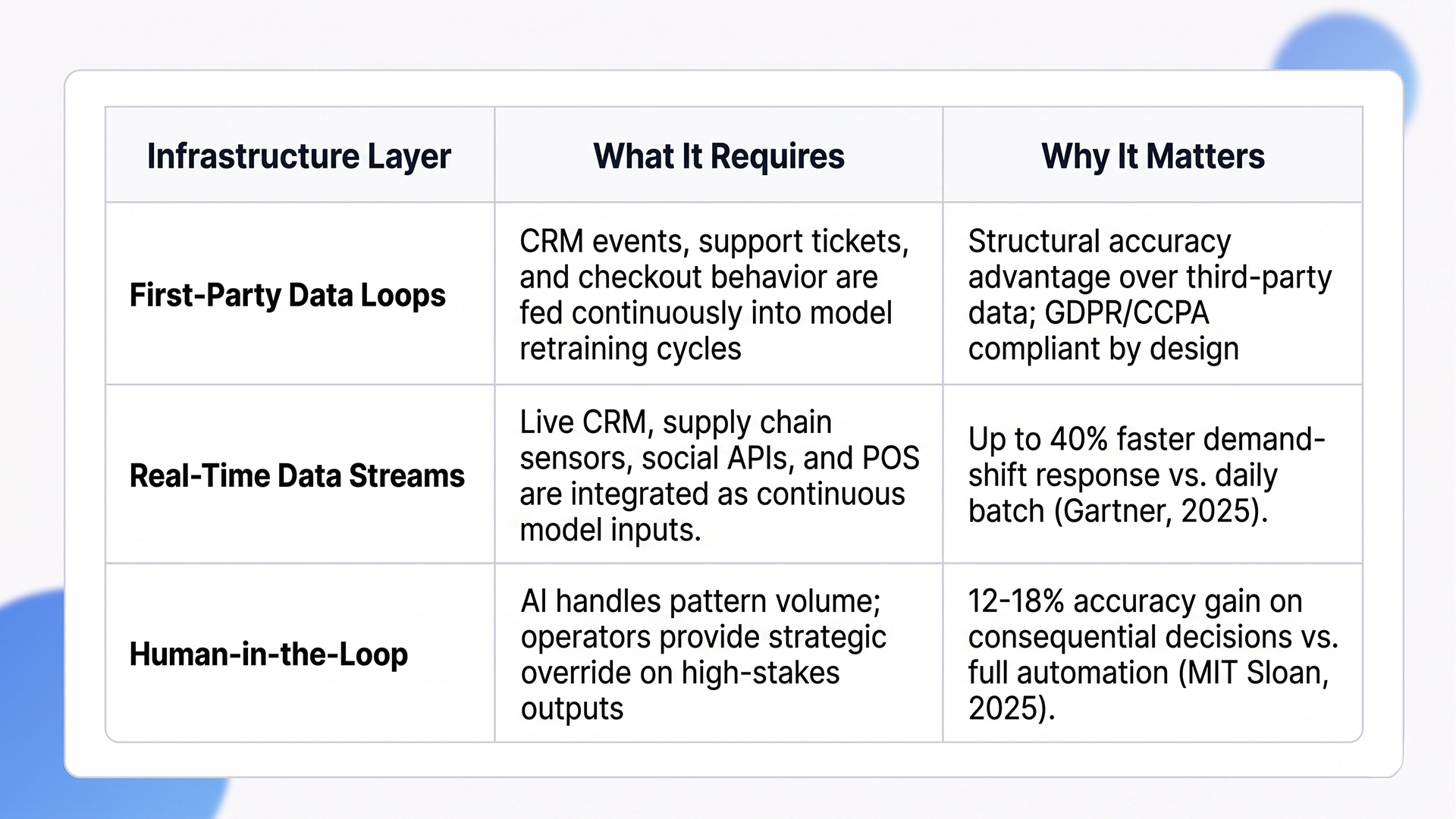
The 2026 Blueprint at a Glance
1. Leveraging First-Party Data in a Cookieless World
First-party data collected from direct customer interactions is now the primary input for machine learning algorithms in any privacy-compliant environment. Its advantage over purchased data is structural: it reflects actual behavior in your product and funnel, not modeled proxies.
The priority is closing the feedback loop. Every interaction, from support resolution to checkout abandonment, should feed model retraining. This continuous learning cycle is what makes the benefits of predictive analytics compound over time rather than plateau.
2. Integrating Real-Time Data Streams
Real-time data streams from CRM feeds, social sentiment APIs, supply chain sensors, and point-of-sale systems allow predictive models to update continuously rather than on a daily batch schedule.
For inventory optimization specifically, restocking decisions happen in hours rather than days, protecting fill rates and working capital in the same cycle. This speed advantage is among the most operationally immediate benefits of predictive analytics in supply chain management.
“The downstream automation architecture is as important as the model itself, which we examine in AI-Powered Automation in Business Processes: From Isolated Tools to Integrated Workflows.”
3. Balancing Human Intuition with Machine Intelligence
Organizations treating model outputs as final decisions consistently underperform those using outputs as structured inputs to human judgment. Teams running a human-in-the-loop approach outperform fully automated forecasting on high-stakes decisions by 12-18% in measured accuracy.
The benefits of predictive analytics peak when AI handles pattern volume and experienced operators make the strategic call. At Ariel, we engineer this handoff explicitly into every deployment.
This engineering-first perspective also explains why most implementations fail, and what the fix looks like.
Why Predictive Analytics Implementations Fail, and What Ariel Does Differently

Most benefits of predictive analytics deployments fail not from bad models but from model drift, pipeline failures on live data, and forecasts disconnected from operational decisions.
Ariel Software Solutions addresses each failure point before deployment begins. Our pre-build data audit identifies architectural gaps before a model is trained. Retraining pipelines prevents accuracy decay as market conditions shift. Predictive outputs connect directly to the tools your team uses, so forecasts drive decisions rather than accumulate in dashboards.
With 1,100+ projects across six continents and a 95% client satisfaction rate, we bring cross-industry pattern recognition that single-domain vendors structurally cannot. For businesses that have invested in the benefits of predictive analytics without seeing expected returns, that diagnostic capability is the difference. Schedule a technical scoping call.
Conclusion
The benefits of predictive analytics are not a future promise. Finance teams have cut forecast variance by 20-30%. Inventory systems are trimming operational costs by nearly a third. Retention teams are stopping customer loss before it registers as a cancellation.
The gap between businesses running data-driven forecasting and those still reacting to what has already happened is compounding every quarter. If your planning infrastructure still responds to yesterday’s data, let’s talk about what a precision forecasting build looks like for your business.
Frequently Asked Questions
1. How accurate is predictive modeling for business?
Accuracy depends on data quality and retraining frequency. Well-maintained systems typically achieve 20-30% better forecast precision than traditional methods. Models retrained on first-party, real-time data maintain accuracy over time rather than degrading, which is the primary driver of long-term model ROI.
2. Do I need a large dataset to start seeing the benefits of predictive analytics?
Churn rate reduction and inventory optimization both produce strong results using CRM or transaction data that most businesses already collect. Starting with a narrow, high-impact use case and expanding as data accumulates, outperforms waiting for a complete infrastructure before starting.
3. What is the difference between predictive and prescriptive analytics?
Predictive analytics identifies which outcome is most likely. Prescriptive analytics specifies the exact action to maximize a desired outcome. Most mature applications use both: prediction surfaces the signal, and prescription defines the response.
4. How does data-driven forecasting improve ROI optimization?
Predictive forecasting improves ROI optimization by identifying which channels, segments, and timing windows carry the highest conversion probability. Budget shifts toward high-signal targets, improving return per dollar without requiring a spend increase.
5. Is business data secure when using predictive analytics platforms?
Security depends on platform architecture. Enterprise systems with end-to-end encryption, role-based access controls, and GDPR/CCPA compliance provide a strong baseline. Custom-built solutions offer tighter control over data residency and audit trails than off-the-shelf SaaS.