
Every AI quote you receive describes the build. Almost none of them describe the bill. The build is the upfront check, a one-time number that gets negotiated, approved, and forgotten. The bill is the recurring cost of keeping the model running once it ships: inference spend, retraining, monitoring, data pipeline upkeep, and the quiet compounding of scope that nobody scoped. That second number is where most AI budgets break, and it’s the number competitors’ pricing tables consistently leave out.
The headline figures are real. Worldwide AI spending will reach USD 2.52 trillion in 2026, a 44% year-over-year increase, according to Gartner. And yet McKinsey’s State of AI survey of nearly 2,000 companies found only a small fraction report meaningful financial returns from their AI investments. Record spending, marginal returns. The gap is rarely the model. It’s the cost structure nobody mapped before signing. From our delivery experience at Ariel, the projects that produce ROI and the projects that bleed budget often start with similar quotes; what separates them is how honestly the total cost was scoped before sprint one.
Here’s what businesses are actually paying for AI in 2026, what drives each band, and the specific line items that turn a controlled ai development cost into a runaway one.
Key Takeaways
- AI development cost in 2026 spans roughly USD 15,000 for a scoped proof of concept to USD 1.5 million+ for an enterprise platform. The spread reflects real differences in data, integration, and compliance, not arbitrary pricing.
- The build is the smaller number. Total cost of ownership over three years typically runs 1.5x to 2x the initial build, driven by inference, retraining, and maintenance.
- Data preparation is the single largest hidden cost, consistently 25% to 40% of total project cost in data-intensive deployments.
- Inference is the subscription you cannot cancel. At enterprise scale, LLM-based applications can burn USD 5,000 to USD 50,000 per month in API and serving costs.
- Regulated industries (healthcare, finance) carry a 25% to 35% cost premium for compliance, audit, and certification work.
- The biggest cost driver isn’t the model. It’s data quality, integration depth, accuracy requirements, and inference volume.
- Scoping discipline changes the total more than the rate card. A clear discovery phase consistently saves more than it costs.
What AI Development Actually Costs in 2026
The honest answer to how much does ai development cost is that it ranges widely, and the range is meaningful rather than evasive. The table below reflects the bands that recur across industry pricing research and our own delivery experience. Treat the figures as illustrative bands, not fixed quotes; the real number depends on the cost drivers covered in the next section.
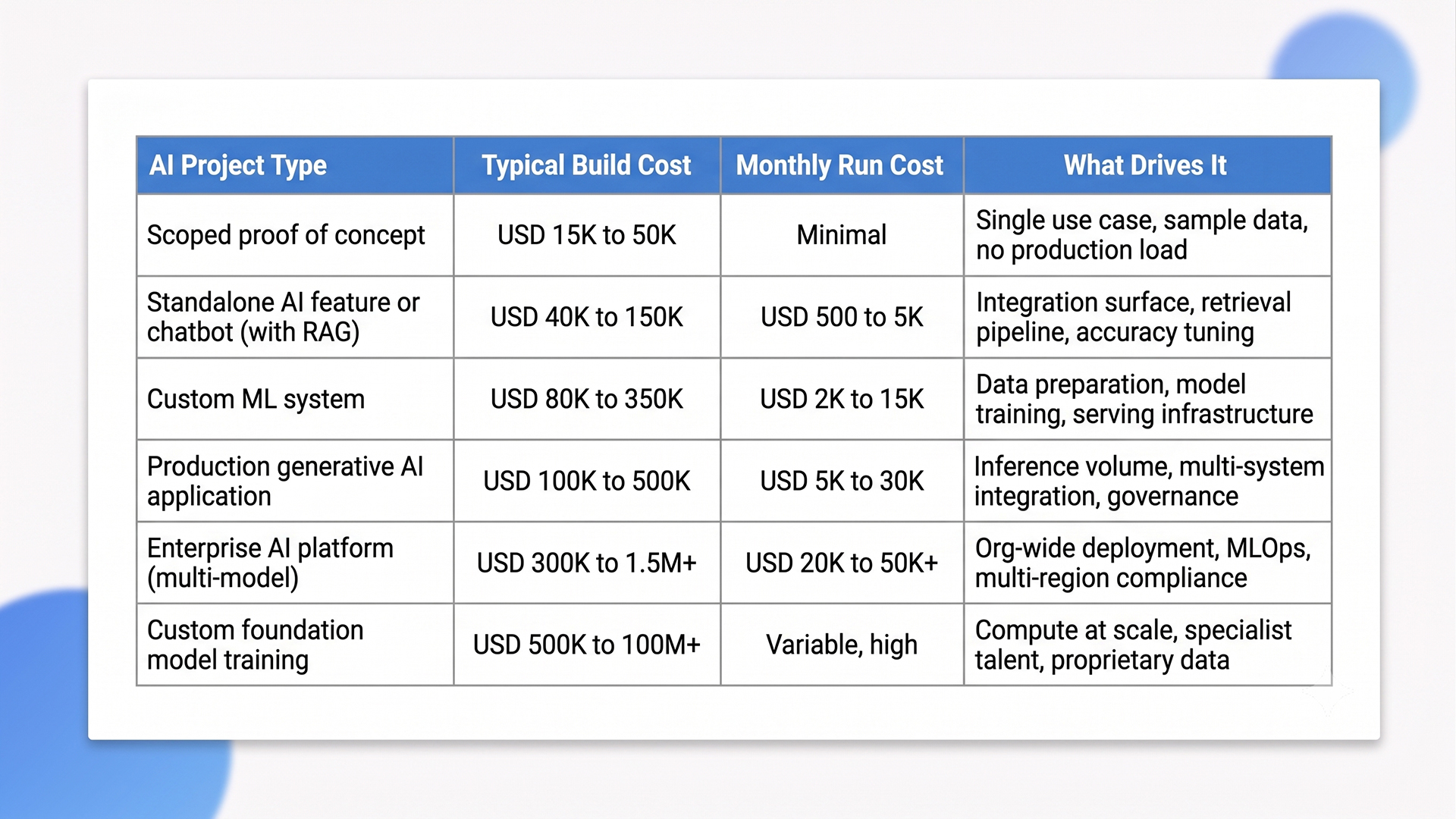
Two patterns are worth naming. First, the ai development cost breakdown is increasingly dominated by the run cost column, not the build column. Second, the jump between tiers isn’t linear; moving from a rules-based system to classical ML, then to foundation-model integration, then to agentic AI can multiply project cost by two to four times at each step. The architecture decision is a cost decision.
The Four Variables That Actually Set the Price
Competitor pricing guides list a range and stop. The useful question is what moves a project from the bottom of a band to the top. Four variables do most of the work, and they compound against each other.
1. Data readiness (the largest hidden cost)
Clean, labeled, well-structured data is rare. Most enterprises have data spread across legacy systems, inconsistent formats, and incomplete records. Every hour spent cleaning and preparing that data is billable engineering time, and from our delivery experience it consistently lands at roughly a quarter to two-fifths of total project cost in data-intensive deployments. This is the single most underestimated line in the cost to build ai software, because it doesn’t show up in a demo and rarely appears honestly in an initial proposal.
- Clean, accessible, well-labeled data: lower band of the cost range.
- Fragmented data across legacy systems: add significant data-engineering scope before any model work begins.
- Unlabeled or unstructured data requiring annotation: often the largest single line item in the budget.
2. Integration depth
An AI model that lives in a notebook is cheap. An AI feature wired into SAP, Salesforce, a billing system, and three legacy databases is not. From our delivery experience, multi-system integration commonly adds a mid-five to low-six-figure layer of custom middleware and API work. The integration surface, not the model, is frequently the line that separates a USD 100,000 project from a USD 400,000 one.
3. Accuracy and reliability requirements
The cost of an AI feature scales sharply with how wrong it’s allowed to be. A sentiment classifier that’s 90% accurate is cheap. A medical coding assistant or a financial reconciliation engine that has to be right nearly every time requires evaluation harnesses, human-in-the-loop checkpoints, extensive edge-case handling, and ongoing monitoring. The 80% case is easy and cheap. The last 20% of reliability is where most of the engineering budget goes, and it’s non-negotiable in regulated or high-consequence workflows.
4. Inference volume (the subscription you cannot cancel)
Running a production AI model costs money on every query, every document analyzed, every recommendation served. At low volume it’s negligible. At enterprise scale, inference for LLM-based applications can run several thousand to tens of thousands of dollars per month depending on usage patterns. A system processing 100,000 daily requests can burn several thousand dollars per month in API calls alone. The build is the upfront check; inference is the recurring bill, and it should be modeled before the model architecture is selected, not discovered on the first invoice.
The Cost Nobody Quotes: Total Cost of Ownership
The most expensive misunderstanding in AI budgeting is treating the build cost as the total cost. It isn’t. The enterprise ai development cost continues well past launch, and the post-launch number is often larger than the build over a multi-year horizon.
From our delivery experience, annual operating cost typically lands at 15% to 30% of the initial build, and total cost of ownership over three years at 1.5x to 2x the build. A USD 1 million enterprise build can mean USD 200,000 to USD 300,000 per year to keep running. That recurring cost covers a specific, predictable set of line items:
- Inference and serving infrastructure. The per-query cost of every request the system handles, plus the compute to serve it.
- Model retraining and evaluation. Models drift. Keeping accuracy steady requires periodic retraining and continuous evaluation against a maintained test set.
- Data pipeline upkeep. Training data, embeddings, checkpoints, and output logs add a recurring monthly data-infrastructure cost that rarely appears in initial estimates.
- Monitoring and observability. Drift detection, performance monitoring, and incident response for a non-deterministic system.
- Security patches and model migration. As foundation models version and deprecate, migration is recurring work, not a one-time event.
None of these are optional. All of them are routinely left out of the quote that wins the deal. The honest version of an ai development cost 2026 conversation includes the three-year total, not just the build.
The Compliance Premium
Regulated industries pay more, and the premium is specific rather than vague. Healthcare, financial services, and other regulated environments rarely complete a serious AI project under the cost of comparable unregulated work, because compliance, audit, and certification are engineering work, not paperwork. The governance and traceability requirements behind that premium are substantial; we cover them in depth in our guide on how to audit AI agents, and they have to be designed into the system rather than bolted on before an audit.
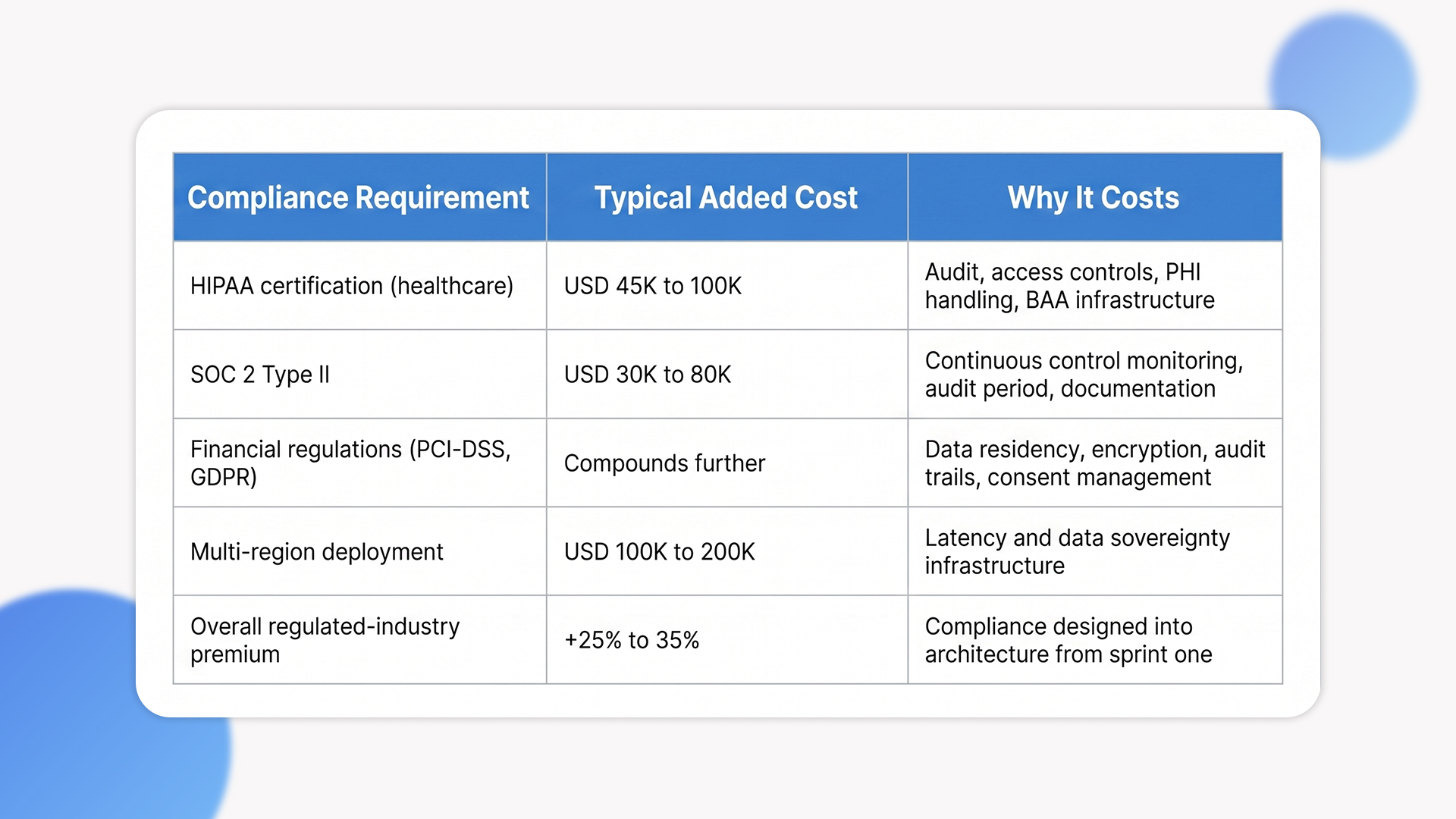
The discipline that controls this premium is designing compliance into the architecture from the first sprint rather than retrofitting it after the build. Definitive scope questions about regulatory obligations should always involve qualified counsel; the cost ranges above are engineering estimates, not legal guidance.
Build, Buy, or Integrate: The Decision That Sets the Floor
Before any rate card matters, the build-versus-buy-versus-integrate decision sets the cost floor. Most businesses overpay by building custom where an off-the-shelf tool or a clean API integration would have delivered the same outcome.
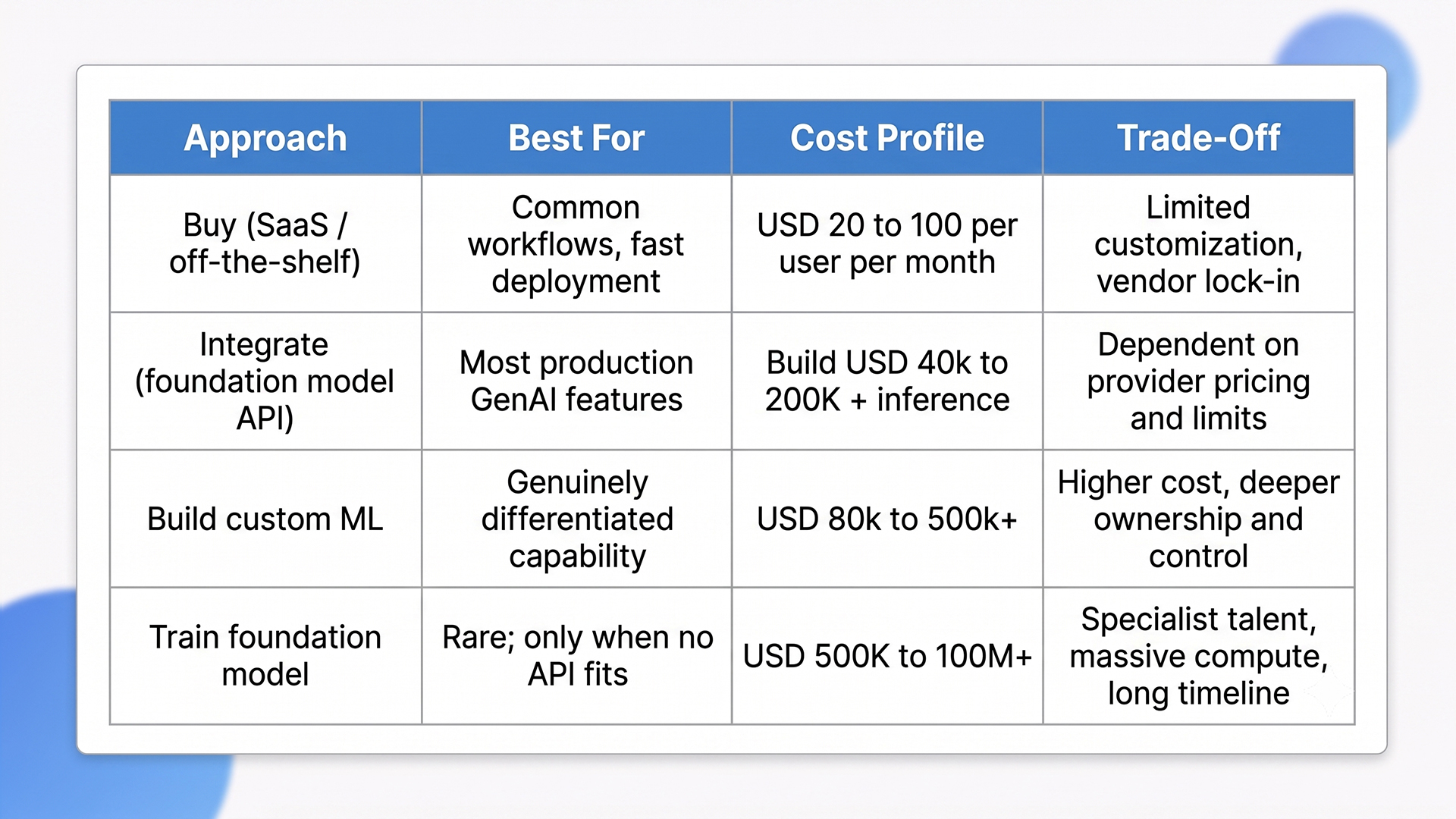
The honest answer most of the time: integrate a foundation-model API cleanly where it fits, build custom only where the capability is genuinely differentiated, and reserve custom model training for the rare cases where no API can do the job. We walk through that decision in detail in our comparison of custom AI agents versus ChatGPT integration. Treating every project as a custom build inflates cost; treating every project as an API wrapper underdelivers on the ones that need real engineering.
Where AI Budgets Break (and How to Prevent It)
From our delivery experience, AI projects rarely fail at the model. They fail at the budget, and the budget fails in predictable places.
Skipped discovery
The cheapest part of the project is the part most teams compress. Without a discovery phase that profiles data quality, maps the integration surface, and models inference volume, the scope is built on assumptions that turn out wrong in month three and expensive to fix in month nine. The discovery phase is where the budget gets right; the cost table just starts the conversation.
Inference modeled after architecture, not before
Teams that pick a model architecture before modeling inference volume frequently discover the run cost is unsustainable after launch. Inference should be modeled first; it often changes the architecture decision entirely.
Data prep treated as a footnote
When data preparation is scoped as a small line item rather than the 25% to 40% of total cost it usually represents, the overrun is guaranteed. The fix is to scope data work honestly during discovery, before any model commitment.
The TCO blind spot
Budgeting only the build and ignoring the three-year run cost is the most common and most expensive mistake. A build that fits the budget but produces an unsustainable run cost is not a project that landed; it’s a liability that shipped.
When Spending More on AI Is the Wrong Move
Not every AI budget should be approved. Here is when we tell clients to wait or scope smaller.
The workflow is broken. AI on top of a broken process produces faster broken outcomes. McKinsey’s research is direct that workflow redesign, not model spend, is the strongest predictor of AI returns. Fix the workflow, then add AI to the cleaner version.
The data foundation isn’t ready. If your data is fragmented and inconsistent, spending on models before data preparation accelerates the underlying problem. The data work comes first, or the AI budget is being scoped to fail.
Deterministic automation already handles it. If rule-based automation handles a process reliably and cheaply, adding AI introduces non-determinism and run cost without adding value. AI earns its place where reasoning and unstructured input matter.
The use case can’t justify the run cost. If the projected inference cost exceeds the value the feature produces, the project is uneconomic regardless of how clean the build is. Model the recurring cost before approving the build.
How Ariel Approaches AI Cost
From our delivery experience across enterprise and mid-market clients, the AI projects that produce ROI are the ones where the full cost (build plus three-year run) was scoped honestly before sprint one. We start every engagement with workflow analysis and data-readiness assessment, not model selection, because those two factors set the real number more than the rate card does.
The operating disciplines we apply to keep ai development cost honest and controlled are:
- Discovery before build. Data profiling, integration mapping, and inference modeling happen before any model commitment, so the budget reflects reality.
- Inference modeled first. We model the recurring cost before selecting architecture, because the run cost often changes the build decision.
- Data preparation scoped as a budgeted line item. Not a footnote. We name the data work explicitly during discovery.
- Three-year TCO, not just the build. Every estimate includes the run cost, so there are no first-invoice surprises.
The principle that drives our cost conversations is that the cheapest AI project is rarely the one with the lowest build quote; it’s the one scoped honestly enough that the run cost doesn’t surprise anyone. Across industries, the pattern holds: the scoping discipline determines whether the AI budget produces a system that pays for itself or a cost line that compounds.
Trying to budget an AI project and want an honest read on the full cost, not just the build quote?
Our team has scoped, delivered, and operated AI systems across enterprise and mid-market clients for 16 years. We’ll review your use case, your data readiness, your integration surface, and the three-year total cost of ownership, then give you a realistic budget instead of an optimistic one.
Frequently Asked Questions
1. How much does AI development cost in 2026?
AI development cost in 2026 ranges from roughly USD 15,000 for a scoped proof of concept to USD 1.5 million or more for a full enterprise platform. A standalone AI feature or chatbot typically runs USD 40,000 to USD 150,000; a custom ML system runs USD 80,000 to USD 350,000; and a production generative AI application falls between USD 100,000 and USD 500,000. These figures cover engineering; data preparation, inference, infrastructure, and compliance add meaningfully to the total.
2. What is the biggest hidden cost in AI development?
Data preparation and quality remediation. It consistently represents 25% to 40% of total project cost in data-intensive deployments and rarely appears honestly in an initial proposal. Clean, labeled, well-structured data is rare; most enterprises have data spread across legacy systems in inconsistent formats, and every hour of cleaning is billable engineering time. The second-largest hidden cost is inference, the recurring per-query spend that continues for the life of the system.
3. Why does the AI development cost breakdown vary so widely?
The ai development cost breakdown varies because four variables compound against each other: data readiness, integration depth, accuracy requirements, and inference volume. A clean-data, single-system, low-accuracy, low-volume project sits at the bottom of a band. A fragmented-data, multi-system, high-accuracy, high-volume project in a regulated industry sits at the top, sometimes several times higher. The model itself is rarely the main driver.
4. What is the cost to build AI software versus buying an off-the-shelf tool?
The cost to build ai software custom runs from USD 40,000 for a focused feature to USD 500,000+ for an enterprise system, while off-the-shelf SaaS tools start at USD 20 to USD 100 per user per month. Buy off-the-shelf for common workflows. Integrate a foundation-model API for most production features. Build custom only where the capability is genuinely differentiated. Most businesses overpay by building custom where an integration would have delivered the same outcome.
5. What ongoing costs should I expect after the AI build is complete?
Plan for annual operating cost of 15% to 30% of the initial build, and total cost of ownership over three years of 1.5x to 2x the build. The recurring line items are inference and serving infrastructure, model retraining and evaluation, data pipeline upkeep, monitoring, and model migration as foundation models version. A build that fits the budget but produces an unsustainable run cost is a liability, not a delivered project. Model the run cost before approving the build.
6. Can Ariel help us estimate AI development cost for our specific use case?
Yes. We help businesses scope the full cost (build plus three-year run) before any commitment, including data-readiness assessment, integration mapping, and inference modeling. Get in touch for a delivery-grade cost conversation about your specific use case.
The Number Behind the Number
The ai development cost that matters isn’t the build quote on the proposal. It’s the three-year total: build, plus inference, plus retraining, plus data upkeep, plus the compliance premium if you’re regulated, plus the scope that drifts when discovery gets skipped. Competitors publish the build range and stop. The businesses that get AI right budget for the whole picture, because the run cost is the part that decides whether the system pays for itself.
Model the inference before the architecture. Scope the data work honestly. Budget the three-year run, not just the build. Match build-versus-buy to the actual problem. Design compliance from sprint one. The rate card matters less than the scoping discipline; the cheapest AI project is the one where the real cost was honest from the start.
Ready to budget AI with the full cost in view, not just the build?
Book a free consultation with Ariel’s AI engineering team. We’ll assess your use case, your data foundation, and your integration surface, then build a realistic three-year cost model so the run cost never surprises you after launch.