

The honest answer to whether TDD makes software better is more interesting than its advocates and its critics both admit. The research shows it improves code quality measurably. The research also shows it can slow teams down, especially in industrial settings, especially with engineers new to the discipline. The same practice that produces fewer bugs and cleaner code also produces, in some studies, lower short-term productivity. Both findings are real. Both matter for the decision. And the conversation has changed materially in 2026 because of one new variable: AI-assisted coding has flooded codebases with code that works in the moment but nobody can verify weeks later.
That’s why test-driven development is getting a second look in 2026. The IEEE meta-analysis of 27 controlled studies found TDD produces a small but real positive effect on external code quality, with little to no discernible average effect on productivity, but with notable variation: industrial studies often show productivity dips, especially when teams are new to the discipline. A separate systematic TDD review of 1,107 articles found that 76% of studies showed internal code quality improvement and 88% showed external quality improvement, with productivity gains in academic settings but declines in industrial ones. The honest verdict isn’t “TDD definitely works” or “TDD definitely doesn’t.” It’s “TDD produces real quality gains, costs short-term velocity to learn, and the trade-off only pays off in specific situations.”
From our delivery experience at Ariel, those situations are now more common than they were five years ago, mainly because AI-assisted coding has created a verification problem that test-first development is unusually well-suited to solve. Here is what TDD actually delivers, when it pays off, when it doesn’t, and how to implement it without absorbing the productivity hit teams typically face.
Key Takeaways
- The research is honest about the trade-off. TDD produces small but real quality improvements; short-term productivity can drop, especially during team learning.
- AI-assisted coding has resurfaced TDD as the verification layer. Vibe-coded codebases need tests that pin down intended behavior, not just tests added after the fact.
- TDD’s biggest payoffs: fewer defects in production, safer refactoring, better modular design, and clearer specifications of intended behavior.
- TDD’s biggest costs: 15% to 35% slower velocity during the learning phase, harder for unfamiliar codebases, awkward for UI-heavy or research-style work.
- TDD vs BDD: TDD lives at the unit level (developer-facing), BDD lives at the acceptance level (business-facing). They complement each other; they don’t compete.
- How to implement TDD without absorbing the productivity hit: start narrow, pair the early sprints, invest in fast test infrastructure, and treat refactoring as non-optional.
- TDD is operational discipline, not religion. Apply it where it pays off; skip it where the structure works against the work.
What the Research Actually Says
The research on test-driven development is more mixed than most blog posts admit, and the nuance matters for the decision of whether to apply it. The two strongest meta-analyses converge on a specific shape of finding: quality improves modestly, productivity has no clear average effect, and the variance is high.
From the IEEE meta-analysis of 27 controlled studies:
- Small positive effect on external code quality across studies.
- Little to no average effect on productivity.
- Quality improvement was larger when the test effort difference between TDD and control groups was substantial.
- Productivity drops were larger in industrial settings than in academic ones.
- Developer experience and task size mattered: more experienced developers and larger tasks showed bigger effects.
From the systematic TDD review (1,107 articles screened, 27 analyzed in depth, 1999-2014):
- 76% of studies showed internal software quality improvement with TDD.
- 88% showed external software quality improvement.
- Productivity gains in academic settings; productivity declines in industrial settings.
More recent industrial work, including IBM’s long-running TDD experience and case studies from large engineering organizations, supports the same pattern: TDD pays off after the learning curve, struggles during it, and works best when the team treats it as a long-term discipline rather than a sprint-level deliverable. The test driven development benefits are real, but they take time to surface, and the early-sprint productivity drop is genuine. Teams that quit TDD after three sprints often quit before the benefits start showing up.
Why TDD Is Getting a Second Look in 2026
The TDD conversation in 2026 has been altered by something that wasn’t a factor in any of the original research: AI-assisted coding. Tools like GitHub Copilot, Cursor, Claude Code, and AI-powered IDE plugins now produce a meaningful share of the code shipping into production. That code works in the moment, often elegantly, and is increasingly difficult for the original developer (let alone future maintainers) to verify weeks later. The result is a verification gap that didn’t exist at this scale before, and it’s exactly the gap that test-first development was designed to close.
The pattern is showing up clearly in our delivery work. Codebases written with heavy AI assistance look clean, pass code review, and ship to production. Six months later, when a refactor is needed, the team can’t tell which behavior is intentional and which is incidental, because the tests (when they exist) were generated after the code and primarily verified what the AI already produced. Test-first development inverts this: the tests pin down intended behavior before the code is written, AI-assisted or otherwise. The code can then be generated, refactored, or replaced freely because the specification is the test, not the implementation.
This is a structural shift in why teams adopt TDD. In 2015, the case was “fewer bugs, cleaner design.” In 2026, it’s also “the only way to be sure what your AI-generated code is actually supposed to do.” The discipline is the same; the urgency has changed. We see the same pattern in cases where AI implementation challenges surface in the integration layer: testable specifications matter more, not less, when the underlying implementation is partially AI-generated.
What TDD Actually Improves
Across the engagements where we’ve applied test-driven development as a delivery discipline, the gains cluster in five specific areas. Each one is documented in academic research and visible in real client work.
1. Fewer defects in production
The cleanest finding across the research. Industrial case studies at IBM and Microsoft showed 40% to 90% defect reductions in TDD-developed code, depending on the team, task, and baseline. The mechanism is straightforward: tests written before the code exercise edge cases the developer would have skipped, and they fail loudly when later changes break intended behavior. Defects that would have shipped to production get caught at the workstation instead.
2. Safer refactoring
A codebase with strong test coverage is a codebase that can be refactored without fear. The tests act as a safety net: change anything you want, and the tests will tell you if you broke something. The lessons we apply across legacy application modernization work directly: the projects that move cleanest are the ones where tests cover the existing behavior comprehensively before any refactoring begins. Without that safety net, refactoring becomes risky enough that teams stop doing it, and technical debt accumulates.
3. Better modular design
Code that’s easy to test is code that’s modular, has clear interfaces, and separates concerns. Writing tests first forces these properties because untestable code is unworkable: you can’t write a clean unit test against a function that depends on five global variables, three database connections, and a network call. TDD pushes design toward separation of concerns by making the alternative impractical.
4. Living specifications
Tests written before the code describe intended behavior in executable form. They are the most accurate documentation of what the code is supposed to do, because they’re verified continuously by the CI pipeline. Documentation drift, the gap between what the docs say and what the code does, doesn’t apply to a well-maintained test suite.
5. Confidence under change
Teams with strong test coverage move faster on changes, even though they were slower on the initial build. Bug fixes are surgical. Feature additions don’t break unrelated functionality. New engineers can be productive faster because the tests teach them how the code is supposed to behave. The compounding effect is real, and it’s why industrial teams that stick with TDD past the learning curve typically don’t go back.
Where TDD Costs You
The honest costs of TDD, drawn from both research and practice:
- Learning curve velocity drop. Teams new to TDD typically see 15% to 35% slower velocity for the first three to six sprints. The drop is genuine, and it’s why teams often abandon the practice before the benefits show up.
- Test infrastructure investment. TDD requires fast test execution. Suites that take 20 minutes to run break the practice. Investing in fast test infrastructure is a real upfront cost that often gets underestimated.
- Mismatch with exploratory or research work. TDD assumes you know enough about what you’re building to write a test for it. For exploratory prototypes, research spikes, or genuinely novel work where the specification emerges from the building, test-first can be the wrong fit. Test-after often makes more sense for these.
- Awkward fit for UI and visual work. Pure TDD struggles with UI styling, animation tuning, and visual polish work, where the “test” is often human judgment. Visual regression testing helps, but it’s not the same discipline.
- Cargo-cult risk. TDD applied dogmatically without understanding why it produces worse code, not better. Engineers who write tests because the rules say so (rather than to specify intended behavior) often produce tests that lock in the implementation, not the specification, and refactoring becomes harder, not easier.
TDD vs BDD: What Each One Actually Covers
The TDD vs BDD comparison gets framed as competing methodologies, but they sit at different layers and solve different problems. Most mature engineering organizations end up using both, and the table below shows why.
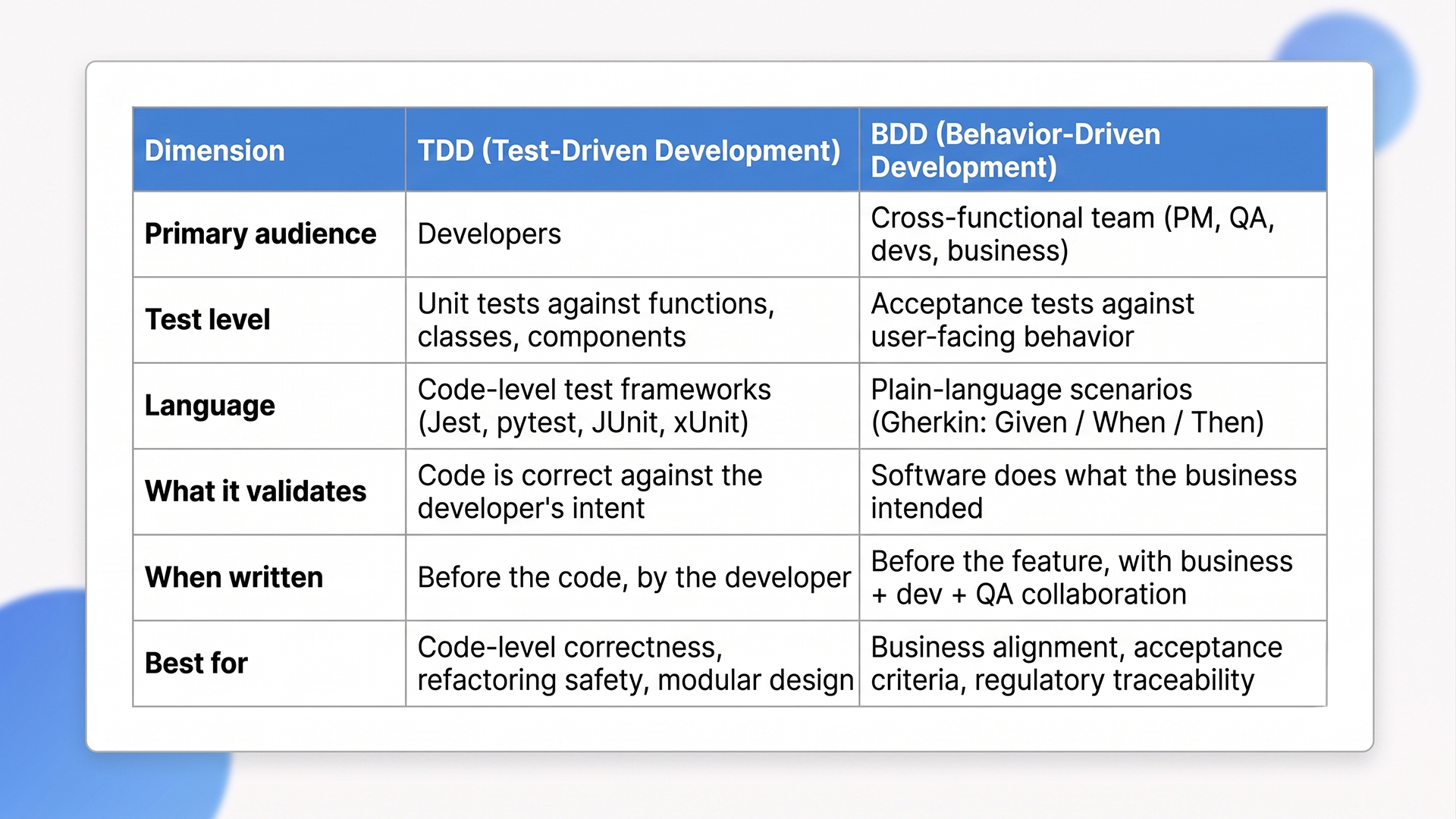
The honest framing: TDD tells you the code works correctly. BDD tells you the code does what the business intended. They’re complementary, not competing. Most teams that adopt both use TDD for the developer workflow and BDD for cross-team alignment on acceptance criteria, especially in regulated environments where traceability between business requirements and tests is auditable.
How to Implement TDD Without the Productivity Penalty
The research is clear that teams new to TDD see a productivity drop. The teams that absorb the drop and reach the long-term gains aren’t the ones with the most talent; they’re the ones with the most disciplined rollout. Here’s the operational pattern that works for teams figuring out how to implement TDD without losing six months of velocity.
1. Start narrow, not everywhere
Don’t roll TDD out to the whole codebase on day one. Start with a single domain (business logic, financial calculations, data transformations, anything with clear inputs and outputs) and apply TDD there exclusively for two or three sprints. The narrow scope lets the team build muscle memory without slowing the entire product down. Expand only when the discipline is stable.
2. Pair the early sprints
Pair programming during the first weeks of TDD adoption is the highest-leverage investment for learning velocity. An engineer who has done TDD before sitting with an engineer who hasn’t compressed the learning curve from months to weeks. The pairing cost looks expensive on paper and pays back fast in practice.
3. Invest in fast test infrastructure first
TDD only works with fast feedback. Tests have to run in seconds, not minutes. If your test suite takes 15 minutes, TDD won’t take hold no matter how much the team wants it to. Invest in test infrastructure (parallel execution, in-memory test databases, mock service layers, watch-mode tooling) before rolling out the practice. Fast tests are the foundation TDD sits on.
4. Treat refactoring as non-optional
The classic TDD cycle is red-green-refactor. Most teams new to TDD skip the refactor step because the test is green and the code seems fine. They produce passing tests on top of badly designed code, which is worse than no tests at all. Treat refactoring as part of the cycle, not an optional bonus. The discipline pays off in maintainability, which is half the point of doing TDD at all.
5. Use AI-assisted coding deliberately, not reflexively
AI coding assistants are excellent at generating test scaffolding and filling in obvious test cases. They’re less good at deciding what to test, what the edge cases are, and what behavior the test is actually pinning down. Use AI to speed up the mechanical parts of TDD (writing the assertion, generating the data fixture, suggesting the next test) and keep human judgment on the specification (what should this code do, what cases must it handle correctly). The discipline is the same one we apply across our work auditing AI agents: humans specify behavior, machines execute against it, and verification stays inside the team.
When TDD Is the Wrong Choice
TDD is a tool, not a virtue. Here is when we tell teams to skip it or apply a different discipline.
You’re prototyping or exploring. If the goal is to figure out what to build, not to build it correctly, TDD often slows the exploration. Test-after, manual verification, or no testing at all can be the right call for genuine prototypes. Once the design stabilizes, then convert to TDD for the production rebuild.
Your team is too small to absorb the learning curve. A two-engineer startup on a 90-day deadline probably can’t afford the early productivity drop. The right answer might be test-after with strong code review, then convert to TDD when the team grows.
The work is UI-heavy or visual. Pure TDD struggles with visual styling, animation tuning, and polish work where the test is human judgment. Pair TDD on the business logic with visual regression testing and manual review on the UI work; don’t try to force unit tests into places where they don’t belong.
The codebase is hostile to testing. Some legacy codebases (heavy global state, tight coupling, no dependency injection) are extraordinarily difficult to add TDD to without first refactoring the foundation. In those cases, start with characterization tests around the boundaries, refactor incrementally toward testability, and adopt TDD as the code becomes testable. Don’t try to apply TDD to code that physically resists it.
How Ariel Applies TDD in Client Engagements
From our delivery experience, test-driven development is one of several testing disciplines we apply, not a universal mandate. We use TDD selectively, in the domains where the research evidence and the practical realities both support it, and we use other testing approaches (test-after, characterization tests, contract tests, BDD scenarios) where they fit better.
The operating principles we apply across testing in every engagement are:
- TDD where the logic is critical. Business logic, financial calculations, data transformations, security-sensitive code: TDD is the default. The quality gain justifies the early-sprint velocity cost.
- Test-after where the specification is exploratory. Prototypes, research spikes, exploratory feature work: tests follow once the design stabilizes, not before.
- BDD for cross-team acceptance. User-facing features and regulated workflows get BDD scenarios alongside TDD, because the acceptance test is the contract with the business.
- Fast test infrastructure as a delivery deliverable. Every engagement ships with a test suite that runs in seconds, in-memory test databases where possible, and CI pipelines that block merges on red builds.
Across industries, the pattern holds. Engagements that apply TDD selectively, with strong test infrastructure and honest scoping of when to use it versus when to skip it, produce better software with manageable productivity trade-offs. The wrong question is “should we do TDD?” The right question is “where does TDD fit and where doesn’t it?”
Thinking about adopting TDD or BDD on your next build and want a delivery-grade read on when it actually pays off?
Our team has applied test-driven and behavior-driven development across enterprise and mid-market engagements for 16 years. We will review your codebase, your team experience, and your delivery constraints, then give you an honest read on where TDD fits, where it doesn’t, and how to implement it without absorbing the productivity penalty teams typically face.
Frequently Asked Questions
1. Does test-driven development actually improve software quality?
Yes, modestly but measurably. The IEEE meta-analysis of 27 studies found test-driven development produces a small but real positive effect on external code quality. Other research has shown 76% of studies report internal quality improvement and 88% report external quality improvement. Industrial case studies at IBM and Microsoft showed 40% to 90% defect reductions in TDD-developed code. The honest summary: TDD improves quality consistently, but the magnitude varies with team experience, task type, and how seriously the team treats the practice.
2. What are the main test driven development benefits?
The five most consistent test driven development benefits are: fewer production defects (the cleanest research finding), safer refactoring because the tests catch regressions immediately, better modular design because untestable code is unworkable, living specifications that stay accurate because the CI runs them continuously, and confidence under change that compounds over time. The trade-off is early-sprint velocity (typically 15% to 35% slower during the learning phase) and the upfront investment in fast test infrastructure.
3. What’s the difference between TDD vs BDD?
The TDD vs BDD comparison is about layer, not competition. TDD lives at the unit-test level, written by developers in code-level test frameworks (Jest, pytest, JUnit). It validates that code is correct against the developer’s intent. BDD lives at the acceptance-test level, written collaboratively by product managers, QA, and developers in plain-language scenarios (Given/When/Then format). It validates that the software does what the business intended. Most mature teams use both: TDD for code correctness, BDD for cross-team alignment on acceptance criteria.
4. How to implement TDD without slowing down the team?
The teams that figure out how to implement TDD without losing months of velocity follow five patterns. Start narrow (one domain, not the whole codebase). Pair early sprints to compress the learning curve. Invest in fast test infrastructure first (tests that run in seconds, not minutes). Treat the refactor step as non-optional. Use AI coding assistants for mechanical test scaffolding while keeping human judgment on what to test. The early-sprint productivity drop is real, but a disciplined rollout shortens it from six months to six weeks.
5. Is TDD still relevant in the age of AI-assisted coding?
More relevant than before, not less. AI-assisted coding produces code that works in the moment but is increasingly difficult to verify weeks later. Test-first development inverts that: the test pins down intended behavior before any code (AI-generated or human-written) is committed. The code can then be regenerated, refactored, or replaced freely because the specification is the test, not the implementation. In codebases where a meaningful share of the code is AI-generated, TDD becomes the verification layer that keeps the codebase maintainable.
6. Can Ariel help us adopt TDD on an existing project?
Yes. We help teams introduce TDD selectively, starting with the domains where it produces the highest return, building the fast test infrastructure that makes it sustainable, and rolling out the practice through pairing rather than mandate. Get in touch for a delivery-grade conversation about your codebase and team.
The Discipline Behind the Tests
The right question about test-driven development isn’t whether it makes software better in some absolute sense. It does, modestly, in the dimensions the research has measured. The right question is whether the quality gain is worth the early-sprint velocity cost for your specific situation, and whether the discipline fits the work your team is actually doing. For critical business logic, security-sensitive code, and codebases that will be refactored over years, the answer is usually yes. For exploratory prototypes, visual polish work, or three-engineer teams on tight deadlines, the answer is often no.
Apply TDD where the evidence and the practical realities both support it. Skip it where they don’t. Invest in the test infrastructure that makes it sustainable. Pair the early sprints so the learning curve doesn’t kill the practice. And in 2026, recognize that the AI-assisted coding shift has made test-first specifications more valuable than they were five years ago, not less, because somebody has to be able to verify what your AI-generated code is supposed to do.
Ready to apply TDD with the discipline that produces results, not the dogma that produces resistance?
Book a free consultation with Ariel’s engineering team. We’ll review your codebase, your team experience, and your delivery constraints, then design a testing strategy that applies TDD where it pays off and uses other disciplines where they fit better.