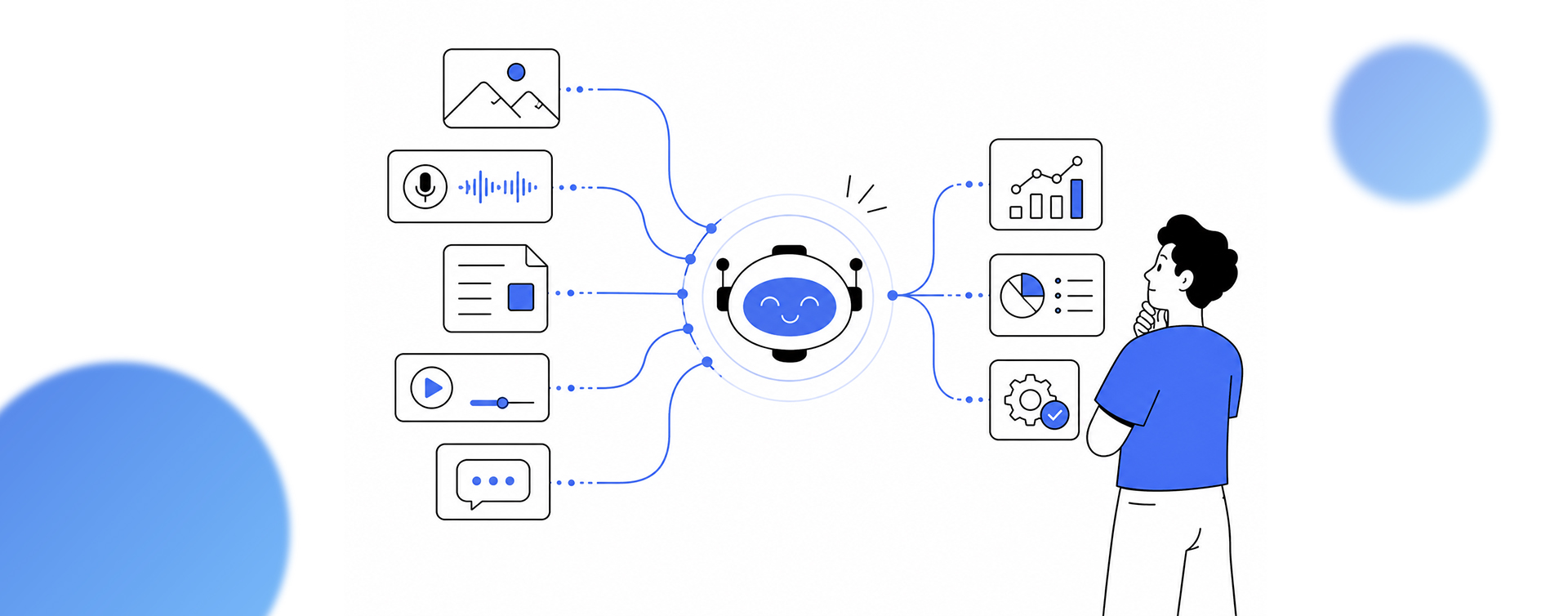
The easiest way to describe multimodal AI is to say it can understand text, images, audio, and video. That is also the least interesting way to describe it.
The real shift isn’t the number of input types it accepts. It’s the ability to connect information across them and reason over everything as a single problem. That’s much closer to how people make decisions. An insurance claim isn’t approved by reading a report alone. A product defect isn’t verified from a photo alone. Context comes from combining evidence, not analyzing each piece in isolation.
Traditional AI excels at individual tasks, but Multimodal AI excels at connecting them. Unimodal enterprise AI can read a customer complaint or inspect a screenshot. Multimodal AI can read the complaint, interpret the screenshot, connect the two, and recommend the next action.
The next question is where that capability creates real business value. Let’s look at multimodal AI examples to understand how businesses are already putting multimodal AI to work.
Key Takeaways
- Multimodal AI solves problems that single-modality AI cannot. By reasoning across documents, images, audio, video, and structured business data simultaneously, it understands the complete business context instead of isolated inputs.
- The highest-value applications already exist. Intelligent document processing, enterprise AI copilots, compliance review, visual inspection, and workflow automation are delivering measurable business outcomes across industries today.
- Success depends on integration, not just the model. The best enterprise implementations connect multimodal AI with existing CRMs, ERPs, knowledge bases, workflow engines, and business rules rather than deploying it as a standalone chatbot.
- Start with a workflow where information is fragmented. Processes that require employees to correlate documents, emails, images, forms, or reports manually are often the strongest candidates for multimodal AI.
- Keep humans in the loop for high-stakes decisions. Multimodal AI should accelerate analysis and present structured recommendations, while people retain responsibility for approvals, compliance, and business-critical decisions.
How are Businesses Using Multimodal AI?
Below are multimodal AI use cases that are already delivering value across industries, each solving a problem that requires more than one type of input at once.
1. Intelligent Document Processing and Data Extraction
Traditionally, organizations relied on OCR to extract text before employees manually verified, correlated, and entered the information into business systems. However, multimodal AI extends this process by interpreting text, document layout, tables, signatures, handwritten notes, and embedded images together. Instead of simply extracting text, it understands the relationship between different pieces of information and converts them into structured business data.
For one document-heavy insurance workflow, we developed a multimodal AI application that extracted and correlated information from claim forms, accident photos, repair estimates, and policy documents before presenting it as structured data. This reduced claim processing time from 40 minutes to around 10 minutes per claim, allowing analysts to focus on higher-value reviews rather than repetitive data extraction.
2. Enterprise Knowledge Search and AI Copilots
Finding information inside an enterprise is rarely straightforward. Employees often search across knowledge bases, SharePoint sites, emails, contracts, technical manuals, presentations, screenshots, and internal documentation before finding the answer they need.
By combining a multimodal foundation model with Retrieval-Augmented Generation (RAG), businesses can build AI copilots that retrieve relevant enterprise information and reason across both textual and visual content. Employees can upload a contract, a product image, or a technical drawing alongside a question, allowing the model to generate responses grounded in the organization’s own data rather than its pre-trained knowledge.
3. Intelligent Document Review and Compliance
Many regulated industries require employees to review large volumes of documents before approving applications, certifications, or business processes. These workflows often involve comparing information across PDFs, forms, identity documents, supporting evidence, and structured records.
Multimodal AI can interpret these documents together, identify missing information, validate required fields, and generate structured review summaries before the final approval stage.
We’ve applied this approach in both healthcare and housing compliance workflows. In one healthcare implementation, the system reviewed clinical documentation against predefined scoring criteria, highlighted missing information, and generated structured review reports. In another project supporting tenant certification, multimodal AI mapped uploaded income records, identity documents, and application forms to the correct applicant profile while identifying incomplete documentation before compliance review.
4. Visual Inspection and Operational Intelligence
Manual inspections remain a critical part of manufacturing, construction, utilities, and logistics, but visual evidence rarely tells the complete story. Inspection images are often accompanied by maintenance logs, equipment manuals, historical reports, and sensor readings that all contribute to operational decisions.
Multimodal AI combines these inputs within a single reasoning process, enabling businesses to detect anomalies, recommend corrective actions, and support predictive maintenance with greater context than standalone computer vision systems.
5. Workflow Automation Across Emails and Business Documents
Many enterprise workflows begin with an email rather than an application. Requests arrive with PDFs, spreadsheets, forms, images, and supporting documents that employees must manually review before routing them to the appropriate business process.
Multimodal AI can understand the email conversation alongside its attachments, classify the request, extract relevant information, and automatically trigger downstream workflows.
By combining email context with attached documents, our team built an application that automatically extracted business information, classified incoming requests, and routed structured outputs into internal workflow systems. We have also used the same multimodal pipeline to generate review-ready PDFs and document packages from the extracted data, significantly reducing repetitive administrative work.
Where are Industries Implementing Multimodal AI?
Every industry generates information differently, and here’s how businesses from different industries utilize multimodal AI to automate complex workflows that were previously difficult to scale:
| Industry | How Do Businesses Implement Multimodal AI? |
|---|---|
| Banking & Financial Services | Correlate loan applications, KYC documents, bank statements, customer emails, and identity images for underwriting, fraud detection, and onboarding. |
| Insurance | Analyze claim forms, accident photos, repair estimates, videos, and policy documents within a single workflow. |
| Healthcare | Combine medical images, physician notes, lab reports, prescriptions, and patient histories to support clinical decision-making. |
| Retail & E-commerce | Process product images, customer reviews, chat conversations, purchase history, and inventory data for search, recommendations, and customer support. |
| Manufacturing | Correlate production-line images, IoT sensor data, maintenance logs, inspection reports, and equipment manuals for quality assurance and predictive maintenance. |
| Logistics & Supply Chain | Analyze shipping documents, warehouse camera feeds, barcode scans, GPS data, and delivery images to monitor inventory and shipments. |
| Real Estate & Property Management | Process lease agreements, property inspection photos, maintenance requests, floor plans, and tenant communications. |
Have visual, audio, or document data you are not using yet?
We have built multimodal features across retail, insurance, healthcare, and document-heavy operations for 16 years. We will identify where multimodal AI fits your data, evaluate it against simpler alternatives, and incorporate human-in-the-loop review for high-stakes use cases.
Why Multimodal AI Is Becoming an Enterprise Priority
The reason why multimodal AI models and applications are becoming a priority for enterprises and businesses is that it transforms decision-making. Since multimodal AI applications can process data of different types, it provides a richer understanding of business context. Most of the business tasks require data that is scattered across documents, emails, images, videos, spreadsheets, and internal systems.
For example, processing an insurance claim may require correlating data from a claim form, accident photos, repair estimates, and the customer’s policy document.
Traditional AI would analyze each of these using separate OCR, computer vision, and NLP models before merging the results. However, multimodal AI reasons across all of them within a single model, preserving context and reducing the need for complex orchestration.
In the case of insurance claim processing, instead of analyzing each source independently, a multimodal AI model understands the relationships between them to generate a single, context-aware output.
This leads to more contextual insights, supports real-time analysis, and helps organizations make decisions based on a more complete picture rather than fragmented information.
How Do Multimodal AI Applications Benefit Businesses?
For most enterprises, the challenge is making sense of the data they already have. Customer interactions, invoices, inspection images, contracts, emails, recorded calls, and sensor data often exist in separate systems and formats, forcing businesses to rely on multiple AI models or manual processes to connect the information.
Here’s how multimodal AI applications help enterprises and businesses:
- Provides a complete business context: Rather than interpreting each data source independently, multimodal AI correlates information across documents, images, emails, audio, and structured records to generate more context-aware outputs.
- Simplifies enterprise AI architecture: A single multimodal model can replace multiple specialized AI pipelines, reducing integration effort, infrastructure complexity, and ongoing maintenance.
- Improves the quality of AI-driven decisions: By preserving relationships between multiple data sources, multimodal AI produces more reliable outputs for workflows such as claims processing, underwriting, quality inspection, and compliance.
- Automates complete business workflows: Instead of automating isolated tasks like document extraction or image classification, multimodal AI connects data ingestion, reasoning, and response generation into a single workflow, reducing manual intervention.
- Expands the scope of enterprise automation: As multimodal foundation models mature, organizations can automate workflows that were previously too complex because they required multiple AI models and human coordination.
Multimodal AI enables enterprises to move from disconnected AI capabilities to unified, context-aware systems that scale more efficiently, require less orchestration, and unlock broader automation opportunities.
How to Get Started with Multimodal AI in Your Business Operations?
After deploying multimodal AI applications across different industries, one thing has become clear: the success of a solution depends far less on the model you choose than on how well it integrates with your business operations. The model is only one component. The real value comes from connecting it to enterprise data, existing systems, and business workflows.
Depending on your objectives, there are several ways to implement it effectively.
1. AI Copilot with Enterprise RAG
An enterprise AI copilot combines a multimodal foundation model, such as GPT-4o, Gemini 2.5 Pro, or Claude 4, with Retrieval-Augmented Generation (RAG) to answer questions using an organization’s internal knowledge.
Rather than relying only on the model’s pre-trained knowledge, the application retrieves relevant information from document repositories, knowledge bases, CRMs, ERPs, and other enterprise systems before generating a response. This allows employees to query contracts, invoices, technical manuals, scanned documents, and images through a single conversational interface while ensuring responses remain grounded in the latest enterprise data.
2. Embed Multimodal AI into Existing Business Applications
Instead of deploying a standalone AI application, multimodal capabilities can be integrated directly into existing platforms such as insurance claims systems, loan origination software, manufacturing execution systems, or CRMs using APIs.
Models such as GPT-4o or Gemini 2.5 Pro process documents, images, forms, or audio submitted within the application, returning structured outputs without changing the user’s workflow. For example, an insurance claims platform can automatically correlate accident photos, repair estimates, and policy documents to generate a structured claim summary within the same interface employees already use.
3. Intelligent Document Processing (IDP)
Modern Intelligent Document Processing combines OCR engines such as Azure AI Document Intelligence, Google Document AI, or Amazon Textract with multimodal AI models to move beyond text extraction. While OCR identifies text and document layout, the multimodal model interprets tables, handwritten notes, signatures, stamps, embedded images, and supporting documents together to understand the document’s context. The resulting structured data can then drive downstream workflows such as invoice processing, KYC verification, compliance screening, or loan onboarding with minimal manual intervention.
4. Multimodal Visual Inspection Systems
Visual inspection systems combine computer vision with multimodal reasoning to analyze both visual and operational data. Images or video captured from cameras, drones, or production lines are evaluated alongside maintenance records, equipment manuals, sensor telemetry, and inspection reports using multimodal models such as Gemini 2.5 Pro or GPT-4o. This enables businesses to detect defects, identify anomalies, recommend corrective actions, and support predictive maintenance with greater contextual understanding than standalone computer vision models.
5. Event-Driven Workflow Automation
In an event-driven architecture, the multimodal AI model is integrated into the organization’s event bus or workflow orchestration platform. Instead of requiring users to manually invoke AI, the model is automatically triggered whenever a predefined business event occurs, such as a customer uploading an invoice, an email arriving in a shared mailbox, a support ticket being created, or an inspection image being received. This enables straight-through processing, reducing manual intervention while accelerating high-volume operational workflows.
The right multimodal AI implementation starts with the right workflow.
Our team helps businesses identify where multimodal AI creates measurable value, recommend the most suitable implementation approach, and integrate it seamlessly into existing enterprise systems.
How Much Will It Cost to Implement Multimodal AI?
The cost of implementing a multimodal AI application depends on the complexity of the solution, the deployment architecture, and whether you use pre-trained foundation models or build custom AI capabilities.
Industry pricing typically places multimodal AI proof-of-concepts at around $10,000 and above, while enterprise deployments can range from hundreds of thousands to several million dollars, depending on the scale, complexity, and business requirements.
The primary cost drivers include:
- Foundation model selection: Using API-based models such as GPT-4o, Gemini 2.5 Pro, or Claude 4 significantly reduces development costs compared to training a custom multimodal model. However, API costs increase with higher request volumes and multimodal inputs, which generally consume more tokens than text-only interactions.
- Custom model development: Organizations that require domain-specific models or on-premises deployments must invest in data collection, annotation, fine-tuning, GPU infrastructure, and model evaluation, making this the most expensive implementation approach.
- Infrastructure and integrations: Enterprise deployments require more than just the AI model. Costs also include cloud infrastructure, vector databases, storage, workflow orchestration, API integrations, monitoring, security, and ongoing maintenance, all of which contribute to long-term operational expenses.
Frequently Asked Questions
1. What is Multimodal AI?
Multimodal AI is a type of artificial intelligence model that can process heterogeneous data streams simultaneously. Modern multimodal AI models, such as GPT-4o and Gemini Pro, use text encoders for language, vision encoders for images and documents, speech encoders for audio, and video encoders that capture both spatial and temporal information. These representations are then fused within a transformer-based architecture, enabling the model to reason across all modalities together.
2. What is the difference between multimodal AI and Vision Language Models (VLMs)?
A Vision Language Model (VLM) is a type of multimodal AI model designed to understand and reason over images and text together. Multimodal AI is the broader category of AI systems that can process multiple data types, including text, images, audio, video, documents, and structured data.
3. What is the best multimodal AI model that businesses can use for enterprise applications?
The best multimodal AI model depends on the use case and deployment requirements. GPT-4o has proven to be a strong choice for general-purpose applications; Gemini 2.5 Pro excels at document-heavy and long-context workflows; Claude 4 is known for its reasoning and document understanding, while Llama 4 is well suited for organizations that require self-hosted deployments to meet privacy, security, or compliance requirements.
4. What is the difference between unimodal AI and multimodal AI?
Unimodal AI processes only one type of input, such as text, images, or audio, and generates outputs based on that single modality. Multimodal AI, on the other hand, can understand and reason across multiple data types simultaneously, including documents, images, audio, video, and structured data.
5. Is multimodal AI more expensive than text-only AI?
Yes, generally. Processing images and audio costs more per request than processing text, so multimodal calls carry a higher unit cost. The way to control it is to route only the work that genuinely needs multimodal reasoning through these models and keep purely textual tasks on cheaper text-only models. Used selectively where mixed data creates value, the higher cost is justified; used by default, it is wasted.
6. What is the difference between multimodal input and multimodal output?
Multimodal input refers to the different types of data an AI model can understand, such as text, images, audio, video, PDFs, or scanned documents. Multimodal output refers to the different formats the model can generate, including text, images, speech, or structured data.
7. Can Ariel help us build multimodal AI applications?
Yes. We help organizations identify where multimodal AI fits their data, choose between general vision-language models and specialized vision models, and build the feature with cost control and human review designed in. The review covers your data readiness, the use case, and simpler alternatives before any commitment. Get in touch for a delivery-grade conversation about your multimodal roadmap.
Use Multimodal AI Where Mixed Data Creates Value
The reason multimodal AI applications matter is simple: most real business information is not clean text. It is photos, scans, recordings, and shelf images, and multimodal models can finally read all of it together. The five uses in this guide, from visual assistance to claims, diagnostics, retail intelligence, and document processing, are already delivering value because each one solves a problem that needs more than one kind of input at once.
Apply it where the value genuinely lives in the pixels or the audio, not as a default. Pair general vision language models with specialized ones, keep a human in the loop on high-stakes decisions, and route only the work that needs multimodal reasoning through the more expensive models. Do that, and multimodal AI becomes a measurable advantage rather than an expensive experiment. Talk to Ariel about where multimodal fits your data, and we will help you build it with the discipline that produces real returns.
Ready to put your visual and audio data to work?
Book a free consultation with Ariel’s AI team. We will pinpoint where multimodal AI creates value in your operations, weigh it against simpler options, and design a deployment with cost control and human review built in.