Fourteen Thousand Applications, One Shot at Occupancy
- Affordable Housing
- AI-powered
- 6 min read

Stat Strip
The Numbers Behind the Lease-Up
The Riskiest Event in Affordable Housing Happens Once
A new affordable building opens once. The lease-up that follows decides whether the owner hits its occupancy covenant, whether the regulator signs off, and whether the first year is profitable or written off.
The economics are unforgiving. A single 197-unit affordable lottery can draw 10,000 to 30,000 applications. Every one has to be logged, ranked, screened against income limits, household-size rules, set-asides, and preferences, then documented well enough to survive an agency audit years later. Meanwhile the building sits finished, the debt keeps drawing interest, and every empty unit is pure loss.
Almost none of that work runs on automation today. Most housing teams still run lease-up on spreadsheets, shared inboxes, and paper files.
Five Jobs That Used to Belong to a Tired Team
- Manual intake: Paper applications, agency waitlist exports, and lottery log files arrive in a dozen formats and get retyped by hand.
- Eligibility re-derived by hand: Income limits, asset imputation, student rules, preference tiers, and set-aside math get recalculated per applicant, per pass, and quietly drift between staff members.
- Documents that drown the team: Pay stubs, benefit letters, tax returns, bank statements, ID, and landlord references, six to nine per household, each read by eye against what the applicant declared.
- Correspondence as a second job: Eligibility letters, ineligibility notices, appointment letters, requests for more information, unit offers, appeal decisions, and lease packets, all templated by hand and all legally consequential.
- Oversight running through email: The supervising agency requests files, staff assemble PDFs and mail them, findings come back in a spreadsheet, and nobody can prove the audit trail holds together.
An AI Layer That Reads, Decides, and Drafts End to End
The team did not bolt a chatbot onto a leasing system. The lease-up pipeline got rebuilt so the reading, the arithmetic, and the paperwork run by machine, leaving people with judgment calls only.
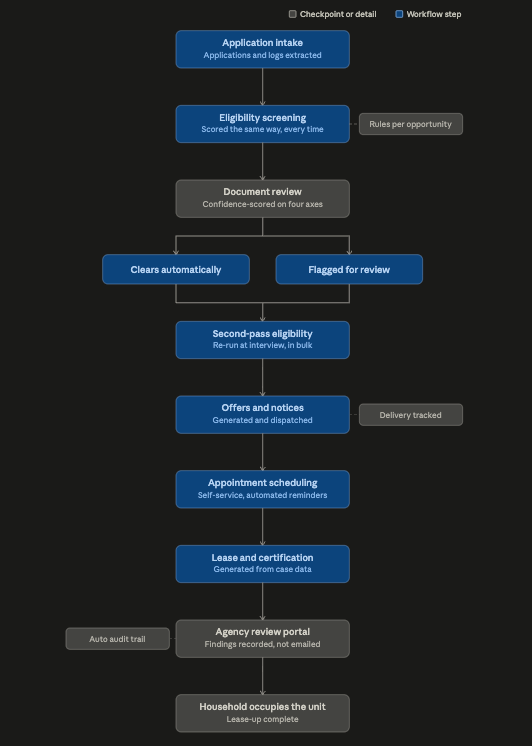
- AI application and waitlist extraction: Paper applications, agency lead files, and lottery logs get parsed by a multimodal model directly from the native PDF, with an OCR fallback for low-quality scans. Applicant, household, income, and contact fields land structured, with no retyping.
- Automated eligibility screening: A rule engine holds income limits, set-asides, preferences, household-size and student rules per development, with documented overrides per opportunity. Every applicant gets scored the same way, every time, and the whole waitlist can be re-run in bulk when a limit changes.
- Document reading and confidence scoring: Each uploaded document gets classified, field-extracted, and scored on four axes: field presence, match against the declared profile, date validity, and source credibility. Anything below the confidence threshold gets flagged for a person; everything above it moves on untouched.
- Generated notices, offers, and lease packets: Eligibility and ineligibility notices, information requests, unit offers, refusal records, appeal decisions, income certifications, and full lease packets get generated from live case data into the organization’s own templates, then delivered by email, text, or mail with delivery tracking.
- An API the assistant operates directly: A dedicated agentic endpoint lets the assistant do real work, beyond answering questions: create and publish opportunities, import waitlists, process applications, pull eligible units by log number, issue unit offers in bulk, and generate certifications and leases, under a scoped key with full attribution.
- A lease-up operations assistant: A conversational agent grounded in the organization’s own rules and live case data. Staff ask which log numbers are still missing income documents instead of building a report. New hires reach productivity in days, not quarters.
- An agency review portal: Supervising agencies get their own portal: applications, marketing plans, certification documents, and reports in place, with review requests and findings recorded against the file. Email-and-spreadsheet review disappears.
- Spend attributed per document: Every AI call gets logged against the document, applicant, and organization that caused it, with quota alerting. Unit economics of the AI layer stay known, not guessed.
Where the Manual Effort Went
| Lease-up step | Manual process | With the platform |
|---|---|---|
| Application and waitlist intake | Keyed by hand, about 6 minutes per application | Extracted automatically, staff confirm exceptions only |
| First-pass eligibility | About 9 minutes of manual math per applicant | Rule engine scores the full list in one run |
| Document review | Every page read by eye against the profile | Fully machine-read, about 12% flagged for a person |
| Second-pass eligibility | Whole cohort re-screened by hand at interview | Re-run in bulk by organization or opportunity |
| Notices, offers, leases | Templated one by one, proofread individually | Generated from case data, issued in bulk |
| Appointment scheduling | Phone tag against a shared calendar | Slot-based self-scheduling with automated reminders |
| Agency oversight | PDF packets by email, findings in a spreadsheet | Live portal with review requests and recorded findings |
| Audit evidence | Reconstructed after the fact from folders | Captured continuously as the work happens |
Three People Doing the Work of Ten
| Conventional team, 10 people | 1 lease-up manager, 5 intake and eligibility specialists, 2 document reviewers, 1 scheduler, 1 agency liaison |
| AI-enabled team, 3 people | 1 lease-up manager, 1 exception reviewer, 1 compliance and agency liaison |
| Role | Annual manual load | Absorbed by |
|---|---|---|
| Intake specialists (3) | 14,000 applications keyed and de-duplicated | Multimodal extraction plus log-number matching |
| Eligibility specialists (2) | About 2,100 hours of eligibility math | Rule engine with per-opportunity overrides |
| Document reviewers (2) | About 11,000 documents read page by page | Extraction plus four-axis confidence scoring |
| Scheduler (1) | Over 1,600 interview appointments booked by phone | Self-service slots with automated reminders |
The three people who stay are the three whose judgment a model cannot reproduce: the manager who owns the occupancy plan, the reviewer who adjudicates flagged exceptions and appeals, and the compliance lead who answers to the agency. The software took the volume. People kept the decisions.
What the Module Is Actually Worth
- 70% reduction in lease-up staffing.
- 4 months faster to stabilized occupancy.
- About 88% of documents cleared without human review.
- 100% of eligibility decisions rule-traced and auditable.
- Revenue beyond the staffing line: Cutting a lease-up team from ten to three is a visible saving. The bigger number sits in the calendar: every month of accelerated lease-up on a 197-unit building is a month of collected rent that would otherwise be lost, plus lower interest carry on construction debt and earlier conversion to permanent financing. On a mid-size affordable asset, four recovered months is typically worth more than the entire annual cost of the staff who got redeployed.
- Risk that surfaces years later: Affordable housing gets audited after the fact. A file that cannot show why an applicant was found eligible, or why one was skipped, becomes a finding, and findings threaten tax credits and subsidy contracts. Because every eligibility decision comes from a versioned rule with recorded overrides, and every document carries its own extraction and confidence record, the audit file builds itself while the work happens.
- Fairness that can be shown: Applying identical rules to 14,000 applicants is something software does, and tired people do not. That consistency is not a nice-to-have. It is the core defense against a fair-housing complaint.
- Rules live in configuration, not code: New programs, limits, and set-asides onboard without engineering work.
- The API means capability, not conversation: The assistant can actually publish an opportunity or issue a hundred-unit offers, instead of only describing how to.
- AI spend gets measured per document: Gross margin on the AI layer stays known at the unit level, and improves as models get cheaper.
Lease Up Faster, With Fewer People, and Prove Every Decision
Ariel builds the systems affordable housing teams run their highest-stakes event on. If your organization is staffing up for a lease-up, or just lived through one, our team can show you the same pipeline running against your programs, your templates, and your oversight agency.
Figures in this case study model a reference lease-up: a 197-unit, three-income-band property drawing 14,000 applications. They illustrate the operating leverage of the module rather than one named client’s result. Actual outcomes vary with portfolio size, program mix, application volume, and incoming data quality.