Every Vacant Day Has a Price Tag
- Affordable Housing
- AI-powered
- 6 min read

Stat Strip
The Numbers Behind the Lease-Up
One Vacant Unit Carries the Full Weight of a Lease-Up
When a market-rate unit goes vacant, an owner advertises it. When an affordable unit goes vacant, the team has to go back to a regulated waitlist, work it in strict order, re-qualify every candidate against current income limits, document the whole chain, and defend it later.
A 4,800-unit portfolio turns over roughly 330 units a year. Each one is its own miniature regulated leasing project, and unlike lease-up, there is never a moment when the work stops.
The dominant cost is not staff time. It is vacancy loss: rent that never gets collected because the unit sat empty while a regulated process ground forward.
Six Places Where a Vacancy Just Sits
- Vacancies are discovered late: A notice to vacate lands in one system, the waitlist lives in another, and days pass before anyone starts working the unit.
- The waitlist has to be worked in order: Skipping a household, even by accident, is a fair-housing exposure, so staff works the list slowly and defensively.
- Most candidates have gone stale: Applicants queued years ago have moved, changed income, or lost interest. Teams burn weeks of contact attempts to reach one qualified household.
- Re-qualification means a full file: Income, assets, household composition, and student status all get re-verified against today’s limits, not the limits in place when they applied.
- The paperwork tail runs long: Offer letters, refusals, information requests, appeal decisions, income certifications, and lease packets, each generated and proofread by hand.
- Nobody sees the pipeline: Which units are vacant, at which step, blocked on what: that answer lives in someone’s head or a spreadsheet updated on Fridays.
Turning Each Vacancy Into a Tracked Pipeline
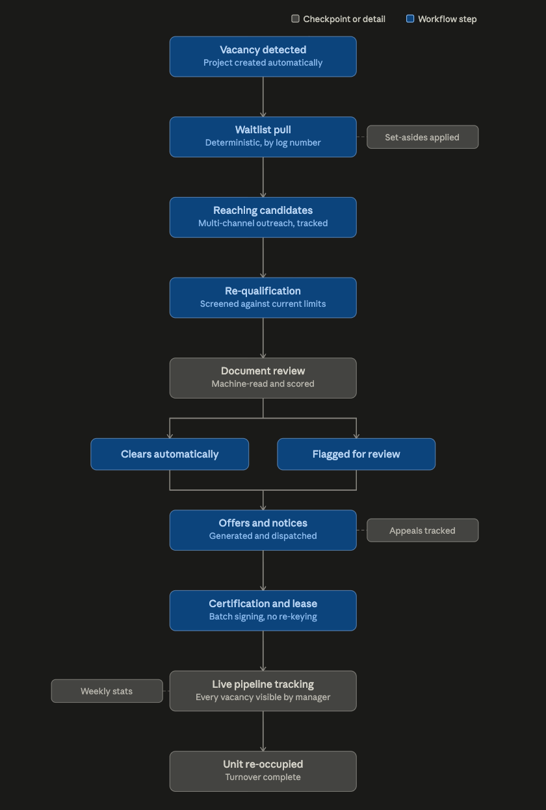
- Vacancy to project, automatically: Vacated units create a re-rental project without anyone opening a form. Units can be vacated and projected in bulk, so a building-wide turnover is one action instead of forty.
- Waitlist pull in strict, provable order: Candidates get drawn by log number against the project’s set-asides and preferences. The order stays deterministic and reproducible: the same inputs always produce the same list, which is exactly what an auditor wants to see.
- Automated re-screening against current limits: Instead of re-deriving eligibility by hand, the rule engine re-runs each candidate against today’s income limits, household rules, and unit fit, for a single unit or the whole portfolio at once.
- Extraction and confidence scoring: Income, asset, and identity documents get machine-read and scored on field presence, profile match, date validity, and source. Only low-confidence documents reach a reviewer.
- Generated offers, refusals, and decisions: Unit offers, offer-refusal records, information requests, ineligibility notices, and appeal decisions get generated from live case data into the organization’s templates and dispatched with delivery tracking.
- Bulk certification signing and lease generation: Ready-to-sign certifications get presented as a batch and executed together instead of one file at a time. The lease packet gets generated from the same case data with no re-keying.
- Structured appeal handling: Appeals exist as first-class records with their own queue, decision letters, and audit trail, not an email thread that has to be reconstructed under scrutiny.
- Live turnover pipeline: Summary and case-level views show every vacancy, its step, its age, and its blocker, scoped to each manager’s own developments, with automated weekly statistics by development.
- An assistant that can act: Through a scoped agentic interface, the assistant can look up applications by log number, pull eligible units, create unit offers in bulk, and generate certifications and leases, so working the next ten vacancies is a request, not a week.
The Turnover, Step by Step
| Turnover step | Manual process | With the platform |
|---|---|---|
| Vacancy detection | Noticed days later, opened by hand | Project created automatically on vacate |
| Waitlist pull | Worked slowly and defensively by log number | Deterministic pull against set-asides and preferences |
| Reaching candidates | Sequential calls and letters, weeks of dead ends | Automated multi-channel outreach with delivery status |
| Re-qualification | Full eligibility re-derived by hand per candidate | Rule engine re-run against current limits |
| Document review | Every page read against the declared profile | Machine-read and scored, exceptions only |
| Offers and notices | Templated and proofread individually | Generated from case data, dispatched and tracked |
| Certification and lease execution | Signed one file at a time | Batch signing, lease generated from the same data |
| Pipeline reporting | Weekly spreadsheet, already out of date | Live per-development pipeline plus automated weekly stats |
A Ten-Person Leasing Team Down to Three
330 regulated turnovers a year is a ten-person leasing and compliance operation. With the pipeline automated, it is three people supervising exceptions.
| Conventional team, 10 people | 1 leasing manager, 3 waitlist and outreach clerks, 3 eligibility specialists, 2 document reviewers, 1 lease and certification administrator |
| AI-enabled team, 3 people | 1 leasing manager, 1 exception and appeals reviewer, 1 applicant-relations specialist |
| Role | Annual manual load | Absorbed by |
|---|---|---|
| Waitlist and outreach clerks (3) | Thousands of contact attempts to fill 330 units | Automated ordered pull plus multi-channel outreach |
| Eligibility specialists (2) | Full re-qualification per candidate, per vacancy | Bulk re-screening against current limits |
| Document reviewers (1.5) | About 9,000 documents read page by page | Extraction plus confidence-threshold routing |
| Lease and certification admin (0.5) | 330 certifications and lease packets assembled by hand | Generated from case data, batch signing |
What is left is judgment: who gets the manager’s attention, which appeal has merit, which household needs a real conversation. The machine works the list. People work the exceptions.
The Case for Fewer Vacant Days
- 31 days average vacancy, down from 62.
- About $590,000 in rent recovered per year on 330 turnovers.
- 70% reduction in turnover staffing.
- 100% of waitlist pulls are reproducible and auditable.
- Vacancy days are the whole argument: At a representative affordable rent of roughly $58 per unit per day, halving the fill time on 330 annual turnovers returns on the order of $590,000 of rent the portfolio previously never collected. That figure recurs every year; it grows linearly with portfolio size, and it dwarfs the labor saving sitting next to it.
- Fair-housing defensibility, by construction: The single largest legal risk in re-rentals is being unable to explain why one household was housed, and another was passed over. Because selection order stays deterministic, overrides get recorded, and every notice carries delivery evidence, the answer to why this household is a report, not an investigation.
- The portfolio becomes visible: Owners and asset managers get a live view of every vacancy, its age, and its blocker, per development, per manager. Problems surface while they are still fixable instead of at quarter end.
- Turnover never stops: Unlike lease-up, this is a permanent, repeating flow. Automation pays every month.
- Value scales with unit count: That makes the module compelling to larger owners and third-party managers.
- It shares the same engine as the other modules: One rules layer, one document intelligence layer, one audit trail across the whole portfolio.
Cut Your Vacancy Days in Half
Ariel builds the systems affordable housing teams run their turnover pipeline on. If regulated turnover is holding units empty for two months at a time, our team can show you the same pipeline running against your waitlists, your set-asides, and your templates.
Figures in this case study model a reference portfolio of 4,800 assisted units with roughly 330 annual turnovers, at an assumed average rent of about $58 per unit per day. They illustrate the operating leverage of the module rather than one named client’s result. Actual outcomes vary with portfolio size, market, waitlist quality, and program mix.