
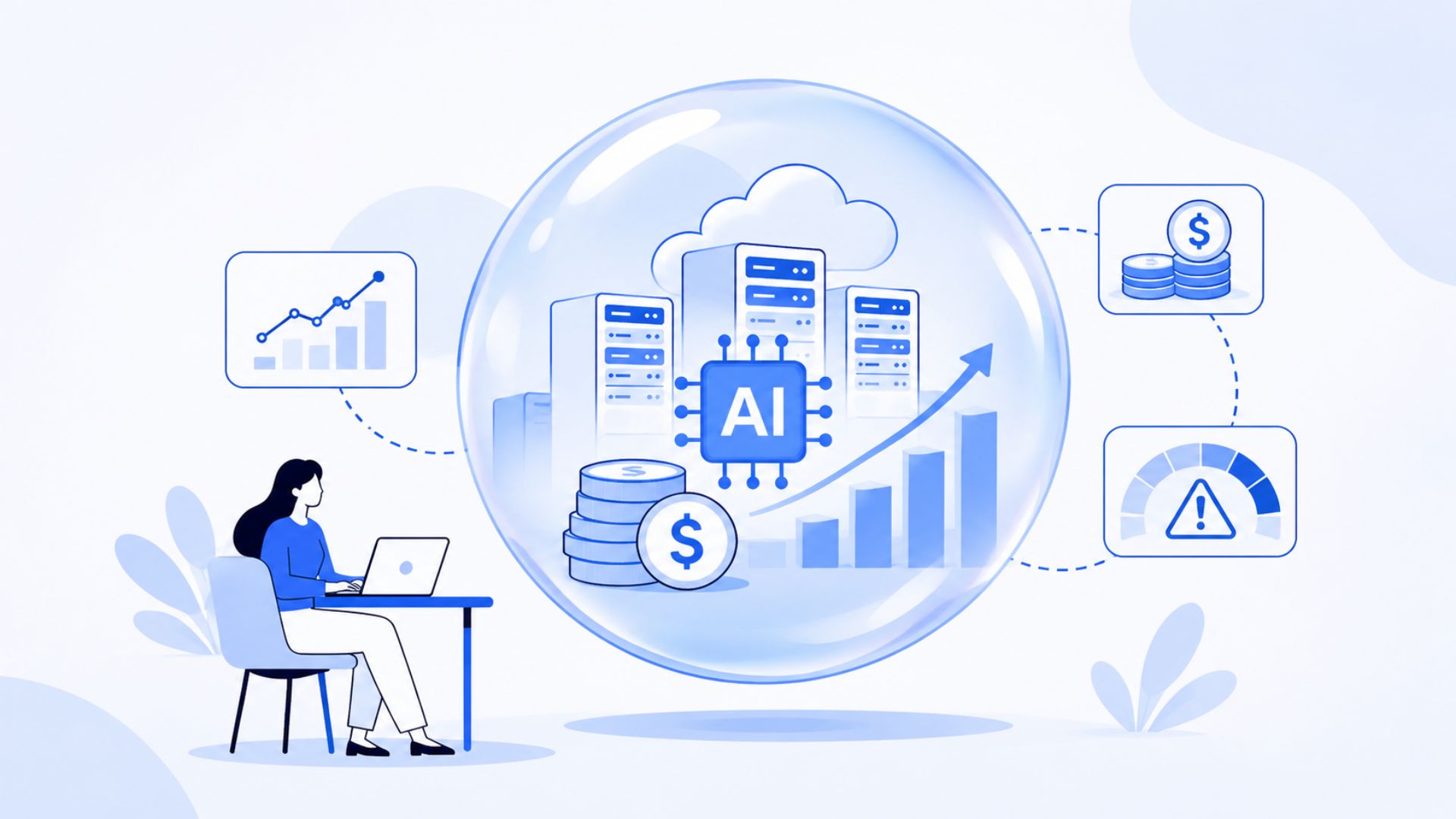
The AI industry is entering 2027 with a difficult question: Can the billions being invested in artificial intelligence generate enough revenue and business value to justify the spending?
Goldman Sachs Research estimates that major US hyperscalers will spend approximately $800 billion on capital expenditure in 2026, with that figure potentially reaching $1.2 trillion in 2027. These estimates include broader infrastructure spending, not exclusively AI. Yet while investment continues to grow, enterprises face a different reality: many are implementing AI without seeing financial returns grow faster than their spending.
This disconnect is driving the AI bubble debate in 2026 and raising concerns about a potential AI market crash in 2027. However, the greater risk may not be that AI fails as a technology, but that financial expectations run ahead of the value it can deliver.
Understanding that distinction is important for investors, technology providers, and businesses deciding where AI deserves a place in their operations.
Is AI a Bubble? Understanding What Is Actually at Risk
An investment bubble occurs when asset valuations become difficult to justify through expected future earnings and cash flows. For artificial intelligence, three concerns are driving the debate:
- High valuations: Some AI companies are priced for exceptional future growth. Even strong businesses can experience valuation corrections when financial results fall below expectations.
- Infrastructure overinvestment: Technology providers are building data centers, acquiring processors, and securing computing capacity before knowing exactly how much future demand will materialize.
- Uncertain enterprise returns: Businesses are adopting AI, but deploying a technically functional solution does not automatically create measurable financial benefits.
These risks should not be confused with the technology becoming irrelevant. The dot-com crash provides a useful comparison: many internet-related companies failed or lost substantial market value, but the underlying technology continued reshaping commerce, communications, and enterprise software.
A similar distinction applies to AI. A financial correction could change which companies attract investment and which business models remain viable without reversing the progress made in AI applications.
How Much Is Being Invested in AI in 2026 and 2027?
The scale of AI infrastructure investment is extraordinary. According to Goldman Sachs Research, capital expenditure by major US hyperscalers could increase from approximately $800 billion in 2026 to $1.2 trillion in 2027.
This spending supports advanced processors, data centers, cloud infrastructure, networking, and the energy systems required to train and operate AI models. The economics are complicated by the different lifespans of these investments. A data center may remain useful for decades, while AI hardware can become less economically competitive much sooner as more efficient processors emerge.
Infrastructure operators must therefore recover substantial investments while continuing to fund upgrades and expansion. Whether customer demand and AI-generated revenue will grow quickly enough to support that cycle remains one of the industry’s most important financial questions.
Why the AI Boom May Continue Despite Bubble Concerns
There are credible reasons to believe AI adoption will continue expanding.
Microsoft reported $63.9 billion in cloud revenue for the quarter ended September 30, 2026, representing 30% year-over-year growth. Azure revenue increased 48%. These figures reflect broader cloud services, not solely AI, but demonstrate substantial commercial demand for the infrastructure supporting enterprise applications.
The long-term opportunity also extends beyond consumer chatbots. Organizations are exploring AI for document processing, operational analytics, knowledge retrieval, software development, and workflow automation. Businesses do not necessarily need to develop their own foundation models to participate; they can integrate existing models into their software and connect them with relevant business data to support specific operational tasks.
ING’s November 2026 outlook anticipates continued investment growth in 2027, although its base case is closer to a high-level plateau than an immediate collapse.
For enterprises evaluating where AI fits into their operations, Ariel’s AI development services focus on identifying suitable business problems, assessing technical requirements, and designing systems for production use.
Where Are the Biggest AI Investment Risks?
The risks become clearer when examining how the industry finances, deploys, and commercializes AI.
1. Spending May Outpace Revenue Growth
AI infrastructure requires major upfront investment, while returns may take years to materialize. If demand grows more slowly than anticipated, companies could struggle to generate returns sufficient to justify their capital commitments.
2. Infrastructure Costs Remain Substantial
Developing AI models is only one component of the cost. Operating them requires computing capacity, storage, networking, electricity, and ongoing infrastructure management. Competition and improved model efficiency could reduce prices for customers while placing pressure on providers’ margins.
3. Financing Relationships Are Becoming More Interconnected
Chip manufacturers, cloud providers, AI developers, and data-center operators increasingly depend on overlapping commercial and financial relationships. These arrangements can support expansion, but they may also increase exposure if one major participant experiences financial difficulties.
4. Enterprise Adoption Does Not Guarantee Profitability
Organizations may invest in AI licenses, integrations, and pilot programs without achieving significant improvements in operating costs or revenue. If this continues, businesses may become more selective about which AI initiatives receive funding.
The underlying concern is not simply excessive investment. It is investment without sufficiently demonstrated returns.
What Could Trigger an AI Market Correction in 2027?
Several developments could put pressure on AI-related valuations:
| Potential Trigger | Possible Consequence |
|---|---|
| Slower AI revenue growth | Investors reconsider future earnings expectations. |
| Reduced hyperscaler spending forecasts | Infrastructure suppliers face weaker anticipated demand. |
| Disappointing enterprise ROI | Businesses delay or reduce AI expansion. |
| Higher financing costs | Capital-intensive projects become more difficult to fund. |
None of these indicators independently proves that an AI market crash is imminent. For example, lower infrastructure spending could reflect improving efficiency rather than falling demand.
A more serious warning would be sustained evidence that revenue and financial returns are failing to justify investment commitments. The critical test for 2027 is whether commercial results begin catching up with expectations.
The Enterprise AI Reality Gap: Why Investment Does Not Always Deliver ROI
The challenges facing AI infrastructure investors have a parallel inside enterprises. Organizations are becoming increasingly capable of deploying AI, but successful deployment and measurable financial returns are not the same thing.
The Fifth Annual Domino Enterprise AI Report, published in July 2026, surveyed 639 senior enterprise AI leaders and found that 93% reported improved AI production capability, while 57% reported that returns on AI investments were not growing faster than their spending.
These findings reflect the surveyed organizations, not a universal failure rate for AI projects. However, they highlight an important challenge: getting AI into production does not guarantee that business users can translate its outputs into useful actions.
Consider an AI document-processing application. A successful demonstration might extract dates, financial figures, or contractual terms from uploaded files. But production software must also handle inconsistent document formats, verify important fields, record exceptions, respect access permissions, and transfer approved information into existing business systems. Without those capabilities, employees may continue checking and re-entering information manually, leaving much of the anticipated efficiency unrealized.
Gartner’s forecast that more than 40% of agentic AI projects will be canceled by the end of 2027 reinforces the need for disciplined implementation. Gartner identifies escalating costs, unclear business value, and inadequate risk controls as contributing factors.
A successful AI implementation must therefore be judged by the workflow it improves, not merely the model it deploys.
How Can Businesses Make AI Investments Pay Off?
The AI bubble debate offers a practical lesson for enterprises: uncertainty in the market makes disciplined technology decisions more important. Organizations should evaluate AI investments through five considerations.
1. Define the Business Outcome Before Selecting AI
Begin with a measurable operational problem. Is the objective to reduce document-processing time, improve customer response quality, shorten approval cycles, or reduce manual errors?
Establish the existing performance baseline before introducing a new solution. Without it, organizations cannot reliably determine whether AI has improved the process. This is central to evaluating data science ROI: identifying the business decision, measuring current performance, and determining whether the proposed solution can improve it.
2. Evaluate Existing Systems and Integration Requirements
AI rarely operates in isolation inside an enterprise. It may need to interact with CRMs, ERPs, document repositories, databases, or industry-specific platforms.
Businesses should assess data quality, access requirements, API capabilities, and workflow dependencies before implementation. The objective is not simply to produce an AI-generated answer, but to make that output usable within an existing business process.
3. Choose the Appropriate Technology
Not every automation problem requires generative AI. Some processes are better addressed through conventional software, predefined business rules, or simpler integrations.
AI becomes more valuable when tasks involve interpreting unstructured information, handling language variations, or supporting decisions that are difficult to express through fixed rules. Choosing the simplest reliable approach can reduce development complexity, operating costs, and maintenance requirements.
4. Include Production Costs in the Business Case
Development expenses alone cannot determine the financial viability of an AI initiative. Businesses must also account for model usage, hosting, monitoring, security, human review, and ongoing maintenance.
For example, multi-step AI workflows may generate several model requests for a single completed task. As usage increases, those costs can become significant. Effective AI FinOps practices help organizations monitor consumption, optimize model usage, and evaluate costs against the actual business activity being performed.
5. Validate the Outcome Before Scaling
A pilot should establish more than technical feasibility. It should determine whether the proposed system performs reliably on representative data and improves the selected business metric.
For document automation, that could mean measuring accepted documents per hour, manual review time, error rates, and cost per successfully processed document. For an AI assistant, it could mean measuring correctly resolved requests, escalation frequency, and the total cost of resolution.
A project should advance because its results justify expansion, not because its initial demonstration was impressive.
A Practical AI Investment Readiness Check
Before approving a larger AI initiative, decision-makers should be able to answer five questions:
- 1. Which business outcome will improve?
- 2. How is the process performing today?
- 3. Can the solution work securely with existing systems?
- 4. What will each successful task cost at production scale?
- 5. What evidence will justify further investment?
If these questions cannot be answered, the next investment may need to be in discovery, data preparation, or architecture rather than another AI pilot.
What Ariel’s Project Experience Shows About Production AI
The gap between an AI demonstration and a dependable business application is primarily an engineering challenge.
Ariel Software Solutions’ publicly documented project involving a governed Claude integration with Google Sheets and Google Drive illustrates this distinction. The requirement went beyond allowing an AI assistant to retrieve information; the system also needed to interact with operational data while keeping critical changes controlled and traceable.
Ariel developed an integration using the Model Context Protocol (MCP), with human approval for critical write operations, audit logging, and revision recovery. The publicly available project example demonstrates an important principle: enterprise AI requires safeguards around what a model can access, which actions it can perform, and how failures are handled.
That engineering discipline becomes increasingly important when organizations need their AI investments to withstand greater financial and operational scrutiny.
If the AI Bubble Bursts, What Happens to Enterprise AI?
A financial correction would not automatically eliminate demand for useful AI applications. Businesses are likely to continue investing in solutions that demonstrate measurable improvements in efficiency, accuracy, or service delivery.
What may change is the level of scrutiny applied to new projects. Organizations could become less willing to fund open-ended experimentation and more focused on implementation costs, system reliability, vendor flexibility, and measurable outcomes.
A market correction could therefore accelerate a shift from AI experimentation toward more selective, business-led adoption.
Conclusion: The Real Test of AI Is Business Value
Will the AI bubble burst in 2027? There is no reliable basis for predicting that outcome with certainty.
AI investment remains substantial, commercial demand is growing, and the technology continues developing. However, those conditions do not guarantee that every infrastructure investment or enterprise implementation will produce acceptable returns.
For businesses, the better question is not when the AI bubble might burst, but whether their AI investments are designed to deliver sustainable value.
At Ariel Software Solutions, that means approaching AI through business requirements, sound architecture, controlled integration, and measurable outcomes rather than treating the technology itself as the objective.
Planning an AI initiative or reassessing an existing investment? Start with an architecture and implementation-readiness review to identify practical opportunities, technical constraints, and the costs that need to be understood before scaling.
Begin the conversation with Ariel’s team.
Frequently Asked Questions
1. Is AI a bubble in 2026?
AI investment shows some characteristics associated with financial bubbles, including substantial capital expenditure and ambitious growth expectations. However, AI also has commercially useful applications. Investment valuations may correct without reducing the technology’s long-term relevance.
2. Is the AI bubble likely to burst in 2027?
No specific market correction can be predicted reliably. Investment forecasts remain strong for 2027, although risks involving revenue growth, infrastructure spending, financing, and enterprise adoption could put pressure on valuations.
3. What could cause an AI market crash?
Potential triggers include disappointing AI revenue, reduced infrastructure demand, rising financing costs, and insufficient returns from commercial adoption. A serious correction would be more likely if several of these pressures occurred together.
4. Why do businesses struggle to achieve AI ROI?
Common challenges include unclear objectives, poor data quality, difficult integration, underestimated operating costs, and insufficient performance measurement. A technically successful AI deployment may still fail to generate enough financial value.
5. How should companies approach AI investment in 2027?
Businesses should prioritize clearly defined use cases, establish measurable baselines, evaluate integration and security requirements, and calculate realistic operating costs. Scaling should depend on demonstrated business outcomes rather than market enthusiasm.