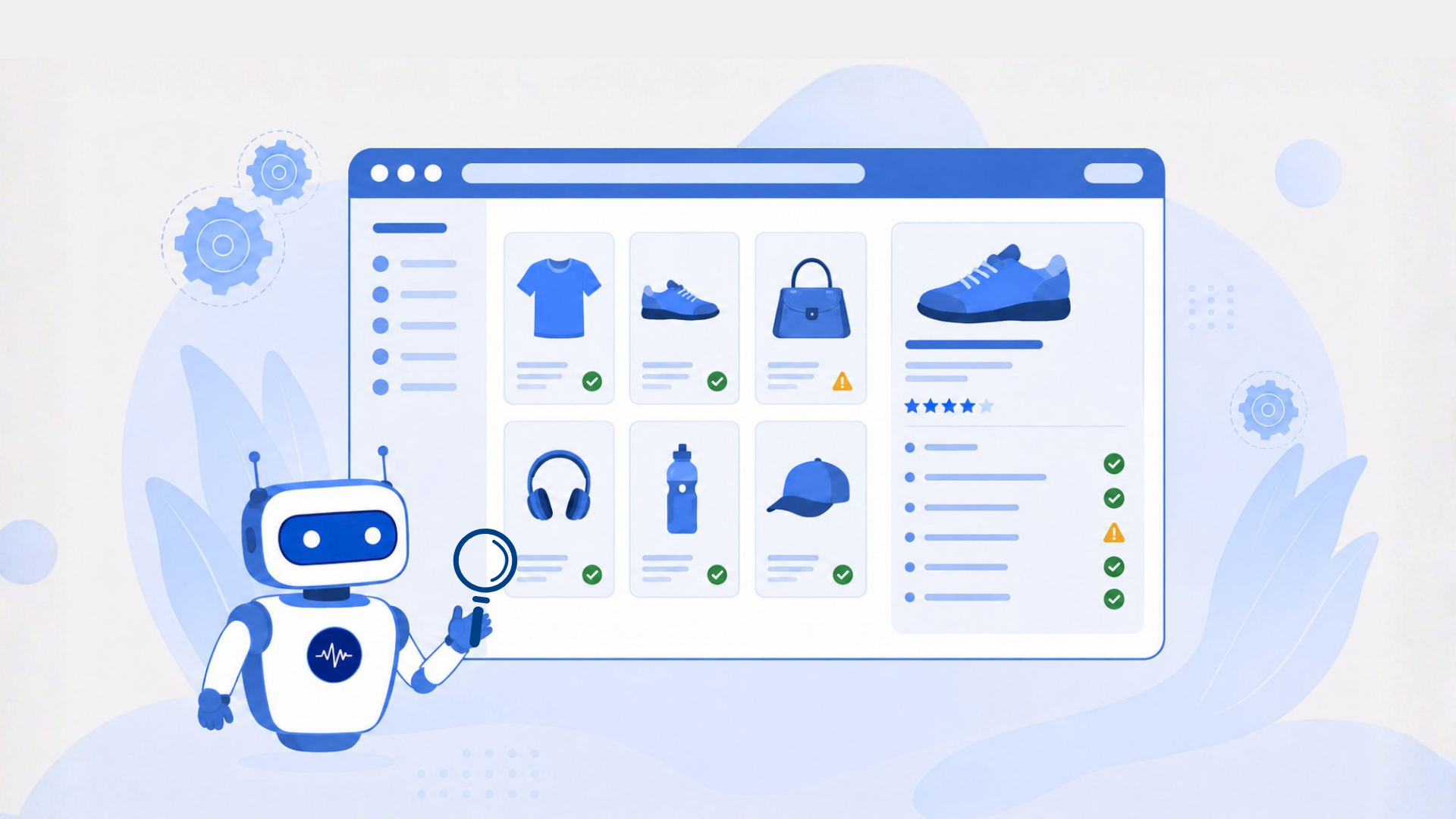
Somewhere in your analytics, a referral source has been climbing for months: chatgpt.com, gemini.google.com, an “AI Overview” line that did not exist a year ago. Or it isn’t showing up at all, which is worse, because a competitor’s SKUs are appearing inside ChatGPT and Gemini shopping results for queries yours should win. Or the board asked whether the company is “AI ready,” and the honest answer took too long to build.
This is a data question, not a strategy one. AI shopping agents rely on structured data, product feeds, and public web content, not a human browsing session, and most catalogs weren’t built with that mix in mind. Here is how to find out where yours stands.
Why this got real in the last eight months
Agentic commerce shipped as real infrastructure inside one fiscal year, and three developments explain most of the shift.
Google announced the Universal Commerce Protocol (UCP) on January 11, 2026, at NRF, co-developed with Shopify and backed at launch by Etsy, Wayfair, Target and Walmart, plus 20-plus partners including Visa, Mastercard and Stripe.
OpenAI took a different path with ChatGPT’s Instant Checkout, launched September 29, 2025, then rebalanced on March 24, 2026 toward discovery and merchant-owned checkout. Most coverage gets this backwards: Instant Checkout was not shut down and can still appear for select products, but it’s no longer the default. The Agentic Commerce Protocol (ACP) behind it is being expanded, not retired, now covering discovery for Target, Sephora, Nordstrom, Lowe’s, Best Buy, The Home Depot and Wayfair.
In April 2026, Google donated AP2 to the FIDO Alliance for open governance, alongside a “Human Not Present” payment capability.
The protocol stack, in one table
The common mistake in vendor pitches is treating UCP, ACP, AP2, and MCP as competitors, four contenders for one job. They are not. Each sits at a different layer.
| Protocol | Layer | Who is behind it | What it decides | Status (Aug 2026) |
|---|---|---|---|---|
| MCP | Data access: AI-to-live-data connections | Anthropic, open-sourced Nov 2024; now under the Agentic AI Foundation (Linux Foundation) | Whether an AI system can query your catalog directly; one route among several, not required for discovery | Open standard, broadly adopted |
| UCP | Full journey: discovery to post-purchase, mainly Google | Google with Shopify; backed by Etsy, Wayfair, Target, Walmart | Whether a shopper can buy inside Google AI Mode or Gemini without leaving the chat | Live for eligible retailers since Jan 2026 |
| ACP | Discovery and merchant checkout, mainly ChatGPT | OpenAI and Stripe, Apache 2.0, Sept 2025 | Whether ChatGPT surfaces products in comparisons and routes to a checkout you control, including in-chat purchase for some products | Active; shifted toward discovery after Mar 2026 |
| AP2 | Payment authorization, one option among several | Originally Google, now FIDO Alliance | Whether an agent can hold a scoped mandate to pay, where supported | v0.2 live, FIDO-governed |
Read this by layer, not rank. MCP is one route to your live data, not a discovery requirement. AP2 is one payment mechanism, not something ACP or UCP depend on. A merchant can be well integrated with one protocol and invisible under another, which is why a single “are we AI ready” answer rarely survives follow-up questions.
Where the agent journey actually breaks
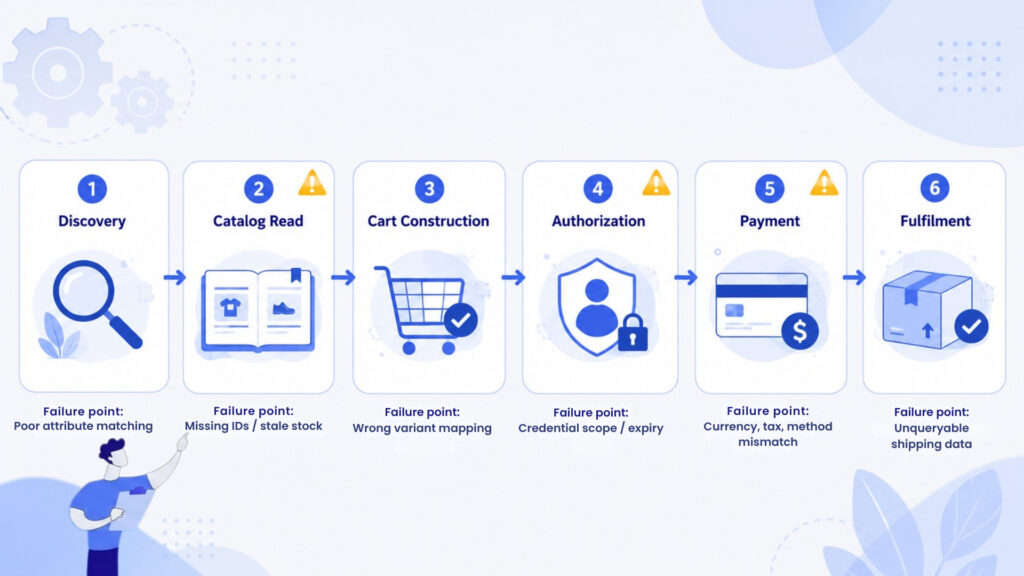
The six stages
- Discovery. The agent matches your product to a natural-language query, not a keyword. Copy written for search engines rather than plain attributes makes matching less reliable.
- Catalog read. The agent pulls data from markup, a feed, an MCP endpoint, or public content. Missing identifiers and stale stock are common failures here.
- Cart construction. The agent needs a stable identifier for the exact variant. Loose SKU mapping can add the wrong item, and it won’t always catch its own mistake.
- Authorization. The agent needs a scoped, time-limited credential to act for the shopper. The mechanism varies by platform; AP2 is one option, not the only one.
- Payment. The token is processed through your payment provider. Currency, tax, and regional method mismatches are common here.
- Fulfilment. The agent can’t verify a delivery promise it can’t query. Machine-unreadable shipping data means it is guessing, and a wrong guess becomes a support ticket.
Three levels of AI readiness
Not every gap here carries equal weight. Readiness splits into three levels; a catalog can clear one and still fail the next.
- Discoverable. Can an AI system find and understand the product through data, a feed, or public content?
- Commerce-integrated. Can the platform receive accurate price, inventory, and variant data it can act on?
- Transaction-capable. Can it build a cart, authorize payment, and complete the purchase?
Most mid-market retailers are solidly discoverable, partially commerce-integrated, and not yet transaction-capable. The checklist below is organized by these levels.
The readiness checklist
Run this against your live catalog, not last year’s architecture diagram. This is the section worth bookmarking.
| Level | What to check | What good looks like | How to test it | Cost if it fails |
|---|---|---|---|---|
| Discoverable | Structured data | schema.org/Product with price/availability, where used | Rich results test on top pages | Harder to parse; feeds/public content can still carry it |
| Discoverable | Crawler access | robots.txt allows retrieval/search bots, e.g. OAI-SearchBot, Claude-SearchBot/User, separate from training bots | Check robots.txt vs. platform docs | Silent loss of visibility |
| Discoverable | Product identifiers | Consistent GTIN, MPN, or brand-plus-ID | Export, check null rate | Missing IDs make matching harder |
| Commerce-integrated | Feed completeness | Core attributes populated consistently (~95%+, an Ariel benchmark, not an official rule) | Field-level audit | Thin records skipped for fuller listings |
| Commerce-integrated | Inventory freshness | Frequency matches stock velocity; high-volume trends near-real-time | Compare feed timestamp to a stock change | Agent recommends an unavailable item |
| Transaction-capable | Checkout/payment support | ACP or UCP integrated, with a supported authorization mechanism | Sandbox test with your processor | Can’t complete a found purchase |
| All levels | AI-surface monitoring | Server logs plus native reporting, e.g. GSC’s AI report, Merchant Center insights | Filter logs; check dashboards | Can’t tell visibility from conversion |
llms.txt is not on this list, and no platform or protocol here requires it. Treat it as optional hygiene: an analysis of 137,000-plus domains found most llms.txt files get close to no AI crawler traffic.
What to fix first
This week
Check robots.txt against current, platform-specific retrieval and search crawlers, not just training bots. Run a rich results test on your top-revenue pages. Both take an afternoon and show whether the problem is access or content.
This quarter
Close the biggest identifier and attribute gaps, prioritizing best-selling and most-searched products first. If data spans systems never designed for one clean feed, look at the underlying architecture rather than patch the export. If a storefront rebuild is planned, fold in agent-readiness now, not as a later phase. Pilot one checkout protocol based on where customers already search.
This year
Add a payment-authorization mechanism suited to your chosen checkout protocol, confirming what the platform actually requires rather than assuming AP2 is universal. Set up a standing review combining server logs with native reporting, such as Search Console’s generative AI report and Merchant Center’s AI insights. This space ships new capability roughly every quarter; compliant today can mean behind by the next review.
The bottom line
None of this needs a platform migration to start. It needs an honest inventory of where your catalog breaks, in the order an agent meets it, and a plan that fixes the highest-leverage gaps first.
If your product data infrastructure wasn’t built with this in mind, Ariel Software Solutions works with ecommerce teams on this groundwork, from catalog architecture to checkout integration. See examples in our success stories.
Frequently Asked Questions
1. Do UCP and ACP compete for the same transaction?
No. UCP spans Google’s AI Mode and Gemini; ACP serves ChatGPT’s discovery and, through partners like Stripe, merchant-controlled checkout, including in-chat purchase for some products. A merchant can integrate both.
2. Is llms.txt enough to make a catalog AI-ready?
No. It’s low-cost hygiene, not a fix, and no platform requires it. Most files get almost no AI crawler traffic. Fix structured data and feeds first.
3. Does MCP replace a product feed?
No. MCP connects AI systems to live data generally; it isn’t commerce-specific or required for basic discovery. Records still need to be accurate wherever an agent reaches them.
4. Do we need every protocol at once?
No. Prioritize by where customers search: Google-heavy traffic favors UCP, ChatGPT-heavy favors ACP. AP2 is one payment mechanism, not a fixed requirement of either.
5. How do we know if agents are visiting our site?
Filter server logs for relevant agent user agents, such as OAI-SearchBot, Claude-SearchBot, and Claude-User. Where available, Search Console and Merchant Center’s AI reports add a platform-native view.