

Key Takeaway: During the 2025 holiday season, shoppers arriving from generative AI in ecommerce platforms converted 31% higher than all other traffic sources, and AI-driven revenue per visit jumped 254% year-over-year. 69% of retailers report revenue increases directly traceable to AI, but only 7% have fully scaled their deployments beyond pilots.
Generative AI in ecommerce traffic to U.S. retail sites surged 4,700% year-over-year as of July 2025. At that point, AI-referred visitors were still 23% less likely to convert than non-AI traffic. By the holiday season (November-December 2025), that gap reversed entirely: AI referrals converted 31% higher than paid search, email, social, and organic combined.
80% of online retailers have integrated AI into their operations, but most remain in early stages. Only 7% have achieved full-scale deployment. The rest sit across a spectrum from piloting to partial rollout, and the gap between those two ends is not a technology problem. The 7% who have scaled made one operational decision the rest have not: they connected AI to real customer data, live inventory, and actual purchase behavior rather than treating it as a standalone layer bolted onto existing systems.
This guide breaks down the AI ecommerce use cases producing real ROI in 2026, where implementation gaps are costing revenue, and how retailers can move from experimentation to measurable business impact.
How Generative AI in Ecommerce Is Changing How Shoppers Buy
Generative AI in ecommerce is restructuring buyer behavior at the discovery, evaluation, and purchase stages. AI-referred shoppers arrive with stronger purchase intent because AI pre-filters their research before they land on a product page – essentially narrowing the consideration set on the retailer’s behalf before any on-site engagement begins.
1. AI-Referred Shoppers Behave Differently
Shoppers arriving from generative AI sources spend 32% longer on-site and show a 27% lower bounce rate compared to paid search, email, or social traffic. These are not casual browsers. By the time a shopper clicks through from an AI-generated response, that shopper has already processed a query, compared options across multiple results, and selected a specific match. The conversion work happens upstream of the product page.
This behavioral shift has direct implications for product page strategy. Pages built around generic copy fail in this traffic environment. A page describing headphones as “high-quality” gives an AI engine nothing concrete to work with when compiling a response to a specific user query. A page that specifies driver diameter, frequency response range, noise cancellation performance in decibels, and physical weight gives AI engines the precise data required to cite that product accurately. Retailers operating on thin AI product descriptions are leaving AI-referred traffic to competitors with more information-dense pages.
Deep product content that includes specifications, comparison points, and use-case context consistently outperforms minimal descriptions in AI citation rates. The product page is no longer just a conversion tool for human visitors – it is the primary data source AI engines reference when forming product recommendations.
2. Consumer Trust Is Growing Fast but Unevenly
38% of U.S. consumers have used generative AI for online shopping, with 52% planning to do so in 2025. Trust levels split sharply by generation: Millennials lead AI-driven shopping at 46% adoption, while Baby Boomers remain the lowest-usage group, though their adoption grew 63% between September 2024 and February 2025.
This generational divide demands differentiated experience architecture. Brands targeting audiences above 45 need to pair AI-driven experiences with visible human support options at every stage of the shopping process. A conversational AI shopping interface that cannot escalate to a live agent will consistently lose older demographics to competitors who offer that fallback.
The operational design that works across demographic segments is layered: AI handles speed, personalization, and query resolution at scale; human agents handle trust-sensitive interactions and exception cases.
3. The Personalization Gap
Most ecommerce personalization stops at surface-level signals: inserting a first name into an email subject line or showing a location-based promotional banner. These tactics produce marginal gains because they do not reflect actual purchase context or ownership stage. Real AI-powered personalization ecommerce requires layering multiple data types simultaneously, purchase timing, browsing session depth, cart composition, return history, and product ownership lifecycle, into recommendations that match what a buyer actually needs at a specific moment.
A returning customer who purchased running shoes last week does not need more running shoes. That customer may need moisture-wicking socks, a GPS watch, or a recovery tool. An AI model trained only on browsing history and demographic tags will miss that context entirely. The retailers closing this gap are the ones connecting AI models to real-time behavioral data and transaction history simultaneously rather than treating them as separate inputs.
“With e-commerce behavior shifting rapidly, monitoring future-proof technology is essential. Beyond current use cases, we analyze upcoming innovations shaping the industry in our deep dive into the latest Generative AI Trends.”
5. AI Ecommerce Use Cases Producing Measurable ROI in 2026
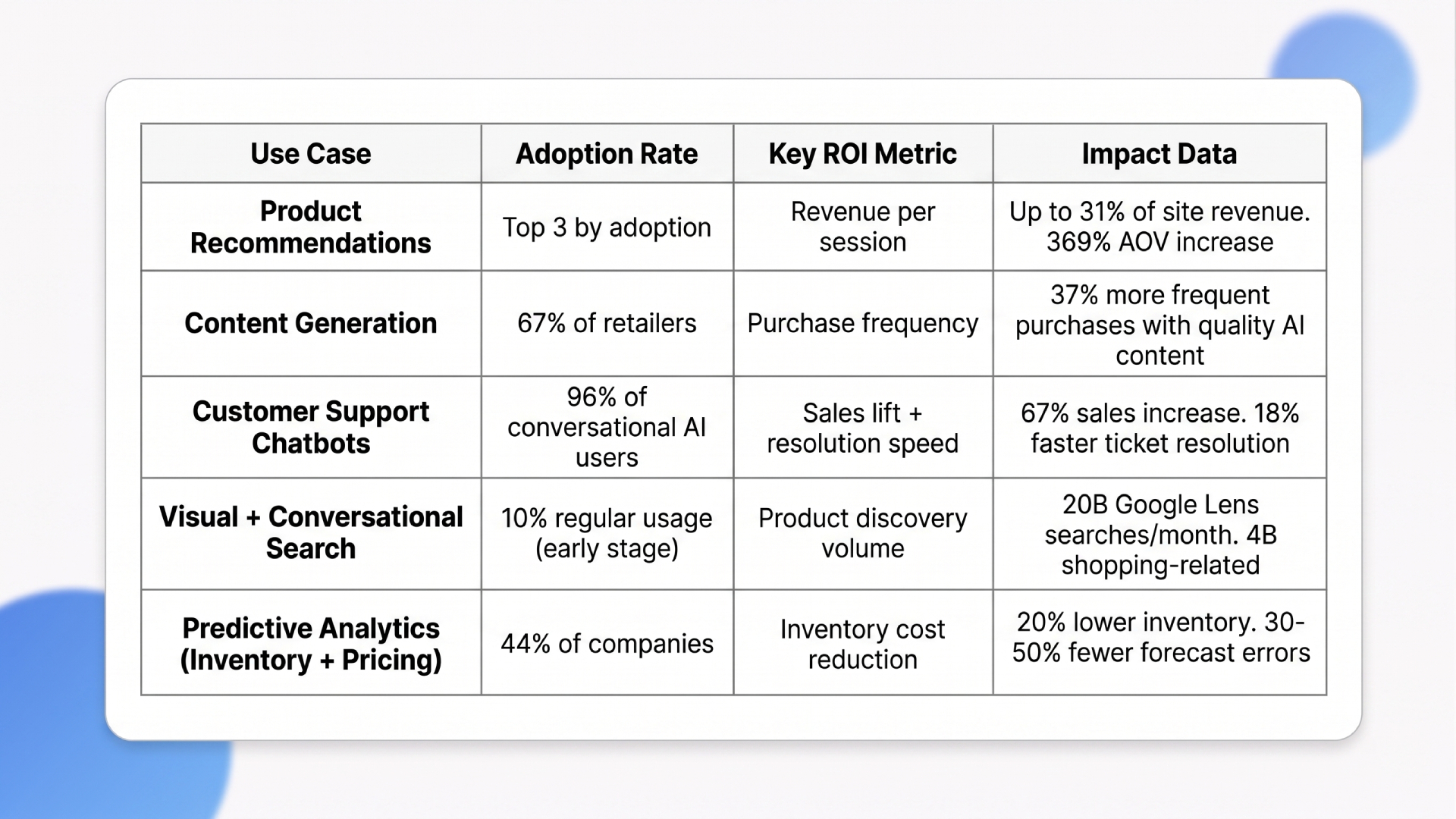
The AI ecommerce use cases generating the highest returns in 2026 include personalized recommendations, automated content production, support chatbots, visual search, and predictive inventory management. Each carries clear adoption data and documented revenue impact across retail verticals. Understanding the operational requirements behind each helps retailers prioritize integration sequencing.
Table 1: AI Ecommerce Use Cases – Adoption Rates and ROI Benchmarks (2025-2026)
1. AI-Powered Personalization and Product Recommendations
AI-powered personalization ecommerce engines represent the single highest-impact use case in online retail. Product recommendations drive up to 31% of ecommerce site revenues, and sessions where shoppers engage with recommendations show a 369% increase in Average Order Value (AOV).
McKinsey projects that generative AI in ecommerce will generate $240 billion to $390 billion in economic value for retailers globally, equivalent to a margin increase of 1.2 to 1.9 percentage points across the industry. That figure is contingent on contextual relevance in the AI output.
The difference between recommendations that convert and those that shoppers ignore is not algorithm quality alone, it is the specificity of input data. A recommendation engine that reads only a shopper’s last purchase cannot account for where that customer is in the ownership lifecycle of that product category.
A system that also processes browsing session depth, cart composition, and time since last purchase can surface complementary products with substantially higher relevance. Retailers running static recommendation models built exclusively on historical data are consistently underperforming against those using real-time behavioral signals as primary inputs.
2. Automated AI Content Generation at Scale
AI content generation produces AI product descriptions, email copy, ad variations, and category page content at speeds no human editorial team can match. 67% of retailers currently use AI for marketing and ad creation. The efficiency gain is significant, but the risk is uniformity: two stores selling the same product will receive functionally identical AI-generated descriptions unless one trains the model on proprietary source material.
The brands seeing measurable revenue lift from AI content treat the model as a first-draft engine rather than a publish button. They supply it with customer reviews, product testing notes, return reason data, and documented brand voice guidelines, then apply editorial review to ensure the output is differentiated from competitor content using the same model.
“Moving from pilot programs to full-scale deployment requires specialized engineering expertise. Learn how our Generative AI Development Services connect core systems to AI for measurable, transaction-level business impact.”
Generic AI copy trained entirely on publicly available product data produces content that ranks and reads identically to every competing retailer using the same inputs. Proprietary training data is what separates AI content that builds brand authority from content that blends into the commodity pool.
3. Customer Support Automation
96% of brands using conversational AI shopping deploy it for customer support automation. AI-powered support resolves tickets 18% faster with 71% success rates. AI chatbots in retail deployments increase sales by 67%.
The most common deployment limitation with AI chatbots retail implementations is scope: most retailers restrict them to post-sale support. The highest-converting implementations handle pre-sale questions: sizing, compatibility, availability, product comparison, with the same precision and speed as human agents.
A chatbot that answers “Will this laptop bag fit a 16-inch MacBook Pro?” with a precise yes or no drives more revenue than one that only processes return requests. Pre-sale query resolution shortens the path from purchase intent to completed transaction, which is where most cart abandonment actually occurs.
4. AI-Powered Visual and Conversational Search
Google Lens processes over 20 billion visual search queries per month, with 4 billion of those related to shopping. Amazon reported a 70% increase in visual searches on its platform year-over-year. Only 10% of U.S. adults currently use visual search regularly.
That low adoption figure is not a warning, it is an early-mover signal. Traditional keyword search forces shoppers to translate visual preferences into words. That process works for commodity purchases like batteries or cables but consistently fails for aesthetic product categories: a specific lamp silhouette, a fabric texture, a shoe style observed on the street.
AI-powered visual and conversational AI shopping search removes that translation friction entirely. A shopper photographs a piece of furniture and surfaces matching items across an entire catalog within seconds. Retailers who implement these capabilities now capture this high-intent traffic segment while competitors are still debating build-versus-buy decisions.
5. Predictive Analytics for Inventory and Pricing
Predictive analytics ecommerce systems reduce inventory carrying costs by up to 20% and cut supply chain costs by up to 10%. AI reduces forecast errors by 30-50%, and dynamic pricing models adjust in real time based on demand signals, competitor pricing data, and margin targets.
The compounding effect is what differentiates this use case from the others. Every sales cycle feeds new data back into the forecasting model. After two to three seasonal cycles, AI-powered demand forecasting can predict promotional spikes, regional demand shifts, and slow-moving SKU patterns with accuracy that no spreadsheet-based planning process can replicate. Retailers who begin building this data loop now will hold a multi-year forecasting advantage over those who wait.
The important warning: the model is only as accurate as the data pipeline feeding it. Forecast performance degrades when inventory systems, ERP records, and sales channel data operate in silos rather than feeding a unified source. Predictive analytics deployed on fragmented data produces confident predictions about the wrong numbers, which is more operationally harmful than no prediction at all.
Why Most Generative AI in Ecommerce Implementations Fail
Most generative AI in ecommerce projects fail not at the technical level but at the infrastructure level. Pilots succeed under controlled conditions with curated datasets and dedicated teams. Scaled rollouts fail when they encounter fragmented data across platforms, no integration with existing ERP and CRM systems, and unclear ownership across marketing, engineering, and operations.
1. The 7% Scaling Problem
Only 7% of organizations have moved beyond experimentation to fully scaled AI deployments. 62% remain in piloting phases.
The root cause of this gap is not technical complexity, it is governance. Pilots succeed because they run on clean, curated datasets with a single stakeholder and a clearly bounded scope. Scaled rollouts fail because they encounter the reality of enterprise data: fragmented across platforms, inconsistently formatted, and owned by different departments with different priorities.
When marketing owns the AI chatbot, engineering owns the product feed, and operations owns inventory data, no single team is accountable for the accuracy of AI outputs. Recommendations surface discontinued SKUs. Chatbot responses cite outdated pricing. Personalization engines work from stale cart data.
The resolution is not more pilots. It is building the data infrastructure and cross-functional governance frameworks that make AI outputs accurate across the full product catalog and customer base before scaling to additional use cases.
2. Data Security and Knowledge Gaps Are the Top Barriers
Security concerns are cited by 44% of CEOs as the primary barrier to AI deployment. Employee knowledge gaps follow at 43%. These two barriers compound each other in a specific way: security concerns slow deployment timelines, and slower timelines prevent teams from building the hands-on operational experience that would help them identify and address those same security concerns.
For AI fraud detection specifically, this gap is measurably costly. Retailers deploying AI in payment processing and account security without internal expertise in data governance tend to either over-restrict AI capabilities (limiting ROI) or under-restrict them (creating genuine exposure).
The organizations that break this cycle invest in internal AI literacy programs, covering data governance, output auditing, and model monitoring, before purchasing new tools. A team that understands what AI requires to function within acceptable risk parameters deploys faster and more effectively than one waiting for a vendor to deliver a pre-packaged solution they feel confident enough to trust.
3. The Trust Problem That Costs Revenue
One poorly targeted recommendation erases the conversion lift from ten accurate ones. When AI suggests a winter jacket to a shopper browsing swimwear, it does not just lose that single sale, it conditions the customer to dismiss every subsequent recommendation that session and, in many cases, in future sessions. Trust in AI recommendations is asymmetric: it builds slowly through consistent relevance and fractures quickly through a single mismatch.
AI recommendation systems must include feedback loops that flag and correct inaccurate outputs in real time. Quarterly model retraining cycles are too slow for this operational requirement. The retailers sustaining AI-driven conversion gains run continuous accuracy monitoring that detects model drift within hours, not months.
This is an operational discipline issue, not a technology limitation. The gap lies in whether the team managing it treats output quality as a live performance metric or a one-time deployment checkbox.
How to Implement AI-Powered Personalization in Ecommerce the Right Way
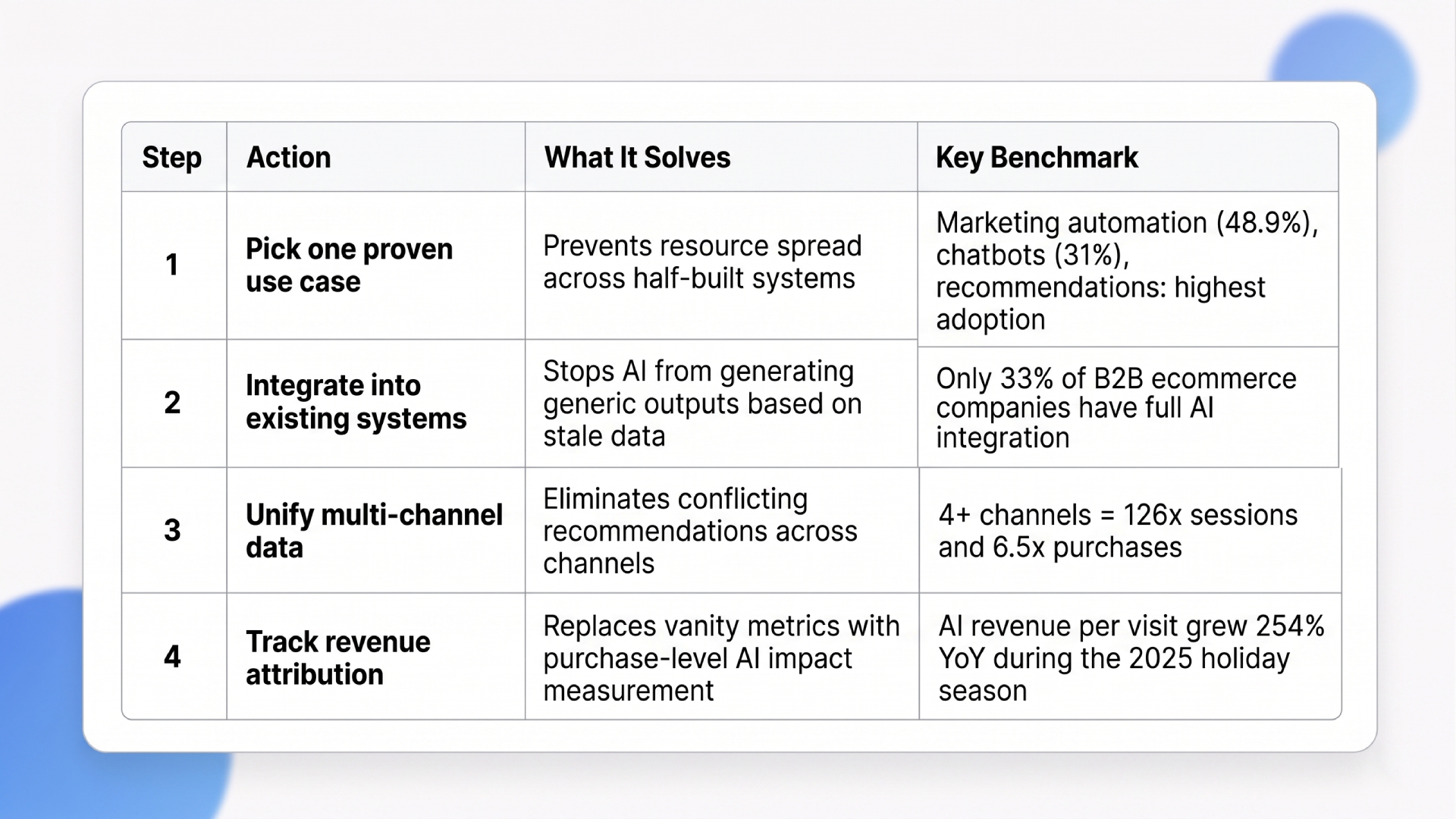
AI-powered personalization ecommerce deployments succeed when companies prioritize proven use cases, connect AI to existing systems with full data access, and measure revenue attribution at the transaction level. The implementation pattern that consistently produces the highest ROI is: one high-impact use case first, complete data integration, 90-day measurement cycle, then phased expansion.
Table 2: Phased Implementation Roadmap for AI-Powered Ecommerce
1. Start With Use Cases That Have Documented ROI
Select one high-traffic, high-data-volume use case. Measure conversion lift and revenue attribution for 90 days before expanding to additional capabilities. Retailers that deploy personalization, chatbots, and AI content generation simultaneously end up with three underdeveloped systems rather than one that generates trackable revenue.
The companies reporting the highest ROI across AI ecommerce use cases all followed the same operational sequence: one use case, full data integration, measurable results against a revenue baseline, then expansion into the next use case using the same data infrastructure. Marketing automation leads adoption at 48.9% of retailers, followed by customer support automation at 31%.
2. Integrate AI Into Existing Systems, Not Alongside Them
Standalone AI tools that lack access to real-time product and customer data generate outputs that shoppers recognize as generic. The practical diagnostic: if a recommendation engine does not know that a product is out of stock, on backorder, or currently discounted, it is operating on stale information. Shoppers who click a recommendation only to find that the recommended product is unavailable at the listed price experience a trust deficit that post-sale support cannot repair.
The performance difference between a recommendation engine pulling from a static CSV and one connected to live inventory, pricing, and purchase history is the difference between 3% and 31% revenue contribution. Only 33% of B2B ecommerce companies have achieved full AI integration with their existing commerce systems. Integration is the step most companies defer, and it is the primary reason most implementations underperform relative to the documented benchmarks of fully integrated deployments.
3. Combine Multi-Channel Personalization for Maximum Lift
Multi-channel personalization generates 126x higher user sessions and 6.5x more purchases when combining four or more channels. Real-time personalization delivers 20% higher conversion rates compared to batch processing approaches.
Email, SMS, on-site, and push notification personalization must run from the same unified data layer to produce coherent experiences. The most common failure in multi-channel deployments is basic: a shopper completes a purchase on-site and receives an email the following morning recommending the same product they just bought.
That single disconnect signals to the customer that the systems have no unified view of their behavior. Unified data pipelines feeding personalization across all touchpoints are what separate incremental per-channel gains from compounding revenue lifts where each channel reinforces the others.
4. Track Revenue Attribution, Not Vanity Metrics
Chatbot conversation volume and recommendation impression counts are operational metrics, not business performance metrics. A chatbot handling 10,000 conversations per month is functionally meaningless if none of those interactions influenced a purchase decision. The KPIs that reflect actual generative AI in ecommerce performance are: revenue per AI-referred session, recommendation click-through rate, AI-assisted conversion rate, and support ticket deflection rate with purchase correlation.
“Building a resilient data infrastructure is the foundation of any scalable AI deployment. We examine the intersection of engineering and safety in Generative AI in DevOps Security for organizations.”
If an AI analytics dashboard cannot show direct revenue attribution by touchpoint, the measurement framework is tracking activity rather than impact. The highest-performing implementations tie every AI interaction back to order data so the team can identify precisely which recommendation or chatbot response preceded a purchase, by how much it increased conversion probability, and where the breakdowns occur.
How Ariel Software Solutions Builds AI That Connects to Real Ecommerce Data

The consistent pattern behind failed generative AI in ecommerce deployments is disconnection: recommendation engines trained on static product feeds, chatbots isolated from live inventory, and AI-powered personalization ecommerce layers that cannot access current purchase history or cart context.
Ariel Software Solutions engineers the integration layer that closes these gaps. The engineering team connects AI models directly to product catalogs, CRM systems, ERP platforms, and order management infrastructure so every recommendation output, chatbot response, and generated content reflects real-time operational accuracy.
Across 1,100+ production builds, the specific data fragmentation problems that strand retailers in the pilot stage have been solved systematically. Our structured 6-stage delivery process maps the highest-impact use case first, builds the data pipeline that feeds it accurate inputs, and layers in post-launch model tuning to keep performance improving as customer behavior evolves.
Book a technical walkthrough with Ariel’s engineering team.
Conclusion
Generative AI in ecommerce is producing measurable, documented results for retailers that integrate it into existing systems and measure revenue attribution at the transaction level. The constraint is not technology availability – 80% of retailers already use AI in some capacity. The constraint is implementation depth: only 7% have moved beyond pilot deployments to full-scale systems connected to real product, customer, and inventory data.
The retailers closing that gap are generating 31% higher conversion rates from AI traffic, 369% higher AOV from recommendation-engaged sessions, and 20% lower inventory costs from predictive demand models. These outcomes are available to any retailer willing to treat integration as the primary investment rather than the afterthought.
Contact Ariel Software Solutions to build an AI-integrated ecommerce system designed around the catalog, customer data, and revenue targets that matter most to the business.
Frequently Asked Questions
1. How is generative AI used in ecommerce?
Generative AI in ecommerce handles product description writing, personalized recommendations, customer support chatbots, dynamic pricing, visual search, and marketing content generation. 67% of retailers use it for marketing and ad creation (NVIDIA, 2025). AI-powered personalization ecommerce engines drive up to 31% of ecommerce site revenue, and recommendation-engaged sessions increase Average Order Value by 369% (Barilliance).
2. What is the ROI of AI in ecommerce?
69% of retailers report revenue increases directly traceable to AI, and 72% see cost reductions (NVIDIA, 2025). AI-powered personalization ecommerce drives 5-15% revenue lift on average, with top performers reaching 25% (McKinsey, 2024). AI-driven revenue per visit grew 254% year-over-year during the 2025 holiday season (Adobe Digital Insights, January 2026).
3. How much does generative AI traffic contribute to ecommerce sales?
Generative AI in ecommerce traffic to U.S. retail sites grew 4,700% year-over-year as of July 2025. Shoppers arriving from AI sources show 32% longer visits and 27% lower bounce rates (Adobe Digital Insights, August 2025). By the 2025 holiday season, AI-referred shoppers converted 31% higher than traffic from paid search, social, or email channels (Adobe Digital Insights, January 2026).
4. Why do most AI ecommerce implementations fail?
Only 7% of organizations have fully scaled AI ecommerce use cases beyond pilots. The main barriers are data security concerns (44% of CEOs), employee knowledge gaps (43%), and system integration complexity. 71% of companies have piloted AI, but only 33% have fully implemented it. Most failures occur because AI tools operate disconnected from real-time product, inventory, and customer data.
5. What ecommerce AI use cases have the highest adoption?
Marketing automation leads at 48.9% of retailers, followed by customer support automation chatbots at 31%, and personalized product recommendations. AI content generation is used by 67% of retailers for marketing (NVIDIA, 2025). Predictive analytics ecommerce for demand forecasting is used by 44% of companies. Conversational AI shopping deployments dedicate 96% of usage to customer support.
6. Do consumers trust AI recommendations when shopping online?
Trust varies by generation. Millennials lead AI shopping adoption at 46%, while Baby Boomers remain the lowest-usage group but grew 63% in adoption between September 2024 and February 2025 (Adobe, 2025). Overall, 47% of consumers trust AI-generated recommendations (Adobe Holiday 2025 Survey). However, 2 in 5 shoppers have abandoned carts as a result of poor AI responses. Offering human support fallback options alongside AI builds trust across all demographic segments.