

42% of startups fail because they build something the market doesn’t need. The fix isn’t more market research. It’s compressing the gap between hypothesis and evidence so tightly that the wrong assumptions can’t outrun your runway.
That’s what 90-day MVP development for startups actually delivers when it works. Not a faster build, a faster feedback loop. The build matters, but it’s the smallest part. The measure step is where most teams underinvest. The learning step is where most teams quietly skip the part that hurts: pivoting away from the idea they’ve been pitching for six months because the data doesn’t support it.
Across the founder engagements we’ve delivered at Ariel, the projects that hit traction inside 90 days aren’t the ones with the prettiest products. They’re the ones where the founder treated the cycle as a learning system, not a launch sequence.
Key Takeaways
- MVP success is measured by learning velocity, not feature count.
- 42% of startup failures trace to no market need. The MVP exists to surface that signal early.
- The Build, Measure, Learn cycle is a continuous loop, not a sequential plan. The fastest founders run multiple loops inside 90 days.
- Most MVP overruns come from scope drift, not engineering complexity. Lock the scope, ship the loop.
- Measurement is the most underinvested phase. Set evaluation criteria before the first sprint.
- Pivoting is data-driven, not emotional. Define your pivot threshold before you fall in love with the idea.
- The 90-day frame is a forcing function. Anything that can’t ship in 30 days isn’t core to the MVP.
Why the 90-Day Frame Actually Matters
The 90-day framing isn’t arbitrary. It’s the longest a startup can credibly run a learning cycle before runway, motivation, and team focus degrade together. Founders who let this stretch to six or nine months don’t just lose time. They lose the ability to be honest with themselves about what the data says, because by the time the evidence arrives, too much has been invested to acknowledge it.
CB Insights data is direct on this. 42% of failed startups cite “no market need” as the dominant cause, with 29% running out of cash and 23% citing the wrong team. Read those together and the operational pattern is clear. Cash and team failures are usually symptoms. The root cause is building too much before validating the demand. The 90-day frame exists to force that validation forward.
This is also the trap most MVP development for startups engagements fall into when they’re scoped wrong. The team optimizes for what gets built rather than what gets learned. Six months later, you have a polished product nobody wants, instead of a rougher product the market is pulling for. MVP software development that ignores this distinction is failure dressed up. The 90-day frame is what protects against it.
Build, Measure, Learn: Done Properly
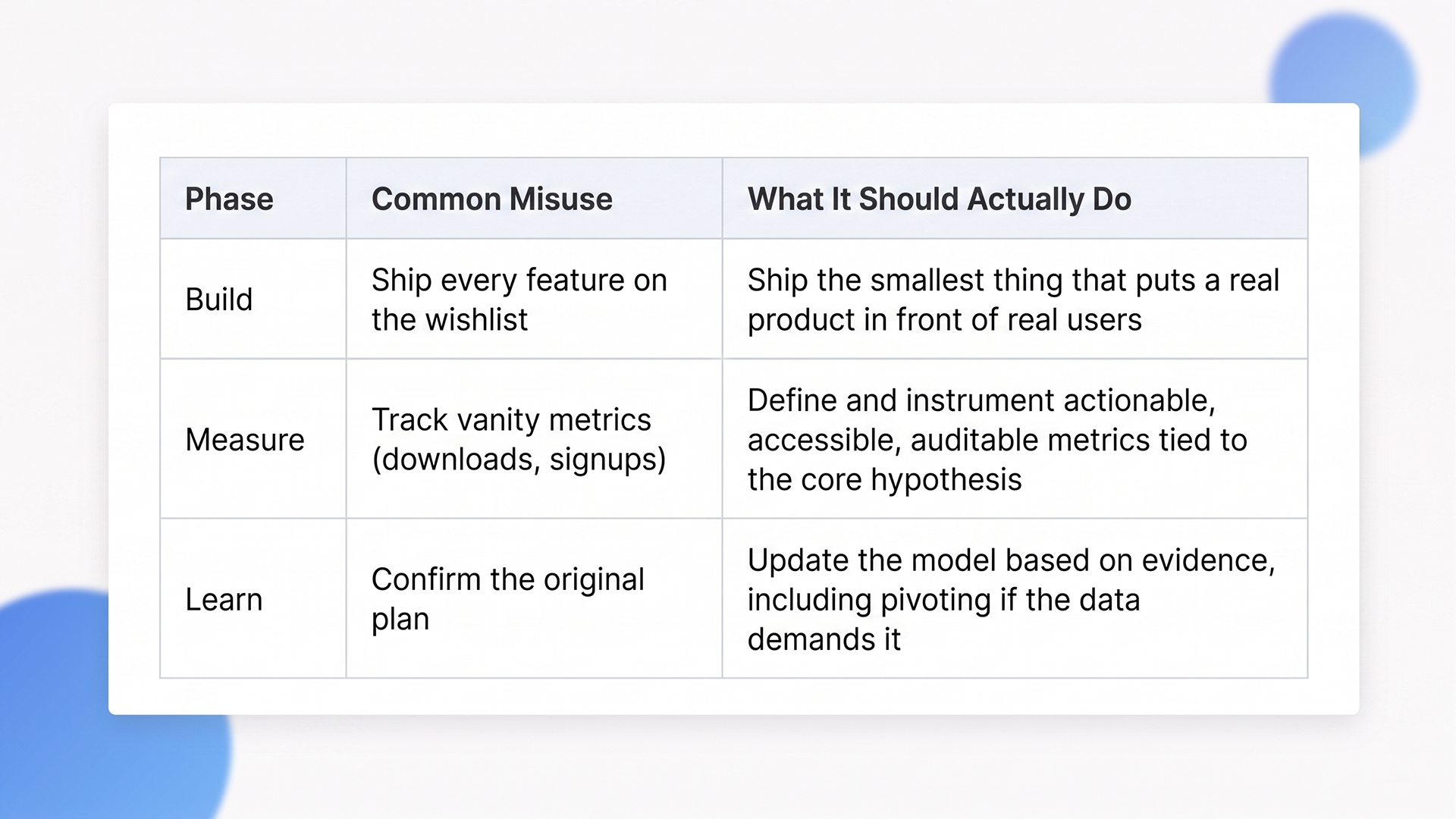
Eric Ries popularized the Build, Measure, Learn cycle in The Lean Startup. Most teams remember the three words and forget the most important point: the loop is meant to be run as fast as possible, not as completely as possible. Speed of iteration is the variable that compounds in mvp software development. The quality of any single iteration almost doesn’t matter.
That reframe changes how every phase gets scoped. Build means “the smallest thing that produces a real signal.” Measure means “a metric that survives a hostile reading.” Learn means “acting on the data even when it contradicts the original plan.” Most teams stretch the build phase, underspend on the measure phase, and skip the hard part of the learn phase entirely. The result is a 90-day cycle that feels productive but produces no actionable insight.
The 90-Day Calendar That Actually Works
The cadence below is what we run with founders during MVP development for startups engagements. It’s not a Gantt chart. It’s a sequence of forcing functions, where each phase has to deliver a specific output before the next begins.
Days 1-15: Hypothesis lock and scope kill
Two weeks. The output of this phase is three documents:
- The hypothesis sentence. One written sentence: “we believe X user has Y problem and will pay Z amount for our solution.”
- The required features list. The features are absolutely necessary to test the hypothesis. Nothing else.
- The kill list. Features explicitly killed for this cycle. They go on the next loop, not this one.
Most founders skip the kill list. That’s the mistake. Without it, scope creep is guaranteed by week six. The kill list is what protects the calendar.
Days 16-45: Build the smallest testable version
Four weeks. The team builds only what’s on the required list. No new features, no “while we’re at it” additions, no design polish beyond functional. The minimum viable product mantra here is operational, not aesthetic: ship something users can actually try, not a demo that runs on hand-cleaned data. Cut anything that doesn’t directly let a user complete the core flow. The result will feel embarrassingly bare. That’s the right level of done.
Days 46-60: Instrument and recruit
Two weeks running in parallel with the tail of the build phase. Instrumentation: every event a user takes during the core flow gets logged. Define five to seven metrics tied directly to the hypothesis, not to vanity. Recruitment: line up 30 to 50 target users to actually try the product. “We’ll figure out distribution later” is the response that kills 90-day MVPs. Distribution is part of the test, not phase two.
Days 61-75: Measure with hostile honesty
Two weeks. Users are using the product. Data is coming in. The discipline now is reading the data without filtering it through the original belief. Two questions matter: are users completing the core action you predicted, and are they coming back. Anything beyond those two is secondary. Most founders during this phase find one of three outcomes:
- Clear signal. Rare and beautiful. The hypothesis holds and the data supports scaling.
- No signal. The most common outcome. Users aren’t completing the core action, retention is flat, the test isn’t producing the response you projected.
- Contradictory signal. The most informative outcome. Users are completing actions you didn’t predict, ignoring the ones you did, or paying for something different from what you pitched.
All three demand action. The first scales the loop. The second triggers a pivot. The third reshapes the hypothesis itself.
Days 76-90: Decide, document, plan the next loop
Two weeks. The decision is one of four:
- Persevere. Data supports the hypothesis. Scale up.
- Pivot. Data invalidates the hypothesis. Change one element of the plan and re-test.
- Patience. Data is ambiguous. Run another short loop with sharper instrumentation.
- Stop. Data invalidates the hypothesis at a fundamental level. Save your runway.
Whichever the call, document the reasoning. The next 90-day loop starts from this decision, not from a fresh start.
What Teams Underestimate About 90-Day MVPs

These are the cost and discipline lines that don’t appear in the original plan but determine whether the loop closes.
Scope drift is the dominant cost
Engineering complexity rarely breaks 90-day MVPs. Scope drift breaks them every time. A founder adds a small feature in week four because a customer asked for it. A second small feature in week six. A third in week eight. None individually justify pushing the launch. Together, they add four to six weeks of work and the launch slips. The fix is the kill list from days 1 to 15, enforced ruthlessly. Anything new goes on the next loop, not this one.
Measurement infrastructure is undersized
Founders treat instrumentation as a launch task. By the time the MVP is in users’ hands, the team is rushing to glue analytics together while users are already churning. The cost: weeks of data lost. The fix is to instrument before launch, not at launch. Five to seven specific events tied to the hypothesis, captured cleanly, with a dashboard ready to read on day one of the measure phase.
Distribution is part of the MVP, not a phase two
If 30 real users can’t try the product, the 90-day cycle produces no signal. Founders who treat distribution as “we’ll figure that out after we ship” are scoping a 180-day cycle and calling it 90. Build the user list during days 1 to 15. Recruit them during days 46 to 60. Have them in the product by day 61. Without that, the calendar collapses.
Founders fall in love with the build, not the loop
This is the human dynamic that derails the most projects. The team is excited about what they shipped. The data comes back ambiguous or negative. The instinct is to keep building rather than to update the model. Define your pivot threshold before days 61 to 75 begin. Write down: “if metric X falls below Y, we pivot.” Without that pre-commitment, the data never wins the argument.
Technical debt accumulates faster than expected
MVP code is meant to be replaceable, but rarely is. Founders ship a 90-day MVP that hits traction, then spend the next six months fighting the code they shipped to validate. The fix isn’t to over-engineer the MVP. It’s to be deliberate about what gets thrown away after validation. The first 90-day cycle proves the hypothesis. The second 90-day cycle is often where the rebuild lives. Plan for both.
When the 90-Day Frame Doesn’t Apply
Not every product can be MVP’d in 90 days. Here’s where we tell founders to scope a different cadence.
Heavily regulated domains. Medical devices, FDA-pathway digital therapeutics, financial services with chartering requirements, defense. The compliance work alone exceeds 90 days. The right approach is parallel: a regulatory-track MVP scoped against the compliance reality, alongside a learning-track MVP that validates assumptions about user behavior in adjacent ways (landing pages, concierge testing, partner pilots).
Hardware-first products. Physical product cycles run on supply chain timelines, not software ones. Hardware MVPs benefit from the Build, Measure, Learn philosophy but on a 6 to 12 month base cycle. The 90-day frame still applies inside that, for software components, customer discovery, and early adopter pilots.
Deep-tech with novel technical risk. If the core technical question is whether the underlying technology actually works (a new ML model, a novel algorithm, an unproven physics application), 90 days isn’t validation, it’s inadequate. Scope a longer technical cycle, then run product MVPs once the technology is proven.
What 90-Day MVP Development Actually Costs
Cost in this space is wide because it depends on tech stack, integration depth, and whether the team is in-house or partnered. The ranges below are illustrative bands drawn from our own delivery experience for production-grade 90-day cycles, not industry-wide benchmarks. Actual project costs depend on scope, region, and team composition.
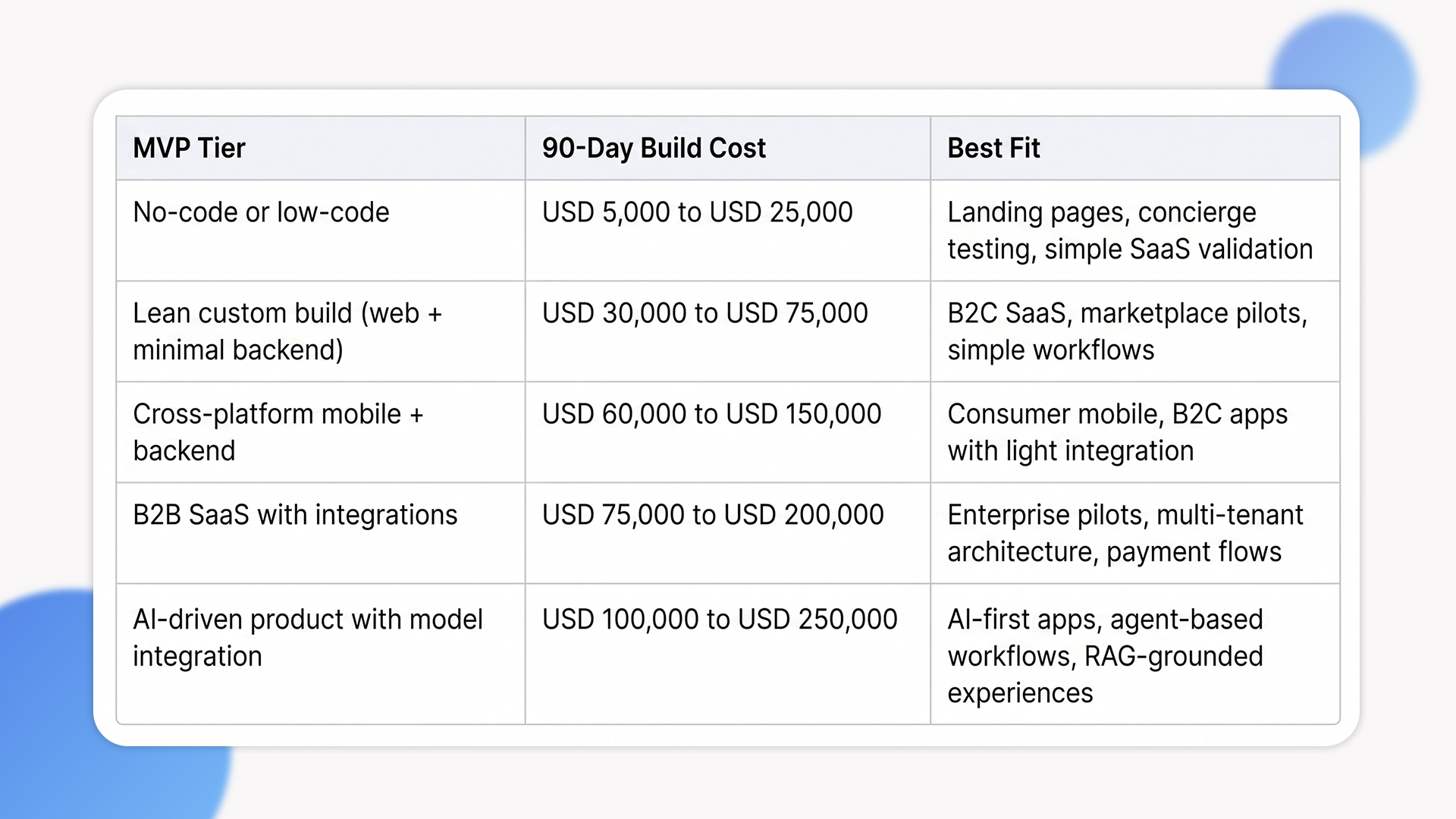
These ranges include build only. Plan for a meaningful additional spend on instrumentation, distribution, and learning infrastructure across the 90 days, on top of the build cost itself. Founders who scope only the build cost of mvp software development discover the missing pieces on day 60, when there’s no time to add them.
How Ariel Approaches MVP Development for Startups
Our delivery model treats the 90 days as a single integrated cycle, not five separate phases handed off between teams. Discovery, build, instrumentation, distribution support, and decision documentation all live inside the same engagement, with the same team.
Our engineering teams work across .NET, Python, Node, React Native, Flutter, and modern web stacks for MVP delivery, with cloud architecture on Azure or AWS for fast scaling once validation lands. We’ve delivered MVP development for startups across multiple verticals through our work with clients spanning healthcare, fintech, real estate, logistics, and travel, and the consistent pattern is that the right MVP for each domain looks different. Healthcare MVPs need compliance scoping in week one. Fintech MVPs need payment infrastructure that doesn’t break under scrutiny. Marketplace MVPs need both sides of the market or the test isn’t real. Tailoring the cycle to the domain is what separates a minimum viable product that produces signal from one that produces busywork.
What stays consistent is the principle. Lock the hypothesis. Kill the scope. Build for signal. Instrument before launch. Read the data without filtering. Decide and document. Plan the next loop. The architecture follows from those decisions, not the other way around.
Planning a 90-day MVP and want a delivery-grade scoping conversation, not a feature pitch?
Our team has run 90-day MVP cycles across SaaS, healthcare, fintech, and marketplace startups. We’ll review your hypothesis, scope your build, and design the measurement and distribution plan that closes the loop in real time.
Frequently Asked Questions
1. Can a real MVP actually be built in 90 days?
Yes, when scope is locked tightly. The constraint isn’t engineering capacity, it’s discipline around what gets cut. A 90-day minimum viable product with a single user journey, two to three core features, and clear instrumentation is achievable across most domains. What doesn’t fit in 90 days is a feature-complete product, which isn’t the goal of this cycle anyway.
2. How much does MVP development for startups typically cost?
Lean custom builds run USD 30,000 to USD 75,000 for a focused 90-day cycle. B2B SaaS and AI-driven products run USD 100,000 to USD 250,000. The biggest cost variable isn’t the technology, it’s the integration surface. MVPs with deep integrations into payment systems, EHRs, or enterprise stacks land in higher ranges because integration work is real engineering.
3. What’s the difference between a prototype and an MVP?
A prototype tests the design. An MVP tests the market. Prototypes can be hand-cleaned demos shown to a focus group. MVPs are real products in real users’ hands generating real data. In mvp software development, the Build, Measure, Learn loop only works once you’ve crossed from prototype into MVP, because validated learning requires actual usage data, not opinion.
4. When should I pivot vs persevere?
Define the pivot threshold before the data arrives. Common patterns we see: a low core-action completion rate among target users triggers a pivot, weak two-week retention triggers a pivot, and users completing the action but refusing to pay triggers a pivot of the business model rather than the product. The exact thresholds depend on your category, your acquisition cost, and your market. The discipline is to pre-commit to numbers that would change your decision, not to numbers that conveniently support it. If the data is ambiguous, run another short loop with sharper instrumentation rather than committing to scale. The hardest decisions are the ones founders make against their own emotional investment, which is why pre-committing to the threshold matters.
5. Can Ariel handle MVP development end-to-end?
Yes. We cover discovery, hypothesis scoping, build, instrumentation, distribution support, measurement, and the post-loop decision framework. Get in touch to scope your project.
The Decision Behind the Decision
The hardest part of MVP development for startups isn’t technical. It’s the discipline to scope tightly, ship before you’re ready, measure honestly, and act on data that contradicts your original plan. The 90-day frame is what forces those decisions to happen. Stretch the cycle and you preserve the founder’s emotional certainty at the cost of the company’s actual learning.
Lock the hypothesis. Kill the scope. Build the smallest version. Instrument before launch. Recruit users into the test. Read the data without filtering. Decide deliberately. Document the reasoning. Run the next loop. The Build, Measure, Learn cycle is a learning system, not a launch sequence. Treat it that way and the minimum viable product earns its name.
Ready to scope a 90-day MVP that produces signal, not just a launch?
Book a free consultation with Ariel’s MVP team. We’ll review your hypothesis, sequence the build, and design a measurement and distribution plan that closes the loop on time.