A Compliance Cycle With No Off-Season
We rebuilt the annual recertification cycle for an affordable housing portfolio, so a team of three could keep pace with 4,800 units that never stop coming due.
- Affordable Housing
- AI-powered
- 6 min read

Stat Strip
The Recertification Cycle, by the Numbers
Every Household Comes Due Again, Every Single Year
Every assisted household must be recertified annually. For a 4,800-unit portfolio, that is 4,800 full compliance cycles annually, roughly 400 every month, forever, with no seasonal relief and no option to skip.
Each cycle runs the same long chain of small obligations: issue the notice on schedule, chase the household until they respond, collect and verify every income and asset source, run third-party verifications, recalculate rent against current HUD limits, produce the income certification, route it for manager review, capture signatures, transmit to the agency, and file the evidence.
Recertification is not hard work. It is enormous work, and the penalty for doing it slightly late or slightly wrong is a compliance finding against the asset.
Six Failure Points Every Compliance Team Knows by Heart
- Notices slip: A missed 120, 90, 60, or 30-day notice invalidates the cycle and can cost the subsidy for that unit.
- Households go dark: Bad phone numbers and stale addresses mean staff spend more time chasing than certifying, and non-response escalates into termination proceedings nobody wants.
- Document review has no ceiling: Twelve to eighteen documents per household, each read by eye, each cross-checked against the tenant’s declarations, each a potential audit finding if misread.
- Calculations drift: Income limits change, asset imputation rules are subtle, and two experienced staff can produce two different rents from the same file.
- Manager review becomes the bottleneck: Everything queues behind one or two senior signatures, and the queue stays invisible until it is late.
- Nobody can answer where the portfolio stands: Getting a clear answer on portfolio status means someone spending a day building a spreadsheet that goes stale the moment it is finished.
A Machine-Driven Workflow With Human Checkpoints
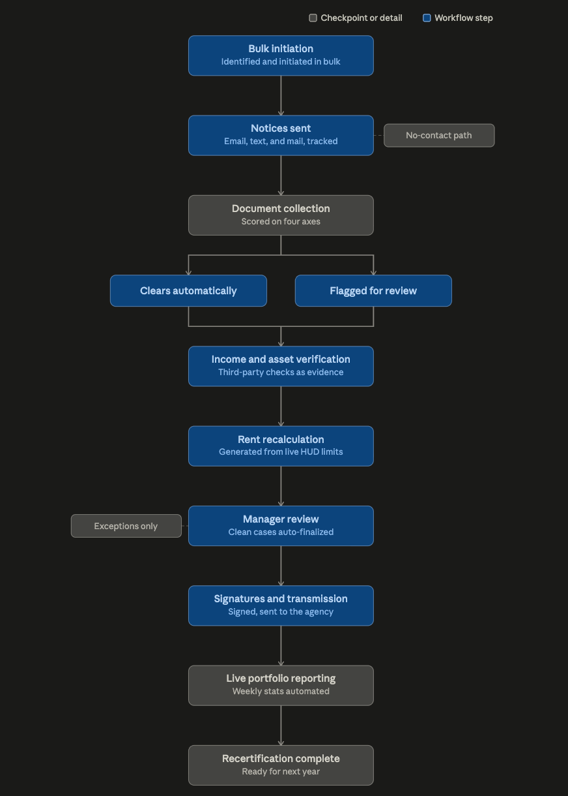
The team treats recertification as a process the machine runs, with people stepping in only at real decision points.
- Bulk, scheduled initiation: Eligible households get identified by organization, development, or anniversary window and initiated in bulk. Background jobs advance the workflow on schedule instead of waiting for someone to remember.
- Automated notices with delivery proof: Notices go out by email, text, and physical mail, with delivery, bounce, and open status tracked back to the case. Missing-contact households get detected automatically and routed to a dedicated no-contact letter path, so the file shows a documented attempt, not a gap.
- Extraction and four-axis scoring: Every submitted document gets classified, field-extracted, and scored on field presence, match against the declared profile, date validity, and source credibility. A confidence threshold decides what a person sees; roughly a fifth of documents need a human, and the rest clear themselves.
- Third-party income and asset checks: Direct income and asset verification integrations replace mailed employer forms and the two-week wait that follows, with results attached to the case as evidence.
- Automatic limit recalculation and certification generation: HUD income limits get recalculated against the live household, and the income certification gets generated from the case instead of retyped. The arithmetic stays identical for every file, every time.
- Auto-finalized manager review: Cases that clear every check get finalized automatically. Only genuinely ambiguous files reach a manager, and signature automation removes the queue that used to form behind one senior reviewer.
- Property management system report ingestion: Resident-activity and unit-transfer reports exported from the property management system get read by a multimodal model straight from the PDF, with an OCR fallback for large or poor scans, so transfers and move-ins update the recertification picture without manual reconciliation.
- A recertification operations assistant: A conversational agent grounded in the organization’s own recertification rules and live case data. It answers which cases are stuck at manager review in a given building directly, and explains the workflow accurately to newer staff.
- Live status across the portfolio: What is due, notice status, delivery status, documents awaiting signature, cases by type, all live and scoped to a manager’s own developments. Weekly statistics compile and deliver automatically.
Every Step, Before and After
| Recertification step | Manual process | With the platform |
|---|---|---|
| Identifying who is due | Monthly spreadsheet built by hand | Continuous, automatic, portfolio-wide |
| Issuing notices | Mail-merged and posted per household | Scheduled multi-channel send with delivery proof |
| Chasing non-responders | Phone calls logged in a notebook | Automated escalation plus a no-contact letter path |
| Document collection and review | 12 to 18 documents per household read by eye | Fully machine-read, about 22% flagged for a person |
| Income and asset verification | Employer forms mailed, 2-week turnaround | Direct verification attached as case evidence |
| Rent calculation and certification | Recalculated per file, results vary by staffer | Recalculated against live limits, certification generated |
| Manager review | Every case queued behind one signature | Clean cases auto-finalized, exceptions escalate |
| Portfolio reporting | A day of spreadsheet work, stale on arrival | Live dashboards plus automated weekly statistics |
Net effect on effort per recertification: roughly 4.5 hours of human touch time falls to about 1.1 hours, and the remaining hour goes to judgment, not transcription.
A Ten-Person Department Down to Three
| Conventional team, 10 people | 1 compliance manager, 4 recert specialists, 2 document reviewers, 2 tenant-outreach clerks, 1 reporting analyst |
| AI-enabled team, 3 people | 1 compliance manager, 1 exception and verification reviewer, 1 tenant-relations specialist |
| Role | Annual manual load | Absorbed by |
|---|---|---|
| Recert specialists (3) | About 14,000 hours of file assembly and rent math | Bulk initiation, automated workflow, certification generation |
| Document reviewers (2) | About 65,000 documents read page by page | Extraction plus confidence scoring with threshold routing |
| Outreach clerks (2) | Notice mailing, calls, non-response chasing | Multi-channel automated notices plus a no-contact path |
| Reporting analyst (1) | Weekly and monthly compliance reporting by hand | Live dashboards plus scheduled weekly statistics |
The three remaining roles are the irreducible ones: someone accountable for compliance, someone who adjudicates the flagged fifth of documents, and someone who handles the households that need a person. Volume moved to the machine. Discretion stayed with people.
What Three People Are Actually Delivering
- 70% reduction in compliance headcount.
- 75% less human touch time per recertification.
- 96% on-time completion, up from 74%.
- About 78% of documents cleared without human review.
- Late recertifications are a revenue problem: An overdue annual recertification puts the subsidy for that unit at risk and can force a retroactive rent correction. Across a 4,800-unit portfolio, moving on-time completion from three-quarters to near-total removes an entire category of avoidable loss, along with the year-end scramble that used to consume the department every December.
- Audit exposure falls because evidence is a by-product: Investors and agencies audit backwards. Every notice carries delivery proof, every document carries its extraction and confidence record, every calculation stays reproducible, and every workflow step is timestamped against a named user. The compliance file is complete before anyone asks for it.
- Consistency is the quiet win: Ten people applying HUD rules produce ten slightly different interpretations. One rule engine produces one. That consistency is what makes portfolio-level assurance possible at all, and what makes a compliance department scalable without proportional hiring.
- Recurring by nature: Recertification happens every year for every household, so the automation earns its keep continuously, not once.
- Scales without headcount: Adding 2,000 units adds computing capacity, not staff.
- Institutional knowledge stops walking out the door: The rules live in the platform, so staff turnover no longer resets the team’s competence.
- AI cost is attributed per document: Cost gets tracked per document, per applicant, and per organization, with quota alerting, so the economics of the AI layer stay measured, not assumed.
Run the Annual Cycle With a Third of the Department
Ariel builds the systems affordable housing compliance teams run their recertification cycle on. If recertification is consuming your team, or you are behind and cannot hire your way out of it, our team can show you the same workflow running against your programs, your notice templates, and your property management system.
Figures in this case study model a reference portfolio of 4,800 assisted units across 22 developments. They illustrate the operating leverage of the module rather than one named client’s result. Actual outcomes vary with portfolio size, program mix, tenant responsiveness, and incoming data quality.