Every AI project starts with an idea.
“We want to automate this.”
“We want to build an AI assistant.”
“We want to make better predictions.”
The use case is usually clear; however, the implementation approach is not.
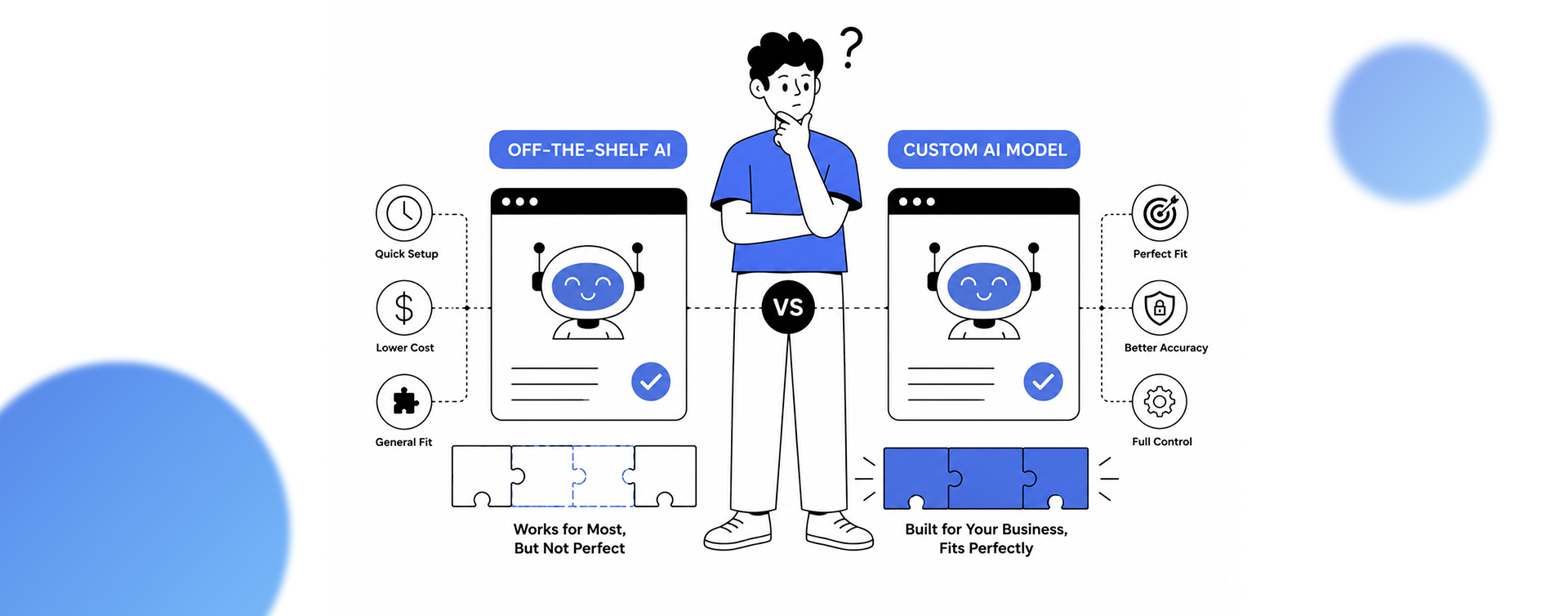
The choice between custom AI model development and off-the-shelf AI is a money decision dressed up as a technology decision. Off-the-shelf tools win on speed and the first invoice. Custom often delivers greater control and differentiation and, in cases where AI is core to the product, usage is high, or compliance requires greater control, it can also offer a lower total cost of ownership over time.
The mistake that wastes the most money is not picking the wrong tool; it is misreading which decision you are actually making, and forcing one approach onto a problem that needs the other.
So, how do you know which path makes sense before you commit months of engineering effort and budget? Let’s understand what the custom AI vs. off-the-shelf AI dilemma is all about, and which approach is suitable for your use case.
Key Takeaways
- Choosing between custom AI and off-the-shelf AI is about finding the approach that delivers the best long-term business value.
- Off-the-shelf AI is often the fastest way to launch AI, but growing inference costs, engineering complexity, and performance limitations can change the economics as adoption scales.
- Custom AI doesn’t usually mean training a model from scratch. In most cases, it involves fine-tuning or adapting existing foundation models using your proprietary data.
- The right choice depends on factors such as your data maturity, compliance requirements, expected AI usage, and whether AI is a supporting feature or your competitive advantage.
- Many organizations achieve the best results with a hybrid AI strategy, using off-the-shelf models for language tasks and custom AI for business-critical workflows.
- Looking only at upfront costs can lead to expensive architectural decisions. Evaluating the three-year total cost of ownership often tells a very different story.
- A structured assessment from an AI consulting team before development helps prevent costly rework and ensures your AI architecture can scale as business requirements evolve.
Custom AI vs. Off-the-Shelf AI: What Does It Mean for Your Business
At a technical level, the difference is simple. An off-the-shelf AI model is already trained and ready to use, while a custom AI model is developed or adapted to meet a business’s specific requirements.
The distinction between custom AI development and choosing an off-the-shelf AI isn’t as straightforward as “build your own” versus “use someone else’s.” In reality, these are two different approaches to adopting AI, each with its own advantages, limitations, and business implications.
Let’s understand in detail what each approach entails.
Off-the-Shelf AI: Ready to Build From Day One
Off-the-shelf AI models, such as GPT, Claude, Gemini, or Llama, are foundation models that have already been trained on massive datasets. Instead of investing time and resources into building the underlying intelligence, businesses can use these models through APIs or deploy open-weight versions within their own infrastructure. Here’s how:
- Using an API: The model is hosted and managed by the provider. Your application sends requests and receives responses, making this the fastest way to bring AI into a product or workflow.
- Deploying an open-weight model: Instead of relying on a hosted API, businesses can deploy models within their own infrastructure. This offers greater control over data, security, customization, and deployment environments.
For example, a development team can integrate Claude Code through its API to assist with code generation, debugging, refactoring, and documentation without training a coding model from scratch.
When using off-the-shelf AI, the model itself isn’t modified. Teams improve performance through better prompt engineering or structured workflows, which enable the model to retrieve relevant information from internal documents and knowledge bases before generating a response.
Custom AI: Built Around Your Business
Custom AI development often involves fine-tuning an existing foundation model, continuing its training on domain-specific data, or building specialized models for tasks such as fraud detection, quality inspection, or medical diagnosis. For example, a bank might fine-tune an open-weight model such as Llama 3 on its proprietary financial data to improve fraud detection and risk assessment.
Despite the name, custom AI development rarely means training a Large Language Model (LLM) from scratch. Depending on the use case, custom AI development may involve:
- Fine-tuning an existing foundation model using your organization’s data.
- Continuing to train a model on domain-specific datasets to improve its expertise.
- Building a specialized model for industry-specific or business-specific tasks such as fraud detection, predictive maintenance, medical diagnosis, or quality inspection.
- Training an entirely new foundation model; however, it is typically reserved for organizations with massive datasets, substantial AI expertise, and significant computing resources.
Custom AI vs Off-the-Shelf AI: The Real Trade-offs
The honest custom AI vs off-the-shelf AI comparison is about matching the approach to the problem, not declaring a winner. Each is correct for different situations. The table below sets out the trade-offs that actually drive the decision.
| Dimension | Off-the-Shelf AI | Custom AI Model Development |
|---|---|---|
| Time to value | Days; subscribe and use | Weeks to months; built around your data |
| Upfront cost | Low; subscription or usage fee | Moderate; engineering and integration |
| Ongoing cost | Scales with seats and usage | Mainly compute; flatter at scale |
| Data & privacy | Data often leaves your perimeter | Can stay self-hosted or in a private cloud |
| Differentiation | Same tool your competitors use | A capability rivals cannot buy |
| Fit to workflow | Generic; you adapt to it | Shaped to your exact process |
| Ownership | You rent the capability | You own and can evolve it |
| Best for | Common, non-core, low-volume tasks | Differentiated, data-sensitive, high-volume core |
When Off-the-Shelf AI Is the Smarter Choice
Off-the-shelf AI is the smarter choice in the following cases:
- The use case is common and well served. If a hosted tool already does the job well, building a custom version is paying tens of thousands to replicate something that costs a small monthly fee. The cheapest custom build is the one you correctly decided not to do.
- Volume is low and stays low. If usage is modest and unlikely to grow, the subscription never compounds enough to justify a build. The crossover point sits beyond your horizon, so off-the-shelf stays cheaper for as long as it matters.
- The budget cannot scope a build properly. Below a realistic threshold, a custom project cannot be scoped without cutting corners that create problems later. A managed tool buys reliability while the case for building matures.
- Speed is the priority. When the business needs a result in days or weeks, off-the-shelf delivers, and a custom build cannot. Invest in off-the-shelf to capture the value, and think about building a custom model once the need and the volume are proven.
Where Do Off-the-Shelf Models Begin to Struggle?
Most AI initiatives begin with an off-the-shelf model. Initially, the results are often impressive. Prompt engineering, Retrieval-Augmented Generation (RAG), and orchestration frameworks solve many early challenges.
However, as AI moves into production and becomes responsible for business-critical workflows, engineering teams begin encountering problems that aren’t easily solved by adding another prompt, another retrieval step, or another guardrail.
Some of the earliest technical signals include:
1. Prompt engineering reaches diminishing results
Well-designed prompts can significantly improve model outputs, but only up to a point. As requirements become more complex, prompts grow longer, workflows become harder to maintain, and even small prompt changes can introduce unexpected behavior.
2. RAG solves knowledge gaps, but not reasoning gaps
RAG is excellent at supplying the model with proprietary documents, policies, and enterprise knowledge. However, it doesn’t change how the model reasons. If the challenge lies in understanding industry-specific terminology, applying complex business rules, or making consistent domain-specific decisions, simply retrieving more information rarely solves the problem.
3. Performance plateaus despite additional engineering effort
Teams continue refining prompts, expanding knowledge bases, adjusting retrieval parameters, and introducing validation layers. Yet the improvements become incremental while engineering effort continues to increase. This often indicates that the limitation lies in the model itself rather than the surrounding architecture.
4. Operational complexities start growing faster than product capabilities
As AI applications scale, organizations often accumulate prompt templates, retrieval pipelines, guardrails, evaluators, fallback logic, and post-processing rules. Each addition improves reliability, but together they create a system that’s increasingly difficult to maintain, test, and evolve.
5. Business-specific knowledge remains external to the model
Foundation models excel at general reasoning, but they don’t inherently understand your organization’s products, terminology, operating procedures, or proprietary decision-making processes. As a result, the application becomes increasingly dependent on external context rather than the model itself developing deeper domain expertise.
6. Inference costs become a part of the architecture discussions
API costs are rarely a concern during pilots. Once AI begins serving thousands or millions of requests, however, inference costs, latency, rate limits, and infrastructure choices become architectural decisions rather than operational details.
When to Build Your Own AI?
Specific, recognizable signals justify the decision to build. If one or more of these is true, when to build your own AI stops being a philosophical question and becomes a clear yes.
- Your proprietary data is the edge. If your competitive advantage lives in your own transaction history, documents, or domain data, a model fine-tuned on that data will outperform any generic tool, and a rival cannot replicate it by buying the same subscription.
- You have hit the ceiling off-the-shelf. When you are stacking multiple tools to patch gaps, paying for features you never use, or constantly working around limits, the generic tools have stopped fitting, and custom becomes the cheaper path to the outcome you need.
- Compliance forbids sending data out. Healthcare, finance, insurance, and legal work often cannot send sensitive data to a third-party SaaS platform. A self-hosted or private-cloud custom model can be the only compliant option, a constraint of data sovereignty rather than preference.
- AI is the product you sell. If intelligence is your differentiator, you cannot build a moat on the same tool your competitors use. Owning the model and the ability to retrain and evolve it is a strategic necessity.
- The total cost of ownership may favor building. For organizations with sustained AI usage, predictable inference workloads, or requirements for greater control and compliance, the long-term economics may justify a custom build despite the higher upfront investment.
A caution that sits underneath all five signals: strategy has to come before the build. RAND Corporation’s research found that more than 80% of AI projects fail, usually because of problem framing and workflow fit rather than the technology, as set out in their study on why AI projects fail. Building custom without a clear business case does not beat that statistic; it joins it.
Not sure whether to build custom or buy off-the-shelf?
We have delivered both across finance, healthcare, retail, and SaaS for 16 years. We will model your three-year total cost of ownership for each path, find your crossover point, and tell you honestly where building your own pays off and where it would just burn the budget.
The Cost of Deploying Your Custom AI Model and Using Off-the-Shelf Models
Off-the-shelf AI offers a low barrier to entry, allowing businesses to launch AI-powered products quickly with minimal upfront investment. Custom AI model, on the other hand, demands a much larger commitment in terms of time, expertise, and budget. Here’s the table that provides the cost estimates of both approaches:
| Cost Component | Off-the-Shelf AI | Custom AI Model |
|---|---|---|
| Initial Implementation | $5,000 – $50,000 for API integration, orchestration, and application development. | $100,000 – $500,000+ for most enterprise custom models, depending on data preparation, model development, and deployment. |
| Deployment Timeline | Days to a few weeks. | Typically months. |
| Inference Cost | Pay per token or API request. Costs scale directly with usage and can become significant at enterprise volumes. | Infrastructure is self-managed, but per-request costs can become lower at high and predictable volumes. |
| Infrastructure | Minimal if using managed APIs. | GPU servers, storage, networking, monitoring, model serving, and MLOps infrastructure. |
| Model Training Cost | Not required because the provider has already trained the foundation model. | Fine-tuning may cost thousands to tens of thousands of dollars; training a new foundation model can cost millions to hundreds of millions. |
| Ongoing Maintenance | Mostly handled by the provider. | Continuous monitoring, retraining, evaluation, infrastructure upgrades, and MLOps. |
Read our detailed guide on AI development costs in 2026 to understand what influences the cost of building, deploying, and maintaining AI solutions.
The best AI strategy isn’t always the least expensive upfront. It’s the one that aligns with your business goals and technical requirements. An off-the-shelf LLM may be ideal for a customer support chatbot, while a fraud detection system built on proprietary data may justify a custom model.
Matching the right approach to the right use case helps control long-term costs, whereas the wrong choice can lead to rising infrastructure expenses, growing engineering complexity, and costly rework.
The Hybrid Approach: Best of Both Worlds
Sometimes, the decision doesn’t always have to be off-the-shelf vs. custom AI development. In many production environments, organizations use both, choosing each where it delivers the most value.
General-purpose foundation models can be used for tasks like content generation, document summarization, semantic search, and conversational assistants because they already excel at understanding and generating natural language.
On the other hand, custom AI models make sense when business context becomes as important as language understanding. Instead of repeatedly supplying the model with instructions and external knowledge, organizations can train it to understand their domain better, improving accuracy, consistency, and control for business-critical workloads.
Here’s how it would look in practice for different industries:
| Industry | Off-the-Shelf AI | Custom AI |
|---|---|---|
| Banking & Financial Services | Customer support, document summarization, internal knowledge assistants | Fraud detection, credit risk assessment, AML transaction monitoring |
| Healthcare | Medical documentation, appointment assistants, patient FAQs | Medical image analysis, disease prediction, clinical decision support |
| Retail & E-commerce | Product descriptions, customer support, semantic product search | Personalized recommendations, demand forecasting, dynamic pricing |
| Logistics | Shipment updates, document summarization, internal operations assistants | Route optimization, demand forecasting, ETA prediction, warehouse optimization |
| Real Estate | Property descriptions, customer inquiries, document summarization. | Property valuation, lead scoring, price prediction, investment risk analysis |
Every AI use case doesn’t deserve the same solution. Some can deliver excellent results with an off-the-shelf model, while others justify the investment in custom AI. Knowing the difference is often the hardest part. That’s why many organizations work with experienced AI consultants who can evaluate the use case, identify the right architecture, and help avoid costly decisions that only become apparent after deployment.
Read More: How to Choose an AI Software Development Company?
How Ariel Approaches the Build-versus-Buy AI Decision
From our delivery experience on both sides of this decision, the teams that get it right treat it as a total-cost and differentiation question, not a technology preference. The teams that struggle either built what they could have bought or bought what they needed to own.
That’s why our AI consultants evaluate five areas before recommending any approach:
- Business goals: Is AI a supporting feature or the core of your product?
- Data maturity: Do you have enough high-quality proprietary data to justify a custom model?
- Performance requirements: Will an off-the-shelf model meet your accuracy, latency, and reliability expectations?
- Cost and scalability: Which approach delivers the best long-term economics as usage grows?
- Compliance and governance: Do regulatory requirements demand greater control over your AI infrastructure?
Our AI development services help startups and enterprises build an AI strategy that aligns with your business today while remaining scalable as your requirements evolve.
Frequently Asked Questions
1. Is fine-tuning an AI model the same as building a custom AI model?
No. Fine-tuning is one way to customize an existing foundation model using your organization’s data. Building a custom AI model can also involve continued pre-training, developing task-specific models, or, in rare cases, training a foundation model from scratch.
2. Is custom AI cheaper than off-the-shelf AI?
It depends on scale and time horizon. Off-the-shelf AI is cheaper upfront because it is a subscription or usage fee with no build cost. Custom AI costs more to build but runs cheaply afterward, mostly on compute. Because per-seat and per-call subscription costs compound with usage, organizations with high inference volumes, predictable workloads, or strict compliance requirements may reach a point where a custom deployment offers a lower total cost of ownership. The timing of that crossover depends on factors such as usage patterns, infrastructure choices, and whether AI is a core part of the product.
3. Can I start with an off-the-shelf AI model and switch to a custom model later?
Yes. Many organizations begin with an off-the-shelf model to validate their use case and accelerate time to market. As AI adoption grows and business requirements become more specialized, they may introduce custom AI models for specific workflows that demand higher accuracy or greater control.
4. Is a hybrid AI approach better than choosing only one model?
Not always, but it often provides the best balance of speed, cost, and performance. A hybrid approach allows businesses to use off-the-shelf AI for general-purpose tasks while
deploying custom AI only where specialized knowledge or higher accuracy creates measurable business value.
5. What factors should I evaluate before investing in custom AI development?
Consider the uniqueness of your data, expected inference volume, accuracy requirements, regulatory obligations, long-term operating costs, and whether AI is a supporting feature or a core part of your product. These factors help determine whether a custom AI model will deliver a strong return on investment.
6. How do I know if my AI use case requires a custom model?
A custom model is worth considering if your use case relies on proprietary data, requires high accuracy, supports business-critical decisions, or must meet strict compliance and governance requirements.
7. Can different departments use different AI models?
Yes. For example, marketing teams may use off-the-shelf AI for content creation, while finance uses custom AI for fraud detection, and operations use custom models for demand forecasting. This hybrid approach balances cost, performance, and scalability.
8. Can an AI consulting partner reduce implementation risks?
An AI consulting partner helps assess data readiness, recommend the right architecture, establish MLOps pipelines, define deployment strategies, and implement monitoring from day one. This reduces costly rework and ensures the AI solution remains reliable as it scales.
9. Can Ariel help us decide and build?
Yes. We help organizations make the build-versus-buy AI decision with explicit total-cost-of-ownership modeling, then deliver whichever path fits: custom AI model development around foundation models, clean integration of off-the-shelf tools, or a hybrid of both. Get in touch for a delivery-grade conversation about your AI roadmap.
Decide on the Three-Year Bill, Not the First Invoice
The custom AI model development versus off-the-shelf question is answered by total cost of ownership and differentiation, not by which option looks cheaper this month. Off-the-shelf is the right spend for common, low-volume, non-core tasks.
Custom is often the right investment when proprietary data creates a competitive advantage, compliance demands greater control, AI is central to the product, or sustained usage makes owning the infrastructure more economical than paying recurring API costs. The expensive errors come from building what you could have bought or renting what you needed to own.
Reframe custom as building around foundation models rather than training from scratch, and the cost falls within reach. Separate your differentiated core from your common context, and send each to the right side of the line. Model the three-year crossover before you commit, and prove the business case first. Do that, and the decision pays for itself instead of becoming the project that quietly failed.
Ready to decide build-vs-buy on real numbers?
Book a free consultation with Ariel’s AI team. We will map your workloads, model the total cost of ownership for each, and recommend the path that fits your data, compliance, and scale.