
Almost every software agency lists AI on their tech stack page right now. The number that have actually shipped a production-grade AI feature with audit logging, evaluation harnesses, governance, and operational discipline is much smaller. The gap between “we work with AI” and “we have shipped AI systems that hold up under real traffic and real consequences” is the gap that decides whether your AI project lands or stalls.
Gartner predicts that more than 40% of agentic AI projects will be cancelled by the end of 2027, largely because of escalating costs, unclear business value, and inadequate risk controls. Choosing the right ai software development company is the highest-leverage decision in any AI engagement, because the partner you select determines which side of that statistic you end up on. This guide walks through the technical and operational criteria that consistently separate genuine AI delivery capability from AI marketing claims.
Key Takeaways
- A serious ai software development company evaluation is different challenge than generic software development. The criteria differ in specific, technical ways.
- Look for production AI experience, not pilot or demo experience. Most agencies can build a notebook; few can ship a system that runs in production with audit, eval, and governance.
- Data preparation, evaluation harnesses, and governance design account for a meaningful share of any AI project. Agencies that scope only the model work miss the dominant cost line.
- Permissions design for AI features is harder than it looks. Senior teams scope it upfront; junior teams discover it during the first compliance review.
- Off-the-shelf model wrappers are not custom AI. Verify the agency does real model work where the project requires it, and uses APIs cleanly where it doesn’t.
- References from technical stakeholders matter more than executive sponsors. Ask to talk to the engineers who shipped the project.
- Pricing transparency separates partners from vendors. Vague pricing on AI work usually masks scope ambiguity that surfaces later as change orders.
Why AI Development Selection Is Different from Generic Software Selection
Standard vendor evaluation criteria still apply: named team, delivery process, references, code ownership, security posture. AI engagements add another layer on top of those because the technical capabilities required to ship AI in production are specific, the failure modes are different, and the operational disciplines that prevent failure are not industry-standard yet.
Most agencies that list AI services have shipped one or two pilots. A smaller subset has shipped production AI features that operate under real load with audit logs, evaluation harnesses, governance, and ongoing monitoring. The difference shows up in interview answers, code samples, and references. The buyer who runs a rigorous ai software development company evaluation surfaces it. The buyer who runs a generic vendor evaluation often doesn’t.
Eight Criteria That Separate Real AI Delivery From AI Marketing
These are the criteria that consistently distinguish agencies with genuine AI delivery capability from agencies with AI as a marketing claim. Use them as a structured evaluation lens for any artificial intelligence development services engagement.
1. Production AI experience, not just pilots or demos
Ask specifically about AI features running in production with real traffic, real users, and real consequences. Most agencies can demo a model that performs well in a notebook. Far fewer can describe how they shipped one that handles edge cases, integrates with downstream systems, logs every decision for audit, and gets monitored for drift over time.
Good answer: Specific production deployments with metrics on traffic, latency, accuracy, and ongoing operational performance.
Red flag: Pilots and proofs of concept presented as production work. Demos that have never seen real users.
2. Data preparation discipline
Agencies that scope AI projects honestly tell you upfront that data preparation is the longest pole. Agencies that don’t usually discover the data work mid-project and either renegotiate or under-deliver. The right answer to “how do you handle data prep” is specific: discovery, profiling, cleaning, labeling, validation, and integration with downstream systems.
Good answer: Named percentage of project budget allocated to data work, examples of data preparation challenges from past projects, specific tools and techniques.
Red flag: Data preparation discussed as a small line item or assumed to be the buyer’s responsibility entirely.
3. Evaluation harness as a deliverable
Production AI quality is measured by an evaluation harness, not by anecdote. Strong agencies build the eval set before the model, run regression tests on every change, and surface results to the buyer continuously. Weak agencies report on accuracy ad hoc and skip the discipline that prevents quality drift.
Good answer: Eval harness as a named deliverable, regression testing built into CI, monitoring dashboards for drift detection.
Red flag: Quality measured by spot checks, no eval harness mentioned, no plan for ongoing regression.
4. Governance and audit logging from day one
AI features that touch revenue, compliance, or customer data need governance designed in from the first sprint. Decision provenance, scoped permissions, audit logs, human-in-the-loop checkpoints. Agencies that treat governance as a phase-five concern produce AI features that work in development and fail their first compliance review.
Good answer: Governance disciplines named explicitly: audit logging, decision provenance, scoped permissions, human approval checkpoints. Examples from regulated-project work.
Red flag: Governance described in marketing language without specifics, audit treated as a feature to add later.
5. Real model work where it’s needed, API wrappers where it isn’t
Some AI projects need custom model training. Most don’t. Strong agencies are honest about which is which. They use OpenAI, Anthropic, or other foundation model APIs cleanly when the use case fits, and build custom models when the use case actually requires it. Agencies that treat every project as a custom model build are inflating cost. Agencies that treat every project as an API wrapper are underdelivering on projects that need real model work.
Good answer: Honest framing of when custom training is needed and when API integration is sufficient. Examples of both kinds of work.
Red flag: Every project framed as custom model work, or every project framed as API wrapper work. Lack of nuance signals lack of experience.
6. Permissions design that handles AI as a non-human actor
AI features acting on behalf of users need scoped, delegated permissions per action with audit trails that link every AI call back to the originating user. Most enterprise IAM stacks weren’t designed for this. Agencies with production AI experience have solved it. Agencies without it usually haven’t thought about it.
Good answer: Specific permissions architecture, audit trail design, examples of how AI calls integrate with enterprise IAM.
Red flag: Permissions handled at the application layer only, no AI-specific authorization design.
7. Pricing transparency and commercial discipline
AI projects have variable cost components (LLM API spend, model serving infrastructure, data preparation work) that traditional fixed-price contracts don’t handle well. Strong agencies are transparent about which line items vary and how. Weak agencies quote round numbers and absorb the variable cost into change orders.
Good answer: Detailed cost breakdown including data prep, model work, infrastructure, run-rate operations. Honest framing of variable cost lines.
Red flag: Round-number bids, no breakdown of variable costs, vague pricing on ongoing operations.
8. Technical references with engineers, not just executives
Standard reference calls happen with executive sponsors. The high-signal version happens with the AI tech lead or senior engineer at a recent client. They will tell you what production was actually like, what surprised them, and what the agency did particularly well or poorly. Marketing references are filtered. Technical references are not.
Good answer: Multiple technical references willingly shared with direct introductions.
Red flag: Hesitation to connect you with engineers, only marketing-facing testimonials.
How to Evaluate AI Development Agencies: A Scoring Lens
The table below summarizes the eight criteria with what strong and weak agencies typically look like on each dimension. Use it as a starting framework when assessing any artificial intelligence development services provider.
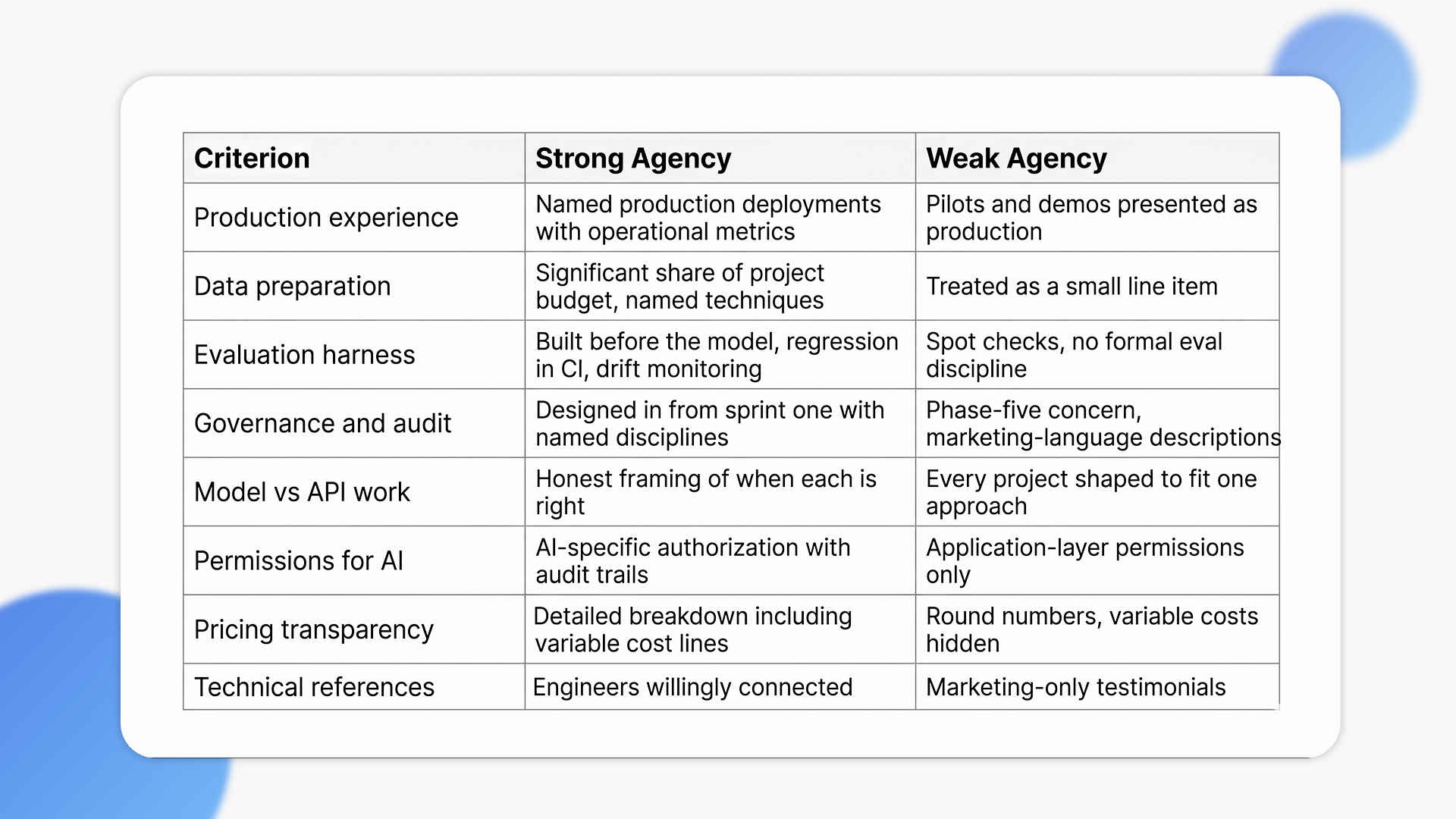
Verifying AI Capability Beyond the Interview
The interview surfaces opinions. The artifacts surface practice. Three additional checks consistently separate agencies that talk well about AI from agencies that ship well in AI.
Code samples and architecture artifacts
Ask for a redacted code sample from a recent AI project, or an architecture decision record covering a hard problem they solved. The artifact tells you whether the patterns they describe in interviews actually appear in their code, what their evaluation discipline looks like in practice, and whether their governance work is real or aspirational.
Eval harness review
Ask the agency to walk you through an evaluation harness from a recent project. What’s the test set, how was it built, what metrics are tracked, how is it run, where do results surface. The walk-through tells you whether eval is a delivery discipline or a marketing claim.
Technical reference call with the AI lead
Ask three specific questions during the technical reference call:
- What was the AI-specific work this agency did particularly well, and what would you have wanted them to do differently?
- How did they handle a hard model performance, data quality, or governance problem during the project?
- How did pilot graduation actually work, and what did the operational handoff look like?
When Hiring an AI Development Agency Is the Wrong Move
Some situations make hiring an external AI agency the wrong call regardless of agency quality. Here is when we tell clients to take a different path.
Your data foundation isn’t ready. If your data is fragmented, inconsistently labeled, or locked in silos, hiring an agency to build AI on top of it accelerates the underlying problem rather than solving it. Fix data quality first, then engage a development partner.
Your team needs to hire ai developers full-time for a permanent function. If AI is going to be a long-term core capability for your product, building an in-house AI team produces better long-term economics than agency engagements. Agencies are best for time-bounded projects, specialist scope, or capacity flex; in-house engineers are better for permanent architectural ownership.
Your scope is too small to justify the management overhead. AI engagements under USD 25,000 often cost more in vendor management than they save in delivery cost. For small experimental work, freelance AI engineers or in-house sprint capacity usually outperforms a formal agency engagement.
You don’t yet know what you’re building. If your AI scope is genuinely undefined, hiring an agency to figure it out for you produces inflated bids based on worst-case interpretations. Run a paid discovery engagement first (4 to 8 weeks, fixed price) before scoping a build.
How Ariel Approaches AI Development Engagements
From our delivery experience across enterprise and mid-market clients, the AI engagements that hold up are the ones where the technical evaluation surfaced the right disciplines before the contract was signed. We respond to AI evaluations regularly, and the buyers who run rigorous selection processes consistently end up with better outcomes regardless of which agency they pick.
The operating disciplines that consistently make AI engagements land cleanly are:
- Workflow analysis before model selection. The technical decision falls out of the workflow analysis, not the other way around.
- Data preparation as a budgeted line item. We scope it explicitly during discovery, before any model work begins.
- Eval harness built before the model. Regression testing runs on every change, monitoring dashboards for drift, results surfaced continuously.
- Governance designed in from sprint one. Audit logs, scoped permissions, decision provenance built into the architecture.
Across industries, the patterns we apply for AI engagements are documented in our overview of AI software development services, which covers the engagement model, technical disciplines, and outcome metrics that determine whether AI work moves business outcomes or absorbs into the technical debt budget. The delivery culture and operating principles we apply across every engagement are consistent: workflow first, then data, then model. Buyers who evaluate against these criteria consistently end up with better outcomes.
Evaluating AI development agencies and want a delivery-grade perspective on the technical questions that matter?
Our team has scoped, delivered, and operated AI features across enterprise systems for 16 years. We’ll walk through your evaluation framework, the questions that consistently separate genuine AI delivery from AI marketing claims, and the contract terms that prevent the most common engagement failures.
Frequently Asked Questions
1. How do I tell if an ai software development company has real production experience?
Three signals separate real production experience from pilot-only experience. First, named production deployments with operational metrics (traffic, latency, accuracy under load). Second, evaluation harnesses as a delivery discipline, not a one-time activity. Third, technical references from engineers, not executives, who can describe what production actually felt like. Agencies that ship AI in production have these by default. Agencies that have only built pilots usually don’t.
2. What’s the difference between artificial intelligence development services and traditional software development?
Artificial intelligence development services add layers that traditional software work doesn’t include: data preparation discipline, evaluation harnesses, governance design, drift monitoring, and ongoing model operations. The build cost is similar in many cases; the operational cost and risk profile are different. Treating AI as just another software project is one of the most common scoping mistakes in the space.
3. Should I hire ai developers full-time or work with an agency?
Depends on whether AI is a long-term core capability or a time-bounded project. If AI is going to be central to your product for years, build the in-house team. If you need AI for a specific project, capacity peak, or specialist scope, hire ai developers through an agency. Most mature product companies run a hybrid: in-house AI engineers own the core, agencies fill specialist or peak-capacity needs.
4. How much does AI development typically cost?
Ranges depend heavily on scope, data readiness, and governance requirements. Simple integration of an existing model API into an application can land in the lower five figures. Custom AI features with data preparation, evaluation, and governance work typically run from the low to mid six figures. Enterprise AI platforms with custom model training, multi-system integration, and regulatory governance run higher. These are illustrative ranges from our delivery experience, not industry-wide benchmarks. Plan for an annual run cost on top of build for API spend, model serving, ongoing evaluation, and prompt iteration.
5. Can Ariel help us evaluate AI development agencies?
Yes. We help buyers structure AI vendor evaluations including engagements where we eventually respond and ones where we don’t. The review is independent of whether we participate as a candidate. Get in touch if you want a delivery-grade perspective on your evaluation framework.
The Decision Behind the Decision
Choosing an ai software development company isn’t about finding agencies that list AI on their tech stack page. It’s about finding the ones that have shipped AI in production with the disciplines that prevent failure: data preparation, evaluation harnesses, governance design, permissions architecture, and ongoing operations. The eight criteria above each surface a specific capability that consistently shows up when AI projects succeed and goes missing when they fail.
Ask about production experience, not pilots. Pressure-test their data work. Verify their evaluation discipline. Probe their governance architecture. Insist on technical references with engineers. Listen for honest framing of when custom model work is needed and when API integration is sufficient. The agency decision matters, but the technical evaluation matters more.
Ready to hire an AI development partner with the rigor the decision deserves?
Book a free consultation with Ariel’s AI engineering team. We’ll walk through your evaluation framework, the questions that consistently separate genuine AI delivery from AI marketing claims, and the technical disciplines that prevent the most expensive AI project failures.