

Most eCommerce MVPs don’t fail because teams built too little. They fail because teams built too much of the wrong thing. According to CB Insights, poor product-market fit remains one of the leading reasons startups fail, often because the product solves the wrong problem or fails to deliver enough value to its target audience.
For eCommerce businesses, delivering a strong mobile experience is equally important. Adobe reported that mobile devices generated 56.4% of U.S. online holiday revenue in 2025 and 54.2% of Prime Day online sales in 2026, highlighting how critical a seamless mobile buying journey has become.
The instinct to “get everything in before launch” is understandable, but expanding an MVP too early can increase development costs, delay customer feedback, and slow product validation. That’s why this guide focuses not just on what to build, but what to build first, helping you prioritize the features and technical foundations that matter most in the early stages of eCommerce app development.
What Does MVP Actually Mean for eCommerce Businesses?
For most founders, “MVP” gets misread as “a smaller version of the final app.” That definition is misleading, and it’s why so many MVPs end up either bloated with unnecessary features or too limited to validate the business.
An eCommerce MVP isn’t a stripped-down store. It’s the smallest working version of your core transaction loop, which is discover, browse, add to cart, checkout, pay, and fulfill, built well enough to prove that real customers will complete purchases using real payment methods. Nothing more.
That distinction changes what counts as “essential.” A wishlist isn’t essential, no matter how often users request it, because the transaction loop functions without it. On the other hand, a secure checkout, payment gateway integration, accurate inventory synchronization, order management, and reliable payment webhooks are essential because they directly affect whether a customer can complete a purchase successfully.
From a technical perspective, an MVP is about validating the end-to-end commerce workflow, not the number of features. The architecture doesn’t need enterprise-level complexity, but it should be modular enough to accommodate additional features without requiring a complete rebuild.
Based on Ariel’s experience delivering eCommerce app development services, the MVP scope is a systems decision, not just a feature decision. Instead of asking, “What else can we add?”, we ask, “What’s the minimum commerce system that must work reliably under real-world conditions to validate this business?”
How to Build an eCommerce App Without Overbuilding?
Many eCommerce MVP development teams use a prioritization matrix, which is a decision-making tool that ranks features, tasks, or initiatives on specific factors, such as impact, effort, and urgency. Visually, it is like a grid (2×2), where the x-axis represents the urgency or importance of a feature and the y-axis shows the results or impact of your actions.
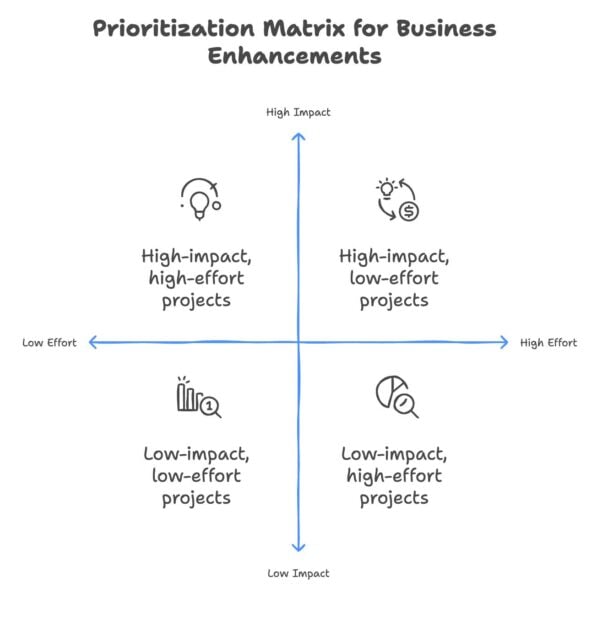
Based on the quadrants, you can rank the features for MVP that should be prioritized first to the ones that can be safely discarded at least for the development sprint.
However, the problem with this matrix is that it does not fully capture the cost of changing a feature once your app is live and processing real transactions. The standard effort – impact matrices plot two dimensions, which usually value against implementation effort. For eCommerce, that’s not enough. A feature can be cheap to build and catastrophically expensive to unwind:
- Adding a wishlist post-launch: Low effort, fully reversible, no dependent systems.
- Changing your inventory consistency model (eventual vs strong consistency) after you’ve got live orders: Low initial effort to skip properly, but extremely expensive to retrofit once order and inventory data are already coupled in production.
- Switching your payment data model or currency handling after transactions have flowed through it: Not a refactor, effectively a migration with real financial risk attached.
That’s why development teams use an eCommerce product prioritization matrix to evaluate features based on their business impact and cost of change (reversibility) during MVP planning. It plots two axes:
- X-axis: User/Business Impact (standard: how much this feature affects conversion, retention, or revenue)
- Y-axis: Reversibility Cost (eCommerce-specific: how expensive this is to change once it’s live and carrying real transaction data)
It categorizes features into four quadrants, helping development teams decide whether a capability should be built first, refined over time, deferred, or excluded from the MVP altogether.
| Quadrant | What It Means | Typical Examples |
|---|---|---|
| High impact, high cost of change | Build these correctly from the start as they form the foundation of your application and are costly to redesign later. | Payment gateway integration, checkout workflow, inventory and order management, tax and currency handling |
| High impact, low cost of change | Launch early, measure performance, and refine based on user feedback. | Product search, shopping cart UX, onboarding flow |
| Low impact, high cost of change | Delay these unless they’re central to your business model, as they often require significant architectural investment. | Multi-currency support (for domestic-only launches), subscription billing (for non-subscription businesses), loyalty programs |
| Low impact, low cost of change | Exclude from the MVP unless they represent your core differentiator, and consider them for future releases. | Wishlists, social features, referral programs, AI recommendations (when not central to the product proposition) |
This reframes “overbuilding” correctly. Overbuilding isn’t just shipping too many features; rather, it’s spending engineering effort on the bottom half of this matrix while treating the top-left quadrant (the actually irreversible stuff) as an implementation detail to figure out later.
That ordering is backward, and it’s the specific failure mode that turns a clean MVP into a costly rebuild once the platform begins to scale.
The practical rule when it comes to choosing eCommerce MVP features: before scoping a sprint, run every proposed feature through both axes, not just “how much value does this add,” but “what does this cost us to get wrong.”
Technical Roadmap Phases for Mobile Commerce App Development
When it comes to how to build an eCommerce app, a useful way to sequence the build: each phase should leave the cumulative product deployable.
Basically, Phase 1 gets you taking real orders. Phase 2 makes those orders trustworthy under real-world failure conditions. Phase 3 is where you earn the right to think about scale.
Let’s read about them in detail:
Phase 1 (Transaction Core)
The first phase focuses on creating a reliable buying journey that customers can trust. Every component involved in completing a purchase should work seamlessly before introducing advanced capabilities. Technical priorities in Phase 1 include:
- Product catalog and search
- Persistent shopping cart
- Responsive UI across devices
- Secure checkout workflow
- Essential payment gateway integration
- Order creation and confirmation
- Basic inventory management
- Secure guest/account session handling
- Idempotent order and payment operations
- Verified payment webhooks
- Inventory reservation and reconciliation
- Retries and failure handling
- Baseline accessibility
- Basic logging and operational monitoring
The objective is to validate that customers can successfully browse, purchase, and receive their orders without friction.
Phase 2 (Consistency & Trust)
Once the transaction flow has been validated, the next priority is ensuring the platform performs consistently under real-world conditions. Technical priorities at this phase include:
- Stronger fraud controls
- Concurrency-safe inventory reservations
- Improved observability
- UX refinement
- Broader accessibility testing
- Operational automation
These improvements make the platform more resilient as order volumes increase and additional integrations are introduced.
Phase 3 (Scale & Growth)
As the business grows, the focus shifts from operational stability to performance, scalability, and customer experience. Technical priorities in the growth phase include:
- Advanced product search with Elasticsearch or Algolia
- Redis and CDN caching for faster catalog delivery
- Event-driven architecture for analytics and personalization
- CRM and ERP integrations
- AI-powered recommendations and marketing automation
- Continuous UX optimization through A/B testing and behavioral analytics
For businesses managing multiple sales channels or planning rapid expansion, this is also the right stage to evaluate a headless commerce architecture. By separating the frontend from the commerce backend through APIs, headless commerce provides greater flexibility to deliver consistent shopping experiences across mobile apps, websites, marketplaces, and emerging digital channels while allowing each layer to scale independently.
Related Read: Is Headless Commerce Worth the Complexity?
The Most Essential eCommerce MVP Features
Behind every successful eCommerce app are three interconnected systems that work together: the Customer Panel, Admin Panel, and Vendor Panel (optional). Each panel serves a different user group while sharing the same product, order, and inventory data through secure APIs and a central database.
The goal of an MVP is to build these panels with only the functionality required to support reliable commerce, and not every feature imaginable.
Customer Panel
The Customer Panel is the customer-facing application where users discover products, place orders, make payments, and track deliveries. Since this is where revenue is generated, the shopping journey should be intuitive, responsive, and free from unnecessary friction.
- User registration & authentication – Account creation, secure login, and (critically) a guest checkout option, since forcing account creation before purchase is one of the most common causes of cart abandonment.
- Product catalog with search & filters – Product listings with images, pricing, descriptions, and basic filtering (category, price range) so customers can actually find what they want
- Shopping cart – Add, edit, remove items, with the cart persisting even if the customer closes the app and comes back later.
- Checkout & payment – A short, simple checkout flow with at least basic reliable payment methods integrated properly
- Order tracking – Customers can see their order status (placed, shipped, delivered) without having to contact support to ask
- User profile/order history – Saved addresses, past orders, and basic account management
That’s genuinely it for MVP. Wishlists, reviews, and loyalty points feel important, but customers won’t miss them on day one. They’ll only notice if checkout is broken or slow.
Admin Panel
The Admin Panel is the operational backbone of an eCommerce platform. It enables business teams to manage products, inventory, orders, customers, and store performance from a single interface. Without a well-designed admin panel, day-to-day operations quickly become manual and difficult to scale.
- Order management – View, update, and process incoming orders; handle cancellations and refunds
- Product management – Add, edit, remove products, manage stock levels and pricing.
- User management – View customer and vendor accounts, handle basic support issues (password resets, order disputes)
- Inventory oversight – Monitor stock levels and reservation status while reconciling inventory with fulfillment operations.
- Reports & analytics dashboard – Sales figures, order volume, and basic performance metrics, so you know what’s working before you decide what to build next.
Alongside first-party operational reporting, eCommerce teams should also consider integrating GA4 (Google Analytics 4) from the beginning. It provides valuable visibility into customer behavior by tracking product views, add-to-cart actions, checkout progression, and completed purchases, helping teams identify conversion bottlenecks and improve the shopping experience.
Read how eCommerce businesses use GA4 to understand customer journeys better, anticipate behavior, and make data-driven growth decisions.
Vendor Panel
(Note: For single-store eCommerce businesses, this panel can be omitted from the MVP.)
If your business allows multiple sellers to list and manage products, a dedicated Vendor Panel becomes essential. It gives vendors controlled access to manage their own catalog and orders without exposing administrative functionality.
- Vendor onboarding & registration – Sellers can create a store profile and get approved to sell
- Product management – Vendors add and manage their own listings, pricing, and stock, without touching anyone else’s
- Order management – Vendors see and fulfill only their own orders
- Earnings/commission visibility – A simple view of what they’ve sold and what they’re owed, since payment disputes are the fastest way to lose vendors early
Everything more advanced, like vendor-level analytics, bulk product import, automated payouts, is a Phase 2 problem, not an MVP one.
The Challenge: Build a Platform that Could Scale Beyond eCommerce
Our client needed more than an online store. They wanted a single platform that could support eCommerce, crowdfunding, memberships, and future growth. See how Ariel prioritized the right features, built a scalable foundation, and turned a complex vision into reality.
Common eCommerce MVP Mistakes That Increase Cost and Delay Launch
1. Overlooking an API-First Architecture
An eCommerce MVP should be designed with integrations in mind, not added as an afterthought. An API-first architecture defines clear integration contracts between systems, making it easier to connect payment gateways, inventory platforms, CRM, ERP, logistics providers, and analytics tools. When paired with abstraction layers for third-party services, it creates a more scalable, maintainable architecture that can adapt to changing business requirements.
2. Treating Inventory as a Simple Counter
Inventory isn’t just a number that decreases after a purchase. Without a proper reservation strategy, concurrent checkouts can oversell products, resulting in canceled orders and poor customer experiences. Your inventory model should handle stock reservations, payment failures, and order cancellations reliably from day one.
3. Shipping Mobile API Changes Without Versioning
Unlike web applications, mobile apps don’t update instantly. Introducing breaking API changes, such as modifying response structures or required parameters, can disrupt critical workflows for users still running older app versions. This is one of the most common pitfalls of API-driven eCommerce, making API versioning and backward compatibility essential for maintaining a stable and scalable application.
4. Ignoring Event-Driven Order Processing
Order confirmation, payment capture, inventory updates, shipping notifications, and customer emails shouldn’t rely on a single synchronous request. Event-driven workflows improve reliability by allowing each process to execute independently, reducing failures when third-party services experience delays.
5. Hardcoding a Single Payment Gateway into Checkout Logic
Integrating a payment gateway directly into your checkout workflow may accelerate MVP development, but it also creates tight coupling between your business logic and a specific provider. As your business expands into new regions, requires gateway failover, or adopts additional payment methods, replacing or adding gateways can require extensive changes across the checkout flow. Using an abstraction layer or payment adapter from the outset decouples gateway-specific logic from your application, making future integrations and migrations significantly easier.
What Do Experienced eCommerce App Development Teams Do Differently?
Most eCommerce apps solve the same problem the same way: browse, cart, checkout. That’s table stakes now, not a differentiator. An app that only replicates the storefront your competitors already have gives customers no real reason to choose you over them.
The teams that get this right stop treating the app as a digital storefront and start treating it as a revenue system; one built to solve a specific, unmet problem your customers actually have, not just to put your catalog in front of them. That distinction changes what gets built first, and why.
Through user research, competitor analysis, and technical discovery, the Ariel app development team identifies the features that differentiate your product while ensuring every development decision aligns with your business goals.
We follow the VPBM framework to reduce product risk, which stands for:
- Validate – Confirm the customer problem, business need, and technical feasibility before writing a single line of code.
- Prioritize – Sequence features based on business impact and cost of change, not simply what’s quickest to build.
- Build – Develop the core shopping experience, with your key differentiator integrated into the customer journey rather than added as a later enhancement.
- Measure – Use real user behavior and performance data to guide future development instead of relying on assumptions.
This structured approach helps businesses launch faster, avoid unnecessary development, and scale with confidence.
The Bottom Line
The success of an eCommerce app isn’t determined by the number of features it launches with; rather, it’s determined by the quality of the decisions made before development begins. Every architectural choice, integration strategy, and prioritization decision shapes how quickly your product can adapt to changing customer expectations and business growth.
A well-planned MVP doesn’t limit your vision; it creates the foundation to expand with confidence. When every feature serves a clear purpose, and every technical decision supports long-term scalability, you’re building a product that’s ready to evolve alongside your business.
Launch with exactly enough. Build the right thing next.
Most eCommerce App Development Mistakes Happen Before Launch
The sequencing decisions you make in week one are the hardest to undo by month six. Talk to our team before you scope your MVP at no additional cost, no obligation, just an honest read on your roadmap.
Frequently Asked Questions
1. What should be my priority while working on eCommerce app development?
Your priority should be delivering a seamless shopping experience that allows users to discover products, complete purchases, and receive order confirmations without friction. During eCommerce app development, focus first on high-impact eCommerce MVP features. Once the core features are validated, you can prioritize additional features.
2. Can you add new features after launching an eCommerce MVP?
Absolutely. An MVP is designed to evolve. Once your app is live, user behavior, analytics, and customer feedback should guide your next development priorities. Rather than expanding the feature set based on assumptions, use real-world data to determine which enhancements will deliver the greatest business value.
3. Should I integrate AI-powered features into my eCommerce MVP?
Not necessarily. However, if AI is your app’s core differentiator, then it should be part of your MVP. The goal of an MVP is to validate your unique value proposition, so if personalized recommendations, AI shopping assistants, or visual search are central to the user experience, they should be included from day one.
4. What metrics should you track after launching an eCommerce MVP?
Track metrics such as conversion rate, cart abandonment rate, average order value (AOV), customer retention, repeat purchase rate, and feature adoption. Monitoring these KPIs helps identify which eCommerce MVP features are driving engagement and which areas require improvement.
5. Should startups build a mobile app or a mobile-responsive website first?
The right choice depends on your business goals and audience. A mobile-responsive website is often the fastest way to validate demand and reach a broader audience. At the same time, a dedicated app is ideal for businesses looking to increase customer loyalty, improve retention, and offer personalized shopping experiences. Mobile eCommerce app development is a good option if repeat purchases, push notifications, or offline capabilities are a part of your growth strategy.
6. How to balance speed to market with long-term scalability?
Focus on building only the essential functionality while establishing a scalable technical foundation. Use an eCommerce product prioritization matrix to identify the features that deliver the highest business value for the MVP. On the technical side, choose a reliable cross-platform mobile app framework, modular architecture, and scalable cloud infrastructure to ensure new features can be added as your business grows without major redevelopment.
7. What are the biggest signs that your eCommerce app has outgrown its MVP?
Your MVP has likely reached its next stage when customer demand consistently exceeds its original capabilities. Common signs include increasing traffic, higher repeat purchase rates, requests for advanced features, expanding product catalog, or growing operational complexity that requires CRM, ERP, or marketing automation integrations.