

In a market this crowded, the health and wellness apps that survive past their first year aren’t the ones with the most features. They’re the ones built around three decisions made before a single line of code is written.
Compliance posture. Data architecture. Retention design. Get those three right, and the rest of the build, the UI, the integrations, the AI features, slot in cleanly. Get them wrong, and you discover the cost six months after launch when industry data suggests around a third of your users have already deleted the app, an OCR letter arrives in the mail, or your investors ask for the audit trail you never built.
Across health and wellness apps we’ve delivered at Ariel, the gap between products that scale and ones that stall almost always traces back to those three decisions.
Key Takeaways
- The wellness app market is projected to grow at roughly 14% to 15% CAGR through 2030, but industry research suggests around a third of users delete health apps within a week of download.
- Most health apps are not actually subject to HIPAA. Knowing whether yours is, is the first compliance decision, not the last.
- OCR enforcement around risk-analysis failures has been active in 2025, with reported settlement amounts spanning a wide range across covered entities and business associates.
- Real cost of a production-grade health app: USD 60,000 to USD 250,000 for an MVP, USD 250,000 to USD 600,000+ for full enterprise builds.
- Wearable integration, telehealth, AI personalization, and EHR/FHIR connectivity are the four features that separate scaling apps from stalling ones.
- Compliance is an architectural decision, not a phase-two task. Retrofitting HIPAA after launch is consistently far more expensive than building it in from day one.
- Most build budgets underestimate post-launch operations. Plan for the run cost, not just the build.
The Market Reality (And What It Hides)
Grand View Research valued the global wellness app market at around USD 11 billion in 2024 with projected growth in the mid-teens annually through 2030, with exercise and weight loss apps holding the majority of the share. The broader mobile health app market is reported on a steeper trajectory in market analyst forecasts through 2033. Those are the numbers everyone cites in pitch decks.
The numbers nobody pitches with are the ones that matter for survival. Industry market research suggests:
- Roughly a third of users delete health apps within one week of download, driven by trust and usability issues.
- Only a minority of available apps comply with international data protection standards like HIPAA or GDPR.
- A substantial share of mobile health app users cite data security concerns as a reason for hesitation.
The market is large, growing, and hostile. Users churn fast, regulators are tightening, and the apps with weak compliance and trust posture are exposed on both sides at once. The teams that build for that reality from day one come out the other end. The ones that build for the pitch deck don’t.
The Compliance Question Most Teams Get Wrong
Before you scope features, you have to scope compliance. And the first question to answer isn’t whether your app is HIPAA-compliant. It’s whether HIPAA actually applies.
This trips up almost every first-time health app team. HIPAA applies only when an app acts as a business associate to a covered entity (a healthcare provider, health plan, or clearinghouse), or when it handles protected health information on behalf of one. A standalone consumer wellness app that tracks meditation, hydration, or workouts, without provider integration or insurance pay flow, often falls outside HIPAA entirely. That doesn’t mean compliance is optional. It means a different framework applies (FTC enforcement, GDPR if you have EU users, state privacy laws, app store policies), and the architecture choices look different.
Misreading this is expensive in both directions. Build a non-HIPAA app with full HIPAA architecture, and you’ve spent meaningfully more than you needed to. Build a HIPAA-applicable app with consumer-grade architecture, and you’ve created a compliance liability that surfaces during your first audit, breach, or enterprise sales conversation.
The decision tree we use with clients
In the discovery phase of every health app development engagement, we map four questions:
- Does the app exchange data with a healthcare provider, payer, or clearinghouse?
- Will the app store, transmit, or process protected health information (diagnoses, lab results, medical history, billing data)?
- Is the app paid for or distributed by an employer health plan, insurer, or covered entity?
- Does the app integrate with EHRs, telemedicine platforms, or clinical decision systems?
If any answer is yes, the project is most likely operating in HIPAA scope and HIPAA compliant app development should be assumed as the working baseline, with all the architecture and operational posture that comes with it. If all answers are no but the app handles sensitive health data, other privacy frameworks (FTC, GDPR, CCPA) still apply, but the architectural footprint is typically lighter. Knowing which side of that line you’re on changes the cost estimate substantially. Final scope determinations should always be made with qualified privacy counsel.
What Health and Wellness App Development Actually Costs
Cost ranges in health app development are wide because the answer depends entirely on compliance posture, integration depth, and whether the app needs FDA pathway consideration. The ranges below are illustrative bands drawn from our own delivery experience for production-grade builds, not industry-wide benchmarks. Actual project costs depend on scope, region, team composition, and regulatory complexity.
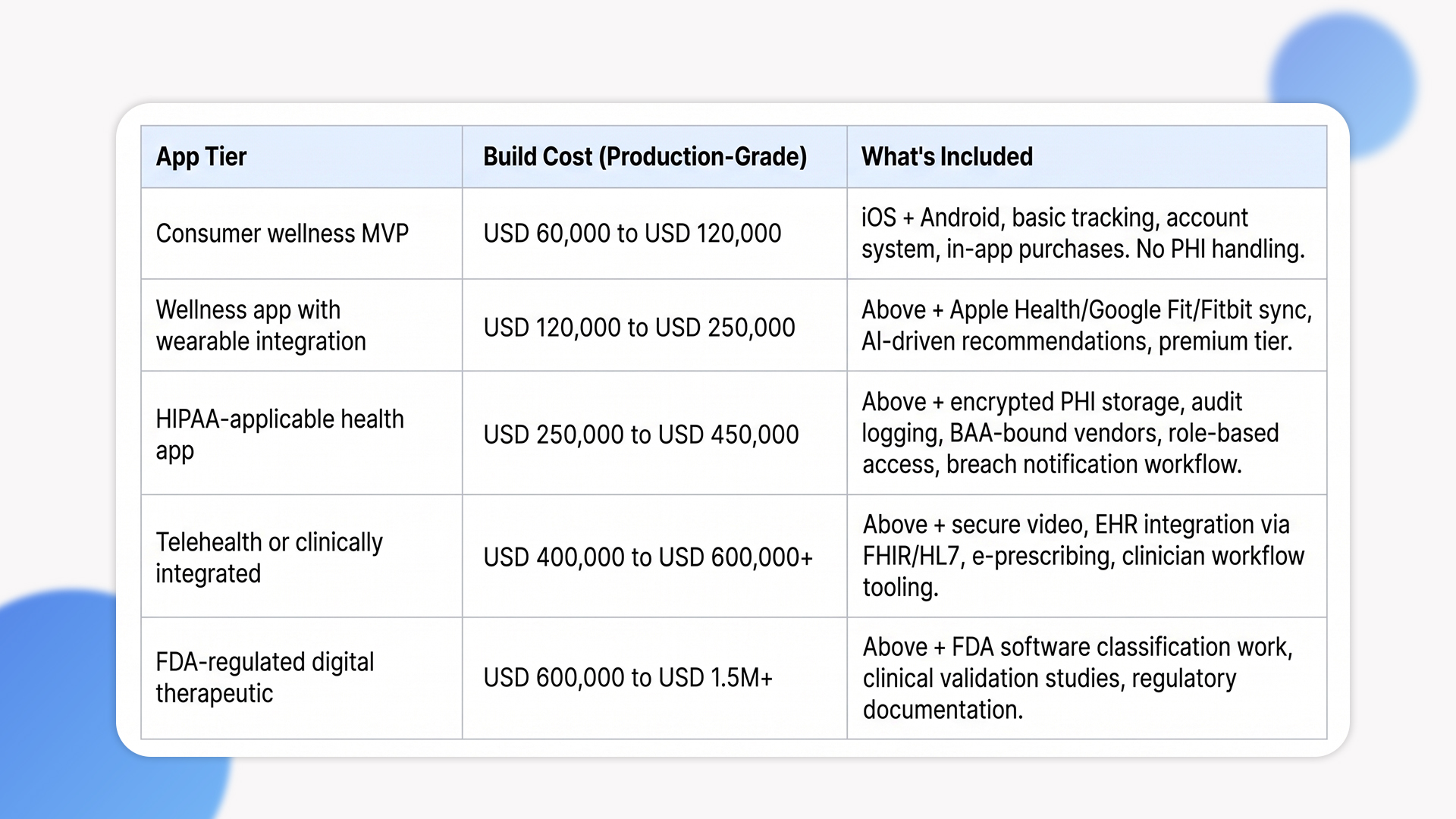
These ranges are build cost only. The line teams underestimate is what happens after launch. App store optimization, content updates, infrastructure scaling, security patches, regulatory changes, and ongoing compliance audits add a meaningful annual run cost on top of the build, which most projects we see should plan for as a non-trivial percentage of build cost. Budgeting for build without budgeting for run is one of the most common reasons promising apps stall in their second year.
The Features That Actually Move the Needle
Most health and wellness apps feature lists read the same way: account creation, push notifications, social sharing, gamification. None of those decide whether the app survives. Four feature categories do.
Wearable and IoT integration
Apps that sync with Apple Health, Google Fit, Fitbit, Oura, and CGM devices show measurably higher retention because the data flows in passively. Users don’t have to remember to log. The integration work is non-trivial: each platform has its own auth model, permission scopes, data refresh patterns, and rate limits, and each one updates its API roughly twice a year. Plan for it as ongoing engineering, not a one-time integration.
AI-driven personalization
Generic recommendations are why users stop opening apps. Personalization built on user data (sleep patterns, activity, mood, biometrics) is what keeps them. The risk is that AI models trained on health data introduce a separate compliance surface (model training data provenance, inference logging, bias testing). For HIPAA-applicable apps, the AI layer needs the same audit posture as the rest of the system. Treating it as “just a feature” is how compliance gaps appear in places nobody is looking.
Telehealth and provider integration
Direct connection to clinicians moves an app from wellness category to healthcare category. That shift unlocks higher LTV and enterprise contracts, but it also pulls the app into HIPAA, e-prescribing rules, state telehealth licensing, and FDA software-as-a-medical-device territory if any clinical decisions are involved. The upside is real. The compliance shift is also real, and it has to be planned upfront.
EHR connectivity through FHIR
For apps that need to read or write to electronic health records, FHIR (Fast Healthcare Interoperability Resources) is now the dominant standard. Apple Health, Epic, Cerner, and most major EHRs support SMART on FHIR for secure record exchange from mobile apps, which means clinical data integration is no longer the engineering moat it used to be. The complexity has shifted from access to governance: scoping which records to pull, mapping consent and authorization flows, and handling the locale-specific schema variations across EHR vendors. For any health app development project touching clinical data, FHIR is no longer optional infrastructure.
The HIPAA Compliant App Development Checklist
A note before you read this section: This is a technical and architectural scoping checklist drawn from our delivery experience, not legal guidance. HIPAA scope, applicability, and obligations are highly fact-specific, change over time, and depend on your organization’s role, your business associate relationships, and your jurisdiction. Always work with qualified privacy counsel and a HIPAA-experienced compliance advisor before making decisions on the basis of any of this content.
With that framing in place: if your app is within HIPAA scope, the architectural and operational floor we work on in our own builds covers the items below. These are the items that, in our experience and in published OCR enforcement actions, surface most often during audits and breach investigations.
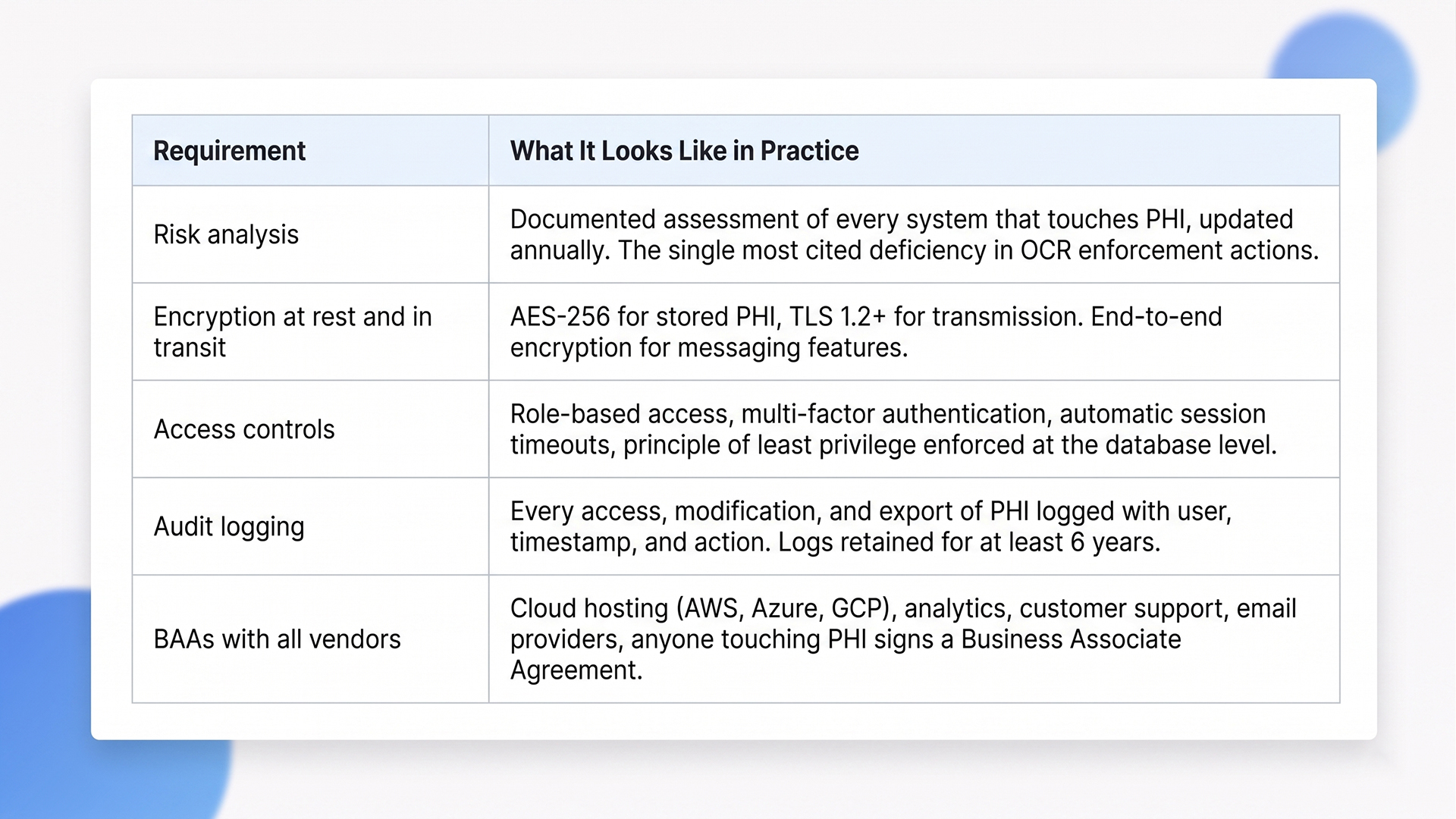
According to legal industry analysis of OCR’s 2025 enforcement actions, a series of HIPAA resolution agreements announced in early 2025 reflected settlement amounts spanning a wide range, from low five-figure to multi-million-dollar payments. The common thread across nearly every settlement was a failure to conduct a thorough risk analysis (current OCR resolution agreements are listed publicly on HHS.gov). Risk analysis is the lowest-effort, highest-leverage compliance step, and it’s the one organizations consistently skip.
What Teams Underestimate About Health App Development
These are the cost lines that don’t show up in the original budget but determine whether the app lands stable.
App store review cycles
Apple and Google have specific review requirements for health apps, including human subject protocol documentation, claims substantiation for medical features, and approved API usage for HealthKit and Health Connect. First-time submissions are rejected at higher rates than non-health apps. Plan for 2 to 3 review cycles, not one, especially for the first release.
Third-party SDK compliance gaps
Analytics, crash reporting, customer support chat, and marketing SDKs that work fine in a consumer app become compliance liabilities the moment PHI is involved. Google Analytics without proper de-identification, Facebook Pixel without filtering, customer support chatbots that read ticket content with PHI in it, all of these have triggered enforcement actions. Audit your SDK list against your data flow before launch, not after.
Multi-state telehealth licensing
If your app connects users with clinicians across state lines, every clinician needs to be licensed in the state where the patient is physically located at the time of the consult. Building the infrastructure to verify this in real time, and to handle the licensing chess game, is engineering work most teams scope as a small feature and discover is a months-long project.
Long-term data retention obligations
HIPAA requires PHI to be retained for at least 6 years from creation or last effective date. State laws often extend that further (some require pediatric records to be kept until the patient reaches age 21 plus 7 years). Storage cost is small. The architectural cost of building data with that lifecycle in mind, with proper purging workflows, encryption key rotation across that span, and audit trails that survive infrastructure migrations, is significant.
Post-launch security obligations
HIPAA requires ongoing risk analysis, security training, and incident response capability. That’s not a launch task, it’s a continuous operating cost. Most teams budget for the build and forget that compliance has a steady-state expense. From our delivery experience, security and compliance operations on HIPAA-applicable apps consistently land as a non-trivial annual percentage of build cost, which the project plan needs to absorb from day one rather than discover in year two.
When Building a Health and Wellness App Is the Wrong Call
Not every wellness business needs an app. Here is when we tell clients to slow down.
Your differentiation is content, not technology. If your moat is the quality of your coaching, programming, or community, a website plus a strong content layer often outperforms a custom app at a fraction of the cost. Build the app when the technology itself is the differentiator, not the wrapper around it.
You don’t have a clear data and compliance plan. Going to market without a worked-out compliance posture is the fastest way to discover your architecture is wrong. Spend the first month on data flow mapping, compliance scoping, and threat modeling before scoping features.
Your business model depends on third-party data sharing. FTC enforcement on health data sharing has tightened sharply in recent years, with multi-million dollar settlements against apps that shared health data with advertisers without explicit consent. If your monetization plan involves data partnerships, the compliance work to do that legitimately is substantial. Pretending otherwise is how regulatory exposure gets into the cap table.
How Ariel Approaches Health App Development
The pattern across our health and wellness apps delivery, alongside the patient engagement platforms, FHIR-enabled systems, and HIPAA-aligned applications we build for healthcare clients, is consistent. We start with compliance scoping and data architecture, not feature lists. We build the audit and security posture in from day one, because retrofitting it after launch is consistently far more expensive. We design for retention from the first wireframe, because acquisition cost in this market is high enough that losing users in week one is what kills unit economics.
Our delivery teams work across a layered stack tuned for healthcare workloads:
- Client tier: iOS, Android, React Native, Flutter, and .NET MAUI.
- Backend: Azure, AWS, and Kubernetes.
- Clinical integration: FHIR/HL7, OAuth2, and SMART on FHIR.
Compliance posture and architecture choices are made together with the client during discovery, before any code is written. That upfront work is what separates health and wellness apps that scale from ones that stall.
Planning a health or wellness app and want a delivery-grade scoping conversation, not a feature pitch?
Our team has delivered HIPAA-aligned platforms, FHIR-based integrations, and consumer wellness apps for 16 years. We’ll review your idea, your compliance scope, and your roadmap, then give you a sequenced build plan that holds up post-launch.
Frequently Asked Questions
1. How much does health app development actually cost?
In our delivery experience, a consumer wellness MVP typically lands in the USD 60,000 to USD 120,000 range for production-grade iOS and Android. HIPAA-applicable health app development generally lands meaningfully higher, in the USD 250,000 to USD 450,000 range, because of the architectural and operational obligations involved. Telehealth and clinically integrated apps run higher still. These are illustrative ranges from our project work, not industry-wide benchmarks. Plan for a meaningful annual run cost on top of the build for ongoing operations and compliance.
2. Does my health app need to be HIPAA compliant?
That depends on facts specific to your app and organization, and is ultimately a question for qualified privacy counsel, not a blog post. As a general rule, HIPAA obligations are most likely to apply when an app acts as a business associate to a covered entity, or when it stores, transmits, or processes protected health information on behalf of one. Many consumer wellness apps fall outside HIPAA scope, but other frameworks (FTC enforcement, GDPR for EU users, state privacy laws, app store policies) typically still apply. The compliance scoping conversation should happen in the first week of discovery, not after MVP, and should involve legal review.
3. How long does it take to build a production-grade health app?
Consumer wellness MVPs typically run 4 to 6 months end-to-end. HIPAA-applicable apps run 6 to 9 months due to compliance architecture and audit posture. Telehealth and EHR-integrated apps run 9 to 14 months because of the clinical workflow and regulatory work. The biggest variable isn’t the technology, it’s how much compliance and data architecture work happens before development begins.
4. Which compliance frameworks apply beyond HIPAA?
GDPR for EU users, CCPA and other state privacy laws in the US, FTC Section 5 enforcement on deceptive privacy practices, FDA software-as-a-medical-device for clinical decision features, and state telehealth licensing for provider-connected apps. App store policies (Apple HealthKit, Google Health Connect) add another layer. The right framework set depends entirely on what your app does and who uses it.
5. Can Ariel handle the full health app build, including compliance?
Yes. We cover compliance scoping, data architecture, mobile and backend development, FHIR/HL7 integration, security testing, and post-launch operations. Our delivery model treats compliance as architecture, not paperwork. Get in touch to scope your project.
The Decision Behind the Decision
The strongest health and wellness apps aren’t the ones with the most features. They’re the ones built around three decisions made before development starts: compliance posture, data architecture, and retention design. Get those right, and the rest of the build is execution. Get them wrong, and no amount of feature work compensates for the structural cost.
Pick your compliance scope deliberately. Build the audit posture from day one. Plan for the run cost, not just the build cost. The market opportunity is real. The apps that capture it are the ones that respect what the work actually costs.
Ready to scope a health app build that holds up after launch, not just at demo day?
Book a free consultation with Ariel’s healthcare app team. We’ll map your compliance scope, sequence the build, and identify the architectural decisions that need to land before code is written.