

The React Native versus Flutter debate has changed shape. For most of the last decade it was a performance argument: which framework rendered faster, animated smoother, drained less battery. In 2026 that argument was largely settled, and not in the way the framework partisans wanted. The performance gap between the two has closed enough that for 90% of business apps, the engine choice is no longer the decision driver. Which makes the question harder, not easier, because the answer now depends on team, ecosystem, product type, and runway rather than on benchmark charts.
The data backs up the convergence. Stack Overflow’s 2025 Developer Survey shows Flutter at 9.4% professional usage and React Native at 8.4%, with both frameworks growing year over year. React Native’s New Architecture (JSI, Fabric, TurboModules) now delivers near-native performance for standard UIs. Flutter’s Impeller engine delivers 120 FPS animations and tight rendering control. Both are stable, both are production-grade, and both have shipped at scale inside Meta, Google, BMW, Toyota, Nubank, and dozens of fintechs and SaaS products. The honest answer to which one to build on isn’t “the better framework.” It’s “the framework whose strengths match your specific situation, and the trade-offs whose costs you’re prepared to absorb.”
Here are the five questions that actually decide the call in 2026, plus the rare cases where the right answer to cross platform vs native is to skip the cross-platform conversation entirely.
Key Takeaways
- The performance gap has effectively closed for 90% of business apps. The decision in 2026 is about team, ecosystem, product type, and runway, not the rendering engine.
- Flutter leads on rendering consistency, pixel-perfect UI control, and animation performance. React Native leads on talent pool depth, web-mobile code sharing, and ecosystem breadth.
- Five decision questions: team makeup, UI fidelity needs, ecosystem dependencies, post-launch trajectory, and compliance posture.
- Native is still the right answer for performance-critical workloads, deep platform integration, and apps where the OS-specific feature lag of cross-platform frameworks is unacceptable.
- Hybrid app development cost is typically 30% to 50% lower than building two separate native apps, but the savings disappear if heavy native module work is required.
- Talent pool matters more than benchmark charts. The framework you can hire for in 6 weeks beats the framework that’s marginally better but takes 6 months to staff.
- Don’t pick the framework first. Decide the product first, then pick the framework that fits.
Why the Old Performance Debate Is Mostly Settled
For years, the cross-platform mobile development conversation centered on a single question: how close can cross-platform get to native performance? In 2026, the answer is close enough that the question rarely matters anymore. React Native’s New Architecture eliminates most of the bridge-related latency that plagued early versions. Flutter’s Impeller engine ships smoother animations than older Skia-based builds. Both frameworks handle 60 FPS rendering on modern devices without serious engineering effort, and both can be pushed to 120 FPS with optimization. Which means the old cross platform vs native performance argument has shifted: cross-platform is now near-native for typical workloads, and the decision lives elsewhere.
There are still edge cases. Heavy real-time graphics, AR experiences, demanding video processing, and certain game-like interaction patterns still favor native or Flutter over React Native. Animation-heavy product UIs still benefit from Flutter’s tighter rendering control. But for the typical SaaS dashboard, fintech app, e-commerce experience, or social platform, the performance differences sit below the threshold most users would notice. Which means the decision has moved upstream, to questions about team, ecosystem, and product trajectory.
Question 1: What Does Your Existing Team Actually Know?
This is the question that should drive the decision more than any benchmark, and it’s the one most decision-makers underweight. A framework that fits the team you already have is worth more than a framework that’s technically superior but requires you to hire from scratch.
From our delivery experience, the practical breakdown looks like this:
- Strong React or JavaScript team already in place. React Native is the path of least resistance. The component model is familiar, TypeScript transfers directly, and existing web utilities and libraries often work without modification. Teams can be productive in days, not months.
- No existing mobile or JavaScript team. Either framework is a fresh hire. Flutter’s Dart requires roughly two to three weeks of ramp for experienced engineers. React Native gives you access to the much larger JavaScript talent pool.
- Existing native (Swift/Kotlin) team. Both frameworks are learning curves, but Flutter’s typed Dart language often feels more familiar to engineers used to typed native languages than dynamically-typed JavaScript.
- Cross-functional team that ships web and mobile. React Native wins on code sharing with web React applications, which can meaningfully shorten delivery time for features that exist on both surfaces.
The Stack Overflow 2025 survey reports 44.7% of professional developers use React (web), which means the React Native talent pool is structurally larger than the Flutter one. That pool advantage isn’t decisive, but it’s real. Hiring six React Native engineers in six weeks is typically easier than hiring six Flutter engineers in the same window.
Question 2: How Important Is Pixel-Perfect UI Consistency Across Platforms?
This is the question where Flutter genuinely wins on technical merit. React Native renders using native platform widgets, which means an iOS app looks like iOS and an Android app looks like Android by default. Flutter renders everything through its own engine, which means the same widget tree produces the same visual output on both platforms, pixel for pixel.
Which is better depends on what you’re building:
- Brand-led products with strong design systems. Flutter. The pixel-perfect rendering means your design system shows up the same on every device, which matters for fintech, automotive, and any product where the UI is a core part of the brand experience.
- Platform-native feel is the priority. React Native. Apps that should feel like they belong on the platform (using iOS-style or Android-style controls naturally) benefit from React Native’s use of actual native widgets.
- Animation-heavy interfaces. Flutter, by a margin. The engine-controlled rendering gives tight frame timing and animation consistency that’s harder to achieve cleanly in React Native.
Most business apps don’t fall sharply into either camp. If you can’t decide whether UI consistency matters more than platform feel, it probably doesn’t matter enough to be the deciding factor. Move to Question 3.
Question 3: What Does Your Ecosystem Actually Need?
The ecosystem question is where react native vs flutter 2026 decisions get decided in practice. Specifically: what libraries, integrations, and tooling does your product need, and which framework has them already mature versus which one requires custom work?
React Native’s ecosystem is larger by raw count. The npm registry contains over a million packages, many of which work in React Native with minor adaptation. Common needs (analytics, payments, push notifications, authentication, mapping) have multiple mature options. The cost is that some of those packages are stale, abandoned, or require native module work to function reliably in modern React Native.
Flutter’s ecosystem is smaller but more coherent. The pub.dev registry is curated more tightly, and the official Flutter team maintains many of the high-traffic packages directly. The cost is that less-common needs (industry-specific integrations, niche SDKs, certain enterprise tools) sometimes don’t have a mature Flutter package and require platform channel work.
The ecosystem questions that should drive the decision:
- Are you using a specific payment provider, identity SDK, or analytics platform? Check whether each has a mature, maintained SDK in your candidate framework.
- Do you need deep integration with platform features (HealthKit, Apple Pay, ARKit, Google Pay, Bluetooth devices)? Check the package maturity for each, and the recency of releases.
- Are you in a regulated industry where security or compliance SDKs matter? Verify the framework support before committing.
Question 4: What’s Your Post-Launch Trajectory?
Both frameworks are stable, but they fail differently when products evolve in different directions. The trajectory question is about where the app is going, not just where it starts.
If the app will stay primarily mobile: Either framework holds up. Flutter scales cleanly through Dart’s strong typing, build reproducibility, and tight rendering control. React Native scales through the New Architecture (Fabric, JSI, TurboModules) and the maturity of the JavaScript ecosystem.
If you’ll add web or desktop: React Native has a clearer path through React Native Web for browser deployment and the React ecosystem for desktop. Flutter has Flutter Web and Flutter Desktop, which are real but still less mature for production work than the mobile experience.
If you’ll integrate heavily with AI or backend services: React Native’s JavaScript foundation makes calling out to AI APIs and consuming streaming responses smoother in many cases. Flutter requires Dart-side work for similar patterns, which is fine but adds engineering surface. We’ve seen this pattern come up repeatedly in our work on AI implementation challenges, where the framework choice influences how cleanly AI features get integrated.
If the app will need to interop with a legacy native codebase: React Native’s incremental adoption model is well-suited to embedding into existing iOS or Android apps. Flutter can do this too via Flutter Modules, but the React Native pattern is more battle-tested at scale, with Meta running it inside large native codebases for years. For migration scenarios, the disciplines we apply in legacy application modernization apply directly: incremental adoption, rollback paths, and parallel-run validation.
Question 5: What’s Your Compliance and Governance Posture?
For regulated workloads (fintech, healthtech, enterprise products with SOC 2 or HIPAA obligations), the framework choice has compliance implications. Neither framework is inherently more or less compliant, but the operational discipline around builds, dependencies, and supply-chain security differs in practice.
- Build reproducibility. Flutter’s Dart compiler produces deterministic builds, which is easier to audit. React Native’s Metro bundler can require manual cache management for clean reproducibility.
- Dependency hygiene. React Native’s larger ecosystem means a larger attack surface. Flutter’s smaller, curated ecosystem is easier to vet, but you may face more custom code for less-common needs.
- Supply-chain security. Both frameworks support SBOM generation and modern supply-chain controls, but the operational discipline of vetting transitive dependencies sits with the team, not the framework.
- Audit trails and observability. Identical in both frameworks. The discipline is the engineering practice, not the platform.
Definitive compliance scoping decisions should always involve qualified counsel rather than framework-level assurance. Both frameworks can be built into compliant products; the engineering discipline around them is what determines whether the result actually passes an audit.
The Side-by-Side Reference
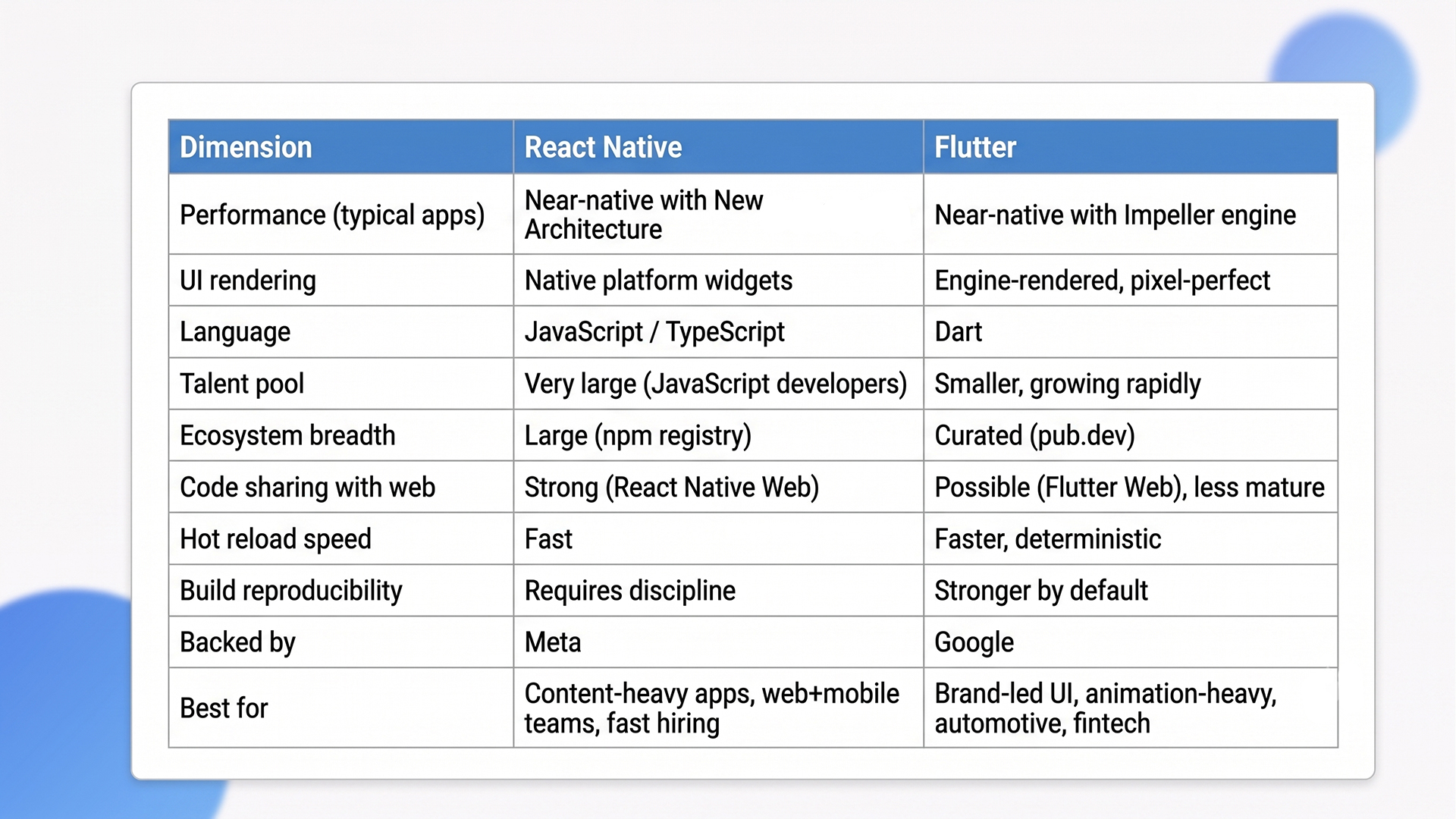
The table below summarizes how the frameworks compare across the dimensions that actually drive decisions in 2026. Treat it as a reference, not a verdict; the verdict depends on the five questions above.
When Native Is Still the Right Answer
Both cross-platform frameworks are excellent in 2026. Neither is universally correct. The honest answer to cross platform vs native is that some products still belong on native, and treating cross-platform as the default for every project is how teams end up rewriting their apps two years in. Here is when we tell clients to skip the cross-platform conversation entirely.
Performance is the core competitive differentiator. Real-time graphics, AR/VR experiences, heavy audio/video processing, demanding games. Both Flutter and React Native are good, but native still has a meaningful edge for the apps where rendering performance is literally the product.
Deep, time-sensitive platform integration. Apps that depend on the absolute latest iOS or Android features at launch (every June and August) often live easier on native, because cross-platform framework support for new OS features typically lags by weeks or months.
Single-platform product with no near-term cross-platform need. If you’re shipping iOS-only or Android-only for the foreseeable future, building cross-platform just to use one platform is paying complexity tax for no benefit. Native people are cleaner.
Hybrid native with shared business logic. Kotlin Multiplatform Mobile and Swift Package Manager now enable a middle path: native UI on each platform, shared business logic in a common module. For teams with strong native expertise and demanding UI requirements, this is increasingly the right answer in 2026.
What Cross-Platform Mobile Development Actually Costs
The hybrid app development cost question gets distorted in both directions. Vendors selling cross-platform often promise 50% to 70% savings versus going native. Teams that have shipped both report something closer to 30% to 50% in real-world delivery, and the savings disappear quickly if the project requires significant native module work, platform-specific UI customization, or integrations that don’t have mature cross-platform SDKs.
From our delivery experience, the realistic cost picture looks like this:
- Simple cross-platform app, two platforms, mature SDKs available: Typically 30% to 40% less than building two separate native apps.
- Cross-platform app with moderate native module work: Closer to 15% to 25% savings versus native, with longer delivery timelines than initially scoped.
- Cross-platform app requiring heavy native customization: Savings can disappear entirely. Two native apps may actually deliver faster, cheaper, and with less long-term maintenance burden.
- Cross-platform app that also ships to web (React Native): Savings can extend to 40% to 55% versus building separate iOS, Android, and web codebases, because the web target absorbs a meaningful share of the codebase.
These are illustrative ranges from our delivery work, not industry-wide benchmarks. The real number depends on how much native customization the product needs, and that’s a question best answered during discovery, not at the framework-selection stage.
When Either Framework Is the Wrong Move
Beyond the native-versus-cross-platform decision, there are situations where the right call is to delay or rescope the build entirely. Here is when we tell clients to step back.
The product hasn’t been validated yet. Don’t pick a framework before validating the product. Spend 4 to 8 weeks on problem validation and scope definition; the framework decision falls out naturally once the product is clear, and you avoid the cost of switching frameworks mid-build because the requirements changed.
The team is too small to absorb a new framework. If you have a three-engineer team and none of them know React Native or Flutter, the cost of training is meaningful relative to the project size. For small teams on tight timelines, going with the framework they already know (even if it’s not technically optimal) is often the right answer.
You’re trying to save money on the wrong line. Hybrid app development cost savings are real but bounded. If the product genuinely needs native performance or platform-specific features, paying for two native builds is cheaper than paying for a cross-platform build that has to be rebuilt 18 months later.
You’re framework-shopping instead of product-scoping. If the team is spending more time debating React Native versus Flutter than defining the product, the framework choice isn’t the bottleneck. Define the product, pick the framework that fits, ship.
How Ariel Approaches the Framework Decision
From our delivery experience across mobile engagements in fintech, logistics, retail, healthcare, and SaaS, the framework decision is rarely the most important choice in a mobile project. The product scope, the team continuity, the integration surface, and the post-launch trajectory all matter more. The framework picks itself once those four are clear.
The operating principles we apply to every cross-platform mobile development engagement are:
- Decide the product before the framework. Problem validation and scope definition come first, framework choice falls out naturally.
- Match the framework to the team. The framework you can hire for in six weeks usually beats the framework that’s marginally better but takes six months to staff.
- Pressure-test the ecosystem early. Check that every integration, SDK, and platform feature the product needs has a mature path in the candidate framework before committing.
- Plan the cross-platform-to-native escape route. For products that may need to switch to native later, design the architecture so that the migration is a six-week project, not a six-month rewrite.
Across industries, the pattern holds. Teams that pick the framework that fits their existing engineers, their actual integration needs, and their realistic product trajectory consistently outperform teams that pick the framework that won the most online debates.
Trying to decide between React Native, Flutter, or native for your next mobile build?
Our team has shipped mobile apps across React Native, Flutter, and native iOS and Android for 16 years. We’ll review your product scope, your team makeup, your integration needs, and your post-launch trajectory, then give you a delivery-grade read on which framework actually fits your situation.
Frequently Asked Questions
1. Is React Native or Flutter better for cross-platform mobile development in 2026?
Neither is universally better. Both are production-grade frameworks with the performance gap largely closed. The right choice for cross-platform mobile development depends on five questions: what your team already knows, how important pixel-perfect UI consistency is, what your ecosystem needs, where the product is heading, and your compliance posture. Teams with strong React or JavaScript backgrounds typically default to React Native. Brand-led products with heavy animation or strong design systems typically default to Flutter. Most decisions are matter of fit, not framework superiority.
2. What does react native vs flutter 2026 cost compare to native development?
The react native vs flutter 2026 cost comparison is roughly equivalent within either framework. Both deliver typical savings of 30% to 50% versus building two separate native apps, with the savings depending on how much native customization the product requires. Flutter developer rates run slightly higher (often 10% to 15%) due to a smaller talent pool, but Flutter’s faster MVP timelines sometimes offset the premium. The actual cost difference between the two frameworks is typically marginal compared to the cost difference between cross-platform and native.
3. When should I choose native instead of cross-platform?
Choose native when performance is the core competitive differentiator (real-time graphics, AR, demanding video processing), when you need access to the latest OS features at launch without waiting for framework support, when you’re only shipping to one platform, or when the product requires deep platform integration that cross-platform frameworks would force you to write as native modules anyway. For most business apps, cross-platform is the right answer. For the cases above, native still wins.
4. What’s the realistic hybrid app development cost in 2026?
The hybrid app development cost depends on scope, integration needs, and platform customization. A simple cross-platform app with mature SDKs available typically saves 30% to 40% versus two native apps. A cross-platform app requiring moderate native module work saves closer to 15% to 25%. A cross-platform app with heavy native customization may save nothing, and two native apps could deliver faster. These are illustrative bands from our delivery experience, not industry-wide benchmarks.
5. Which framework has the larger talent pool?
React Native, by a meaningful margin. The talent pool is structurally larger because React Native uses JavaScript and TypeScript, which are the dominant web development languages. The Stack Overflow 2025 Developer Survey reports 44.7% of professional developers use React on the web, and many of them can transition to React Native productively in days. Flutter requires Dart, which is a smaller but rapidly growing talent pool. For organizations that need to hire quickly, React Native usually wins this dimension.
6. Can Ariel help us decide between React Native, Flutter, and native?
Yes. We help teams scope mobile engagements, including the framework decision, before any code commitment. The review covers team makeup, product scope, ecosystem needs, post-launch trajectory, and compliance posture. Get in touch for a delivery-grade conversation about your specific situation.
The Decision Behind the Framework
Picking a framework for cross-platform mobile development in 2026 isn’t about which engine renders faster or which has the bigger ecosystem in absolute terms. It’s about which framework fits the team you already have, the product you’re actually shipping, and the trajectory you’re realistically on. The performance gap that drove the debate for a decade has largely closed; the decision has moved to questions the benchmark charts can’t answer.
Check what your team knows. Ask whether pixel-perfect UI consistency or platform-native feel matters more. Verify the ecosystem against your actual integration needs. Think through where the product is going, not just where it starts. Examine compliance against your specific obligations. The framework that fits those five answers is the framework to build on. Both React Native and Flutter can produce excellent products. So can native. The wrong answer isn’t picking one over the other; the wrong answer is picking before you’ve answered the questions that decide which one fits.
Ready to make the framework decision with a delivery-grade read on what actually fits your situation?
Book a free consultation with Ariel’s mobile team. We’ll walk through the five decision questions, surface the framework that fits your team and your product, and design a delivery plan that gets you to a shippable app without the cost of switching frameworks 18 months in.