

Every overrun looks obvious in hindsight. The vendor that quoted low and billed high. The team that won the pitch with senior architects and delivered with juniors. The contract with no key-person clause, no IP assignment, no source-code escrow, no exit terms. The change-order process that turned every scope adjustment into a renegotiation. None of these were invisible at signing. They were just never checked, because the evaluation stopped at the demo.
The numbers on this are not subtle. BCG’s 2024 research, across more than 1,000 companies, found that more than two-thirds of large-scale tech programs miss their targets on time, budget, or scope. The University of Oxford’s analysis of large IT projects puts it more bluntly: they deliver, on average, 56% less value than predicted. The vendor decision is the single biggest lever on which side of that statistic you land, and the evaluation that protects your budget happens before the contract, not after the first slipped milestone. From our delivery experience at Ariel, the engagements that hold up are the ones where the buyer did real due diligence on the things a demo can’t show.
Here is the due-diligence that catches the overrun before you sign it, organized around the specific budget risk each check is designed to prevent.
Key Takeaways
- Overruns are rarely surprises. They trace to specific things that were checkable at evaluation and never checked.
- Demos show capability. Due diligence shows reliability. The two are different evaluations, and only the second protects your budget.
- The five highest-leverage checks: named delivery team, financial stability, IP and contract terms, security and compliance posture, and reference quality at the technical level.
- Pricing transparency separates partners from vendors. Round-number bids and vague change-order pricing are budget risks in disguise.
- Source-code ownership, escrow, and exit terms decide whether an engagement is recoverable if it goes wrong. Negotiate them before signing.
- A weighted scorecard turns a subjective vendor decision into a defensible one, and forces the soft factors to compete with the hard ones.
- The cheapest evaluation mistake to fix is the one caught in due diligence. The most expensive is the one discovered in month nine.
Why Evaluating a Software Development Company Is a Budget Decision
Most evaluation guides treat vendor selection as a capability assessment: can this team build what we need? That’s necessary, but it’s not where budgets break. Budgets break on reliability, not capability, and reliability is invisible in a demo. A team can be genuinely skilled and still blow your budget through key-person attrition, a punitive change-order process, or financial instability that pulls them off your project mid-build.
This is the distinction that matters when evaluating a software development company: the demo answers “can they build it,” and due diligence answers “will the engagement stay on budget if something goes wrong.” The second question is the one that protects the money, and it requires verifying things the sales process is structured to keep out of view. The Standish CHAOS research has tracked this for decades: the majority of challenged projects were challenged for organizational and contractual reasons, not because the technology was beyond the team.
The Five Due-Diligence Checks That Protect Your Budget
These five checks, run before the contract is signed, prevent the overruns that show up in months six through twelve. Each one maps to a specific budget risk. Run all five on any software development company you’re seriously considering.
1. Named delivery team (prevents the bait-and-switch overrun)
Vendors win engagements with senior architects in the room and deliver them with whoever is on the bench. The gap between the pitch team and the delivery team is one of the most consistent sources of cost overrun, because junior engineers on senior-scoped work produce rework, missed edge cases, and timeline slippage. The check:
- Require named team members with stated allocation percentages written into the contract.
- Request relevant project history for each named individual.
- Insist on a key-person clause that lets you renegotiate or exit if named delivery leads change without consent.
2. Financial stability (prevents the mid-build collapse)
A vendor that runs out of runway mid-engagement is the most expensive overrun of all, because you inherit a half-built system and the cost of finding a replacement partner to finish it. Financial due diligence on a development partner is standard practice in mature procurement and routinely skipped by everyone else. The check:
- Review financial stability indicators: years in operation, client concentration, and evidence of stable cash flow.
- Ask about runway and dependency on any single client representing a large share of revenue.
- For larger engagements, request evidence of financial health proportionate to the contract size.
3. IP, source code, and contract terms (prevents the lock-in overrun)
The contract is where the partnership becomes real, and where the most expensive overruns are quietly written in. Vague IP assignment, vendor-hosted repositories, no escrow, and a punitive change-order process all transfer budget risk to the buyer. The check:
- IP ownership. Explicit assignment of code, models, and derivative works to the buyer, not assumed.
- Source-code access. Repositories under the buyer’s organization, or source-code escrow for buyer continuity.
- Change-order process. Written estimates, milestone updates, and signed approval before work starts, not retroactive invoices.
- Exit terms. A defined off-ramp that lets you transition without losing months of velocity.
4. Security and compliance posture (prevents the audit-failure overrun)
For regulated or data-sensitive work, a missing compliance control discovered after launch is an expensive retrofit and a potential regulatory exposure. The discipline behind verifiable security and traceability is substantial, and we cover the depth of it in our guide on how to audit AI agents, where the same governance principles apply to any system handling sensitive data. The check:
- Verify relevant certifications (SOC 2 Type II, ISO 27001) with scope matching your data-handling requirements.
- Request recent penetration test results, redacted as needed.
- Confirm GDPR data-processing coverage and HIPAA BAA capability if handling regulated data.
- For regulated industries, route definitive scope questions to qualified counsel rather than relying on vendor assurances.
5. Reference quality at the technical level (prevents the optimism overrun)
Marketing references are filtered. Technical references are not. A reference call with a CTO or senior engineer at a recent client surfaces what production was actually like, what surprised them, and what they’d do differently, which is exactly the information that predicts whether your engagement will stay on budget. The check:
- Ask to speak with a technical stakeholder, not just an executive sponsor.
- Ask what surprised them, good or bad, about working with the vendor.
- Ask how the vendor handled a hard problem or a missed milestone during the engagement.
A Weighted Scorecard for the Decision
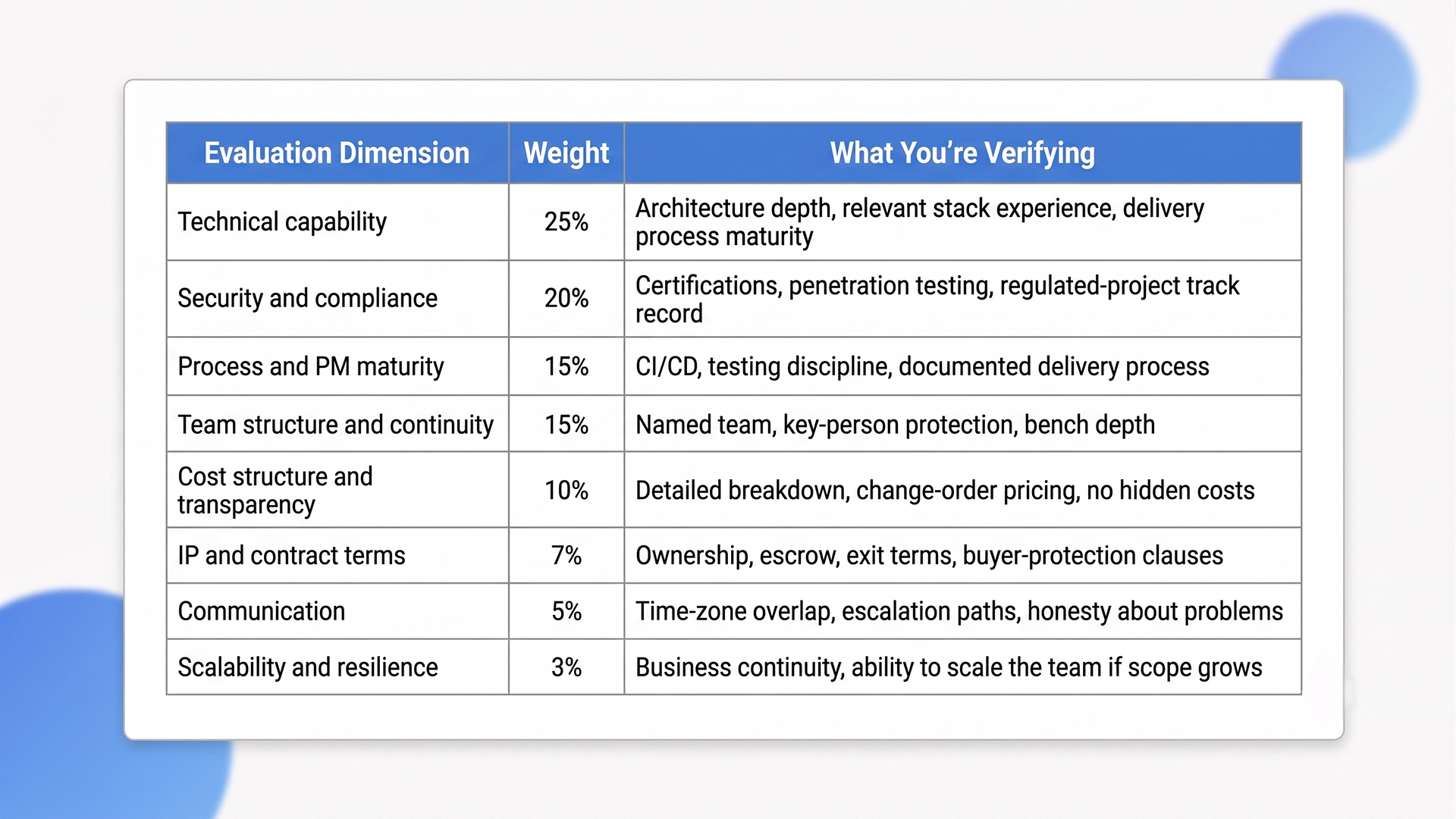
A subjective vendor decision is hard to defend and easy to bias toward the best pitch. A weighted scorecard forces the soft factors to compete with the hard ones and produces a number you can take to a budget owner. The dimensions and weights below reflect how we see buyers structure rigorous evaluations; adjust the weights to your project’s actual risk profile.
Score each dimension 0 to 10, multiply by weight, and sum to a composite out of 100. As a working rule of thumb, vendors above 85 are strong candidates, 70 to 84 proceed with monitoring, 55 to 69 require remediation before signing, and below 55 should be rejected. The exact thresholds matter less than the discipline of scoring every software development company against the same weighted criteria, so the decision is defensible rather than impressionistic.
Where Budgets Actually Break (and the Check That Catches It)
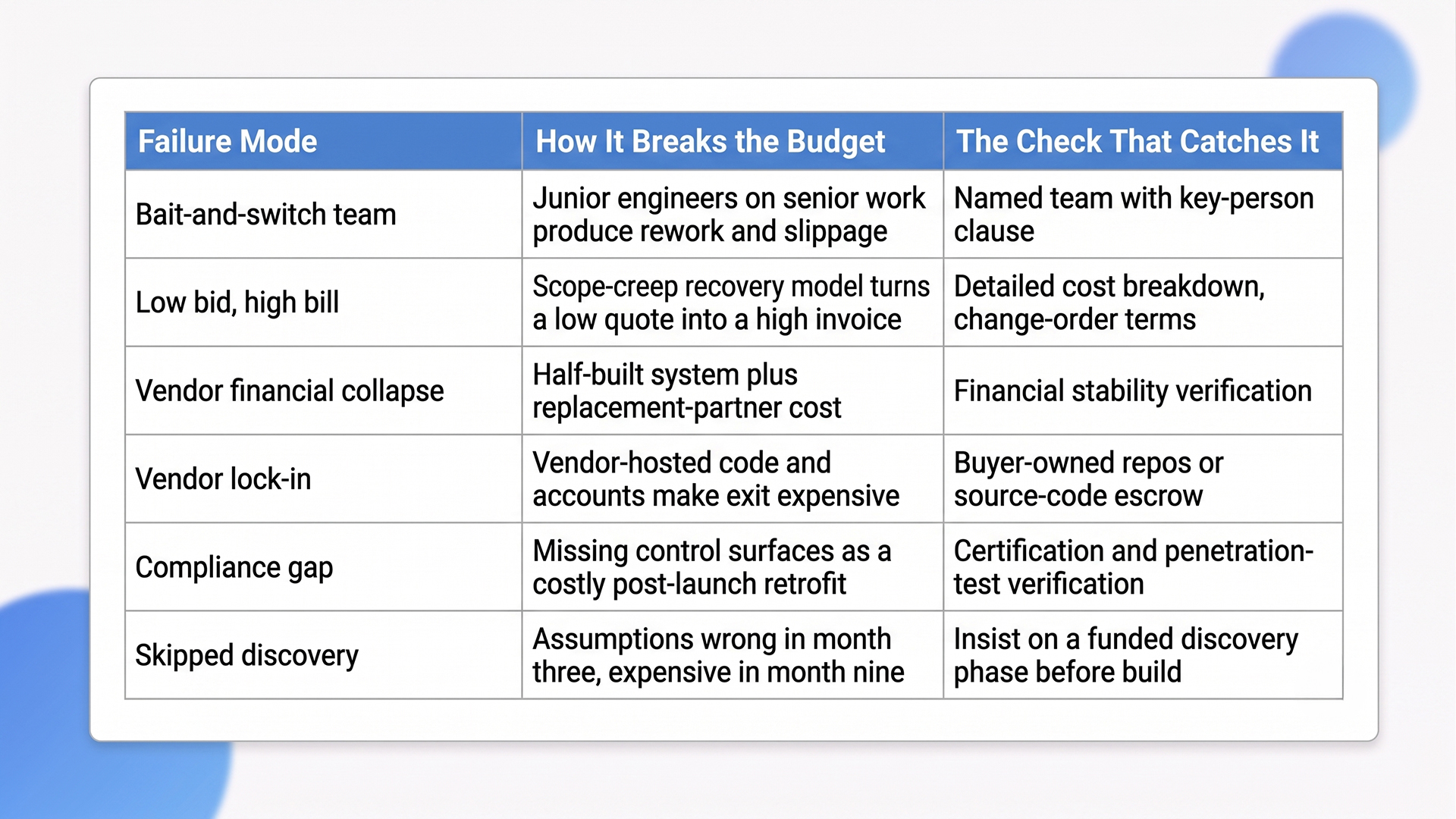
From our delivery experience, overruns cluster around a handful of failure modes, and each one is catchable in due diligence. The table maps the failure mode to the check that prevents it.
The pattern is consistent: the cheapest place to catch an overrun is in due diligence, and the most expensive place to discover it is in production. The discovery phase deserves special attention, because skipped discovery is the single most common root cause of budget failure. A four-to-eight-week discovery investment routinely saves multiples of its cost in avoided rework.
When a Rigorous Evaluation Is the Wrong Move
Due diligence has a cost, and it isn’t always proportionate to the engagement. Here is when we tell buyers to scale the evaluation down or take a different path.
The engagement is small or time-boxed. For work under a modest threshold, a full weighted scorecard and financial due diligence cost more in evaluation time than they protect. A senior freelance engineer or a lightweight vendor check is the proportionate response. Reserve heavy due diligence for engagements where the budget at risk justifies it.
You’re running paid discovery first. If scope is genuinely undefined, a short paid discovery engagement with one or two vendors surfaces more about fit and reliability than any pre-contract evaluation could. Let the discovery phase do the vetting, then run full due diligence before the build commitment.
The work is core and belongs in-house. If a system is your competitive differentiation, the question isn’t which vendor to evaluate; it’s whether to outsource at all. Some work should stay in-house regardless of how strong the external options are, because the architectural judgment needs to live inside your company.
Your data foundation isn’t ready. If the underlying data or architecture is the real constraint, evaluating build partners is premature. Modern AI and data workloads in particular break on legacy foundations, a pattern we examine in our breakdown of AI implementation challenges. Fix the foundation first, then evaluate partners against the cleaner starting point.
How Ariel Approaches Vendor Evaluations
From our delivery experience across enterprise and mid-market clients, the buyers who run rigorous evaluations end up with better outcomes regardless of which software development company they ultimately pick. We respond to structured evaluations regularly, and we expect to be asked the hard questions: name the team, show the financials, commit to the IP and exit terms, connect us with a technical reference. The vendors worth hiring welcome that scrutiny; the ones to avoid resist it.
The operating principles we bring to every engagement, and that we encourage buyers to verify in any partner, are:
- Named team continuity. The architects who scope the engagement stay on through delivery, protected by key-person clauses.
- Buyer-owned everything. Repositories, cloud accounts, and pipelines under the buyer’s organization from day one.
- Discovery before build. A funded discovery phase that profiles the real scope before the budget is committed.
- Honest change-order discipline. Written estimates and signed approval before any scope change, with no surprise invoices.
These disciplines are the same ones that make modernization and migration engagements land cleanly, which we cover in our lessons from legacy application modernization. The throughline across every engagement type is that the scoping and contractual discipline, not the rate card, determines whether the budget holds.
Evaluating a software development partner and want a delivery-grade read on the due diligence that protects your budget?
Our team has responded to hundreds of vendor evaluations across industries for 16 years. We’ll walk through your evaluation framework, the checks that catch overruns before they happen, and the contract terms that keep an engagement recoverable if something goes wrong.
Frequently Asked Questions
1. How do I evaluate a software development company before signing a contract?
Run five due-diligence checks the demo can’t show: verify the named delivery team with a key-person clause, confirm financial stability, lock down IP and source-code ownership and exit terms, verify security and compliance posture, and speak to a technical reference at a recent client. Score every candidate against the same weighted criteria so the decision is defensible. The demo answers whether they can build it; due diligence answers whether the engagement stays on budget if something goes wrong.
2. What is the biggest budget risk when hiring a software development company?
The bait-and-switch team is the most consistent. Vendors pitch with senior architects and deliver with whoever is on the bench, and junior engineers on senior-scoped work produce rework and slippage that inflate the budget. The fix is a contract that names the delivery team with stated allocation and includes a key-person clause. The second-largest risk is a punitive change-order process that turns every scope adjustment into a renegotiation.
3. Should I check a software development company’s financial stability?
Yes, for any engagement large enough that a mid-build vendor collapse would hurt. A vendor that runs out of runway mid-project leaves you with a half-built system and the cost of finding a replacement to finish it, which is the most expensive overrun of all. Review years in operation, client concentration, and evidence of stable cash flow proportionate to the contract size. For small or time-boxed work, this check can be lighter.
4. What contract terms protect my budget when hiring a development partner?
Five terms do most of the work: explicit IP assignment of code and derivatives, buyer-owned repositories or source-code escrow, a written change-order process with approval before work starts, named team members with key-person protection, and defined exit terms that let you transition without losing months of velocity. These rarely appear in a standard master services agreement template, so they have to be negotiated in. Have qualified counsel review them before signing.
5. How long should evaluating a software development company take?
Three to six weeks for most engagements. That covers proposal review, the five due-diligence checks, reference calls, and contract negotiation. Compress it below two weeks and you trade signal quality for speed; stretch it beyond eight and the strongest candidates often disengage. The due-diligence checks add little time if they’re requested upfront rather than bolted on at the end.
6. Can Ariel help us run a vendor evaluation?
Yes. We help buyers structure evaluations, including ones where we eventually respond to the brief and ones where we don’t. The review is independent of whether we participate as a candidate. Get in touch for a delivery-grade perspective on your evaluation framework.
The Check Behind the Decision
Evaluating a software development company well isn’t about finding the best demo. It’s about verifying the things a demo can’t show: the team that will actually deliver, the financial stability behind the contract, the IP and exit terms that keep the engagement recoverable, the compliance posture that survives an audit, and the technical reference that tells you what production was really like. Each check maps to a specific overrun, and each overrun is cheaper to catch in due diligence than to discover in month nine.
Verify the team by name. Check the financials. Lock down IP, escrow, and exit terms. Confirm the security and compliance posture. Insist on a technical reference. Score every candidate against the same weighted criteria. The demo tells you what a vendor can build; the due diligence tells you whether your budget survives the build.
Ready to evaluate a software development partner with the rigor your budget deserves?
Book a free consultation with Ariel’s delivery team. We’ll walk through your evaluation framework, the due-diligence checks that catch overruns before they happen, and the contract terms that keep an engagement on budget from discovery through delivery.