Imagine a service manager asking an AI agent to resolve a billing complaint. The agent retrieves the customer’s history, checks an invoice, prepares a correction, and routes the adjustment for approval. The manager might never open the CRM or billing dashboard. But those applications still hold the customer record, transaction rules, permissions, and evidence of what changed.
That distinction sits at the center of the AI agents vs traditional software debate. Gartner estimates that up to $234 billion in enterprise application spending could be exposed to agent-driven disruption by 2030. This is spending at risk of changing, not a prediction that $234 billion will disappear. The pressure is real, though: if software can complete work without a person navigating every screen, what exactly are businesses paying their SaaS providers for?
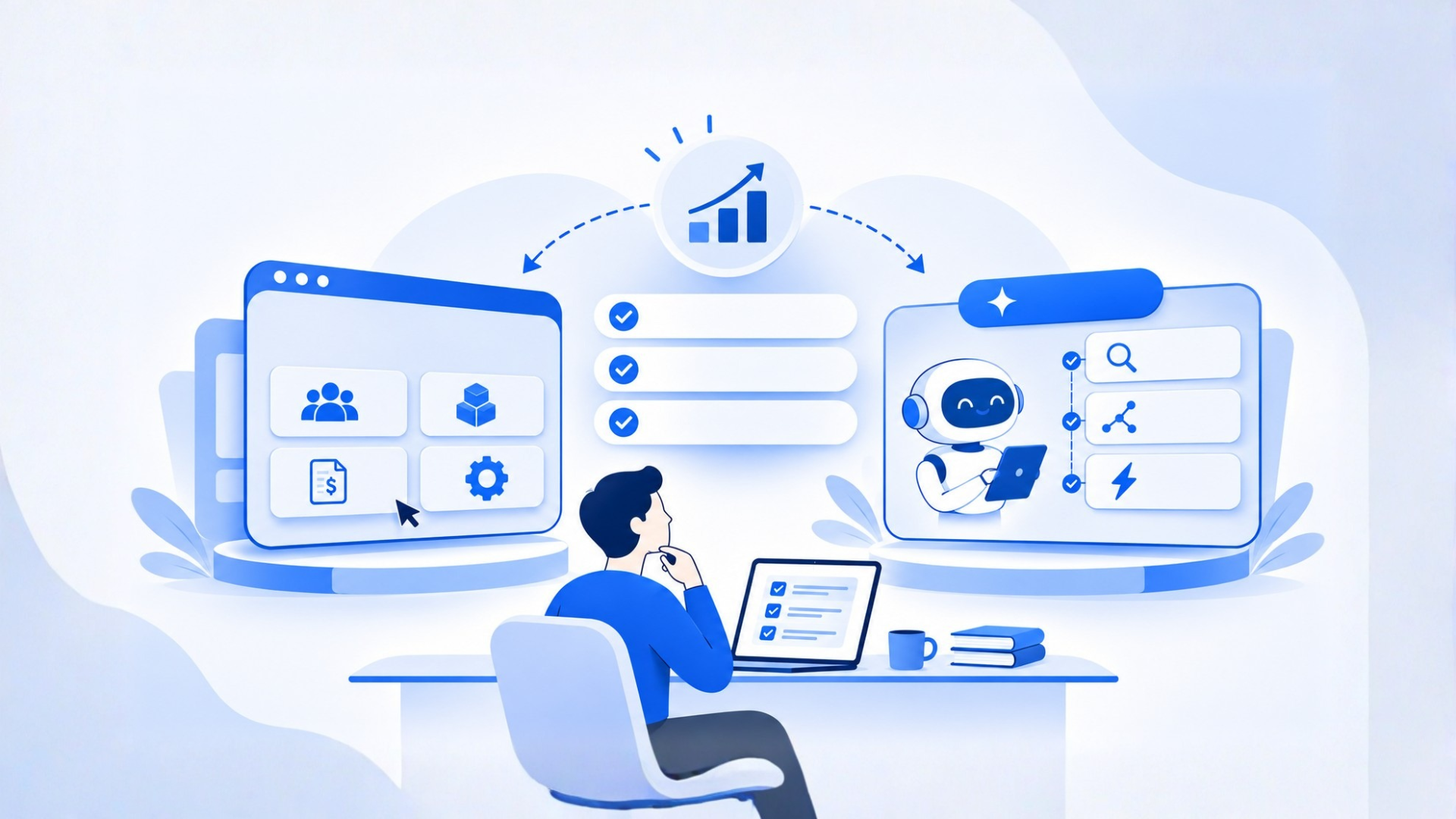
AI agents are unlikely to eliminate enterprise SaaS entirely. They will change which applications earn their place, how people use them, and where software creates value. For technology leaders, the practical decision is whether to replace, modernize, or extend the systems they already own.
AI Agents vs Traditional Software: What Is Actually Changing?
Traditional SaaS is not necessarily manual or unintelligent. Mature platforms already automate approvals, calculations, notifications, and integrations. Their strength is consistency: a defined rule produces a predictable outcome, and the application keeps the corresponding record.
An AI agent introduces a different capability. Instead of requiring every step to be specified in advance, it can interpret a goal, retrieve relevant context, select from permitted tools, and coordinate a task across systems. Unlike a chatbot that only answers questions, an agent can initiate actions, provided the surrounding software grants those capabilities.
For example, a support agent might investigate a delayed shipment by checking the order system, delivery status, and service history before proposing a response. The fulfillment platform remains responsible for the order, while the agent changes how the work gets done around it.
The useful distinction is not old software versus smart software. It is deterministic business operations working alongside AI-assisted task execution.
Will AI Replace SaaS Applications or Just the Interfaces We Use?
Some familiar software interactions are genuinely vulnerable. A user may no longer need to open three dashboards to research a customer, copy details between systems, or prepare a routine status update. Narrow tools whose primary value is moving information from one screen to another could become less compelling.
Yet a CRM is more than its contact screen. An ERP is more than a purchase-order form. These platforms store authoritative records, enforce business rules, reconcile transactions, and preserve audit histories. Even if an agent becomes the main interface, it still needs reliable systems underneath it.
That distinction is reflected in Gartner’s October 2026 analysis: 51% of surveyed organizations were reassessing point solutions, compared with 22% reconsidering major ERP and CRM systems. IDC similarly argues that the underlying data model, governance, and process layer are what make enterprise software useful to an agent.
This is why the future of the SaaS industry is unlikely to be a simple choice between applications and agents. Some interfaces may fade from daily use, while systems of record become more important and harder to replace casually.
For SaaS product owners, the immediate question is whether their platform can expose its capabilities securely through APIs. That is also a central consideration in SaaS development: creating software that can evolve without sacrificing the integrity of its core workflows.
Where AI Agents Can Change Work First and Where They Should Stop
The strongest opportunities involve work that crosses applications but still has a clear outcome. In customer service, an agent can gather case history and prepare a response. In finance, it can extract invoice details, compare them with purchase orders, and flag exceptions. In internal operations, it can assemble information from approved systems and prepare the next task for a person to review.
That does not mean every downstream decision should be delegated. An agent can prepare a refund, but the system should validate eligibility and limits before payment. It can summarize an applicant’s documents, but regulated eligibility decisions must follow applicable rules and oversight. It can recommend an access change, but identity controls must decide whether the change is permitted.
The pattern worth investing in is agent assistance where interpretation helps, deterministic controls where the outcome must be exact, and human judgment where accountability cannot be delegated. That boundary matters more than how impressive the agent looks in a demonstration.
The Hidden Cost of Agent-Led SaaS: The Work After the Work
Market adoption is real, but production results are more complicated. In G2’s October 2026 research of B2B software buyers, 66% reported agents in limited or scaled production. At the same time, 45% said oversight and rework consumed more than a quarter of their expected productivity gains.
An agent may save ten minutes gathering information but introduce several minutes of checking, correcting, or approving its output. That is not necessarily a failed implementation; some oversight is essential. But it changes the economics. The relevant measure is not how quickly the agent generates an answer. It is the cost and reliability of a correctly completed task, including model calls, human review, exceptions, and recovery.
Pricing will change with this shift. Gartner sees pressure on traditional seat-based licensing, while G2 found that only 9% of surveyed buyers considered per-seat pricing the fairest approach for agent services. Usage and outcome-based models may be better aligned with work completed, although they introduce their own metering and quality challenges.
A company paying for fewer seats may still spend more on inference, integrations, monitoring, and exception handling. A pricing change is not the same thing as a cost saving.
Replace, Modernize, or Extend? A Decision Framework for Existing SaaS
Before investing in AI automation software, organizations should classify the workflow, not the product category. The same SaaS platform may contain functionality worth preserving, improving, and retiring.
| What You Find | Better Starting Decision | Why |
|---|---|---|
| Reliable records and business rules, but repetitive cross-system tasks | Extend with a focused agent | Preserve the trusted core and automate selected interactions. |
| Fragmented data, weak APIs, or brittle integrations | Modernize first | An agent will inherit the existing failure points. |
| A narrow, interchangeable tool performing one easily verified task | Evaluate replacement | Simpler automation or an agent may remove redundant software. |
| High-stakes transactions, compliance logic, and authoritative records | Preserve and integrate | Keep approvals and transaction rules under controlled execution. |
A useful first review asks: Which steps demand interpretation? Which outputs are legally or financially consequential? Where is the authoritative record? What does a successful task cost today? And who will be accountable if automation goes wrong?
Those answers reveal whether the organization needs a new agent, an API improvement, a workflow redesign, or no AI at all. Ariel’s agent development guidance explores the implementation decisions after that first architectural choice.
What an Agent-Ready SaaS Architecture Actually Requires
The difficult part of agent integration is rarely giving a model access to a tool. It is ensuring that the tool performs only authorized actions, against the correct data, with observable results.
An agent-ready platform needs a clear system of record, where customer, financial, and operational data remains authoritative; controlled APIs and permissions, so the agent receives only the capabilities required for its task; approval and validation boundaries, particularly before irreversible or regulated actions; and operational recovery, including audit logs, error handling, safe retries, and a way to investigate or reverse supported changes.
These details are not optional finishing touches. An agent that retries a failed payment action without understanding whether the original transaction succeeded can create a duplicate. An agent with unrestricted write permissions can turn a mistaken interpretation into a business incident. Better prompts alone cannot resolve those architectural problems.
This is where AI-powered SaaS becomes a software engineering discipline rather than a feature added to the navigation menu.
What Ariel’s Project Work Shows About the Transition
Ariel Software Solutions has published examples on both sides of this architectural shift.
In its vehicle title and registration case study, Ariel built a cloud-native, multi-tenant SaaS platform around a configurable rules engine. State-specific forms, fees, validations, and approvals can be managed through configuration rather than repeated code releases. AI-assisted document extraction supports the process, while the application maintains the governing rules, workflow, and tenant boundaries. It is an example of why reliable enterprise software cannot be reduced to a collection of screens.
In a separate governed Claude MCP integration, Ariel enabled an AI agent to work with data in Google Sheets and Drive through explicitly defined tools. Critical write operations were placed behind change previews and human approvals, supported by audit records and revision recovery. The agent could participate in operational workflows without receiving unrestricted authority over the data.
These projects do not establish that agents will replace SaaS. They demonstrate something more actionable: trusted business logic and controlled AI actions can be engineered to work together. For organizations introducing agents into existing products, that combination is the foundation of sustainable adoption.
Conclusion:
The Future of SaaS Belongs to Systems Agents Can Work With
AI agents will change how businesses interact with software, and some standalone applications may lose relevance. But core systems will still be needed to maintain accurate records, execute approved transactions, and show what happened when a decision is questioned.
The competitive question for SaaS vendors and enterprise IT leaders is no longer simply how many AI features they can add. It is whether their systems are accessible, governed, and economically sound when software begins doing more of the work.
Is your SaaS platform ready for agent-driven workflows?
Ariel Software Solutions can help assess existing architecture, identify suitable integrations, and determine whether to modernize, extend, or replace specific capabilities. Start a focused conversation about your current platform and business requirements.
Frequently Asked Questions
1. Will AI agents replace SaaS applications?
Not entirely in the near term. Agents can automate tasks and reduce direct use of some application interfaces, but core SaaS systems still provide data, transactions, permissions, and auditability. Narrow point solutions may face greater replacement pressure.
2. What is the difference between AI agents and traditional software?
Traditional software follows defined operations and business rules, often with substantial existing automation. AI agents can interpret goals, retrieve context, choose permitted tools, and coordinate multistep actions. They still depend on software controls to execute those actions safely.
3. Can AI agents work with existing CRM and ERP systems?
Yes, where suitable APIs, authentication, and permissions exist. Agents can retrieve information, prepare updates, or initiate approved workflows while the CRM or ERP remains the authoritative system of record.
4. How will AI-powered SaaS change software pricing?
Agent-driven workflows may weaken the relationship between the number of human users and the value software delivers. Usage-, task-, and outcome-based pricing may become more common, but businesses should evaluate total costs, including review, monitoring, and correction.
5. Should businesses build AI agents or modernize existing SaaS first?
It depends on the existing architecture and workflow. If records and APIs are reliable, a focused agent may be appropriate. If data is fragmented or permissions and integrations are weak, modernization is often the more valuable first investment.