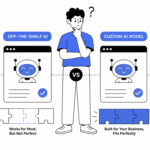

The choice between AI powered automation and RPA is usually framed as a technology decision. It is really a budget decision, and the two have opposite cost curves. RPA is cheap to start and expensive to keep alive. AI-driven automation costs more to stand up and less to maintain at scale. Picking the wrong one for a given process does not just produce a worse system; it produces a worse three-year bill, often several times over.
The market is already moving on this. Gartner’s Market Share Analysis of the RPA software market found that RPA software grew 14.5% to $3.6 billion in 2024, but reported something more revealing underneath that number: generative AI, computer-use tools, and agentic automation actively slowed RPA’s growth rate, with UiPath, Microsoft, and Automation Anywhere leading the market. Buyers are not abandoning RPA. They are getting more selective about which problems deserve a rule-based bot and which need something that can reason.
The reason this matters for your budget is structural. A traditional RPA bot follows fixed rules against a fixed screen. When the screen, the form, or the upstream system changes, the bot breaks and a developer has to fix it. AI powered automation interprets intent and context, so it adapts to variation instead of breaking on it. That single difference reshapes where your money goes: from a low licensing fee plus a permanent maintenance tax, to a higher build cost plus far lower ongoing repair.
This guide will explain how the two approaches differ, where the budget actually diverges, how AI automation works under the hood, and how to decide which one fits a specific process before you commit a single rupee or dollar.
Key Takeaways
- AI powered automation and RPA solve different problems. RPA executes fixed rules on structured, stable processes; AI automation interprets context and handles variation, exceptions, and unstructured data.
- The budget difference is in the tail, not the sticker price. Industry analyses commonly cite that software licensing is only about 25% to 30% of total RPA cost, with the remaining 70% to 75% going to development, integration, and ongoing maintenance.
- RPA’s hidden cost is brittleness. Bots break whenever the underlying applications change, and widely cited industry estimates put RPA project failure or stalling at roughly 30% to 50%.
- AI automation costs more to build and less to maintain. It trades a higher upfront investment for self-adapting behavior that reduces the break-fix cycle that drains RPA budgets over time.
- Gartner reported RPA software grew to $3.6 billion in 2024, but noted that generative AI and agentic automation slowed that growth, a signal that buyers are shifting spend toward intelligent automation.
- The right answer is usually both, sequenced deliberately. RPA for stable rule-based steps, AI automation for the judgment-heavy steps, orchestrated together rather than chosen as rivals.
- Model the three-year total cost of ownership, not the licence. The cheapest automation is rarely the one with the lowest subscription; it is the one whose full cost, including maintenance, you have honestly projected.
What Is AI-Powered Automation, and How Is It Different From RPA?
AI powered automation is the use of artificial intelligence, machine learning, natural language processing, and computer vision to automate work that involves judgment, interpretation, or unstructured inputs. Where traditional automation follows explicit rules, AI-powered automation makes context-dependent decisions: it reads an email and infers intent, extracts data from an invoice it has never seen before, or decides which of several paths a case should follow. It is the engine behind what the industry calls intelligent automation and, at the orchestration layer, hyperautomation.
Robotic process automation is the older, narrower discipline. An RPA bot mimics the clicks and keystrokes a human would perform across applications: copy a value from one screen, paste it into another, trigger a download, update a record. It is fast to deploy and genuinely useful, but it has no understanding of what it is doing. It follows a recorded sequence of steps against a known interface. Traditional business process automation has historically been built on exactly this kind of rule-based execution. AI-powered automation extends it into what the field calls cognitive automation: systems that interpret, classify, and decide rather than only execute. The distinction that matters for budgeting is this: RPA is deterministic and rule-bound, while AI-powered automation is probabilistic and context-aware.
How AI Automation Works at a High Level
Understanding how AI automation works makes the cost difference obvious. A typical AI-powered automation pipeline runs in five stages. First, ingestion: the system takes in inputs from emails, documents, forms, APIs, or user interfaces. Second, understanding: machine learning models, natural language processing, and intelligent document processing (the modern successor to plain OCR) convert messy, unstructured input into structured meaning. Third, reasoning: the system decides what to do, including how to handle cases that do not match any template. Fourth, action: it executes the work, often using an RPA bot or an API call as the hands that touch downstream systems. Fifth, learning: outcomes feed back so the models improve over time. Process mining often sits alongside this pipeline, mapping how a process actually runs before any automation is built.
RPA only ever performs the fourth stage. It is the hands, not the brain. That is why so many mature programs pair the two: AI automation interprets and decides, and an RPA bot carries out the deterministic clicks. The architecture matters for cost because the interpretation layer is what stops the whole workflow from breaking the moment an input varies. We see the same principle in agent-based systems, where verifiable, well-structured behaviour is the foundation of anything trustworthy, a theme covered in our guide to auditing AI agents.
AI Automation vs RPA: Where the Budget Actually Diverges
The honest AI automation vs RPA comparison is not about which is smarter. It is about where each one spends your money over a three-year horizon. RPA wins decisively on day one and often loses by year two. AI automation loses on day one and frequently wins by year two, on the right kind of process. The reason is the shape of the cost curve, not the headline price.
The RPA Cost Iceberg
RPA vendors quote a licence fee, and that fee looks affordable. The licence is the tip of the iceberg. Industry analyses, frequently citing HfS Research, consistently put software licensing at only about 25% to 30% of the total cost of an RPA program, with the other 70% to 75% absorbed by process analysis, development, infrastructure, testing, training, and maintenance. Some practitioner estimates put the ratio even higher, at roughly three to four dollars of services and upkeep for every dollar of licensing. The number that should worry a budget owner is not the licence; it is everything below the waterline.
The single largest item below the waterline is maintenance, and it exists because RPA bots are brittle by design. A bot is bound to the specific layout of the screens it operates. When an application vendor ships a UI update, when a form adds a field, or when a workflow changes upstream, the bot stops working and a developer is pulled in to repair it. This break-fix cycle is reactive and recurring. Widely cited industry estimates place RPA project failure or stalling at roughly 30% to 50%, and underbudgeting for maintenance is repeatedly named as a leading cause. Forrester research has also reported that only around half of firms manage to scale beyond their first ten bots, which is the point where governance and maintenance costs stop scaling linearly.
Where AI Automation Spends Instead
AI powered automation moves the cost forward and shrinks the tail. The upfront investment is higher because it requires data preparation, model selection, integration, and validation rather than a simple screen recording. In return, the system adapts to the variation that breaks RPA. When a button label changes from “Submit” to “Confirm,” a context-aware system understands the intent is identical and proceeds; a coordinate-bound bot fails. That adaptability is the budget lever. It converts a large, unpredictable maintenance line into a smaller, more predictable one. The trade is real and it cuts both ways, which is why the decision has to be made per process, not as a blanket policy.
The table below compares the two approaches on the dimensions that actually move a budget, rather than on feature checklists.
| Dimension | Traditional RPA | AI-Powered Automation |
|---|---|---|
| Core logic | Fixed rules, recorded steps | Context-aware, interprets intent |
| Input type | Structured, predictable data | Unstructured and variable data |
| Upfront cost | Low; fast to deploy | Higher; needs data and model work |
| Maintenance cost | High; bots break on change | Lower; adapts to variation |
| Handles exceptions | No; fails or escalates | Yes; reasons through edge cases |
| Time to value | Days to weeks | Weeks to a few months |
| Best-fit process | Stable, high-volume, rule-based | Variable, judgment-heavy, document-led |
| Cost risk over 3 years | Maintenance tax compounds | Build cost is the main exposure |
The reading that holds across most engagements: RPA produces a better bill when the process is stable and structured, and AI-powered automation produces a better bill when the process is variable and exception-heavy. The expensive mistake is using RPA on a process that changes constantly, because the maintenance cost quietly overtakes everything the licence saved.
Intelligent Automation Examples That Show the Cost Difference
Abstract comparisons only go so far. These intelligent automation examples show where the budget logic plays out in practice, and why the same task can be cheap or ruinous depending on which approach you pick.
Invoice and document processing. A pure RPA bot can move invoice data between systems only if every invoice arrives in an identical format. Real invoices do not. Vendors use different layouts, fields move, and scans vary. An intelligent document processing layer reads invoices it has never seen, extracts the fields, and hands clean data to a bot for entry. The RPA-only version generates constant break-fix tickets as formats vary; the AI version absorbs the variation. This is the clearest case where paying more upfront saves more later.
Customer support triage. Rule-based routing breaks the moment a customer phrases a request in an unexpected way. AI automation reads the message, classifies intent, and routes or resolves it. Many support organisations now resolve a meaningful share of tier-one tickets without human involvement by combining language understanding with an RPA bot that retrieves the answer from backend systems. The cost story is that the AI layer prevents the misroutes and escalations that quietly consume staff time.
Exception handling in finance operations. Reconciliation and approvals are full of edge cases. RPA handles the 80% that follow the rule and dumps the remaining 20% on a human queue. Because the exceptions are the expensive part, automating only the easy 80% caps the return. AI-powered automation reasons through a large share of the exceptions, which is where the real labour cost sits.
Legacy-system data entry. Many enterprises run RPA precisely because a legacy system has no API and the only way in is the user interface. This is a legitimate, lasting use for RPA. The cost trap appears when that legacy interface changes often. When it does, the brittleness tax returns. The lessons from our work on legacy application modernization apply directly: characterise how stable the interface really is before committing to a bot that depends on it.
A useful pattern across these examples is that RPA and AI automation are most cost-effective together. The Microsoft Power Platform stack, for instance, pairs deterministic flows with AI services, an approach we broke down in our look at real Power Automate use cases where a document-heavy HR workflow saved a client meaningful weekly hours by combining both layers.
Which Should You Choose for a Given Process?
The decision is per process, not per company. The five questions below decide it faster than any vendor demo. Run each candidate process through them before choosing between RPA and AI powered automation.
- Is the input structured and consistent? If every input arrives in the same predictable format, RPA is likely the cheaper choice. If inputs vary or arrive as free text, documents, or images, AI automation earns its higher build cost.
- How often does the underlying system change? Stable interfaces favour RPA. Frequently changing screens or upstream systems turn an RPA bot into a maintenance liability and favour an adaptive approach.
- How many exceptions does the process generate? Low-exception, rule-based processes suit RPA. High-exception, judgment-heavy processes need reasoning, and that means AI.
- What is the volume and lifespan? High-volume, long-lived processes justify a larger upfront AI investment because the savings compound. Short-lived or low-volume processes rarely justify it.
- What is the cost of an error? In regulated or high-stakes workflows, the reasoning and traceability of AI automation, paired with proper governance, can be worth far more than the licence saving from a simpler bot.
Organisations weighing whether to build their own intelligent automation or assemble it from existing AI services will find the trade-offs laid out in our comparison of custom AI agents versus integration. The build-versus-buy question changes the cost curve again, and it deserves its own analysis.
Why the Market Is Shifting Toward Intelligent Automation
The spend is following the cost logic. Gartner’s forecast for hyperautomation enablement software projects the category will reach roughly $1.07 trillion by 2028 at a compound annual growth rate near 14%, a far larger envelope than the RPA software market alone. The direction is consistent across analysts: standalone, rule-bound automation is being absorbed into broader intelligent automation that combines RPA, AI, machine learning, process mining, and orchestration. McKinsey’s long-running research on automation potential has estimated that around 30% of the activities in most occupations are technically automatable with current technology, and the activities still left on the table are disproportionately the judgment-heavy ones that pure RPA cannot touch.
The newest layer of this shift is agentic automation, where AI agents plan and execute multi-step work rather than following a single recorded script. It is the same trajectory we traced in our writing on how to use Claude Code for coding, where reasoning systems augment deterministic tooling under human oversight. The budget implication is that the maintenance-heavy RPA model is slowly being priced out for variable work, while it remains entirely rational for the stable, structured tasks it was built for.
Not sure whether a process needs RPA, AI automation, or both?
We have scoped and delivered automation programs across finance, logistics, healthcare, retail, and SaaS for 16 years. We will map your candidate processes, model the three-year total cost of ownership for each option, and tell you honestly where a simple bot wins and where it will quietly drain your budget.
When AI-Powered Automation Is the Wrong Investment
Spending more on intelligence is not always the right call. Here is when we tell teams to choose the simpler, cheaper path or to wait.
The process is genuinely stable and rule-based. If inputs never vary and the interface rarely changes, a plain RPA bot is the cheaper answer and AI adds cost without adding value. Do not pay for reasoning a process does not need.
The data foundation is not ready. AI-powered automation depends on reasonably clean, accessible data. Building it on fragmented records and inconsistent identifiers produces unreliable results. Fix the data first. The same pattern recurs across our work on AI implementation challenges, where modern systems break on foundations that were never designed for them.
The volume cannot justify the build. A low-volume process that runs a few times a month rarely repays the upfront cost of an intelligent automation pipeline. A lightweight bot or even a documented manual step can be the rational choice.
There is no owner for the outcome. Automation without a named owner for monitoring, governance, and exceptions becomes an orphaned risk. This is doubly true for AI automation, where decisions need to be explainable and auditable. Assign ownership before you build.
How Ariel Approaches the RPA-versus-AI-Automation Decision
From our delivery experience across automation engagements, the programs that succeed treat the RPA-versus-AI question as a per-process cost decision rather than a platform preference. The ones that struggle almost always pick a tool first and force every process onto it. The discipline that separates the two is consistent, regardless of industry.
- Model total cost of ownership before tooling. Every candidate process gets a three-year cost projection that includes maintenance, not just licensing. The deployment model falls out of the numbers.
- Match the approach to process stability. Stable, structured, high-volume work goes to RPA. Variable, unstructured, exception-heavy work goes to AI automation. Most real workflows get a deliberate blend.
- Design for change, not just for launch. We assume interfaces and inputs will change, and we choose the approach whose cost survives that change rather than the one that looks cheapest at go-live.
- Build governance and observability from the start. Especially for AI automation, every decision needs to be traceable and every action attributable, the same principles we apply when designing agentic systems for audit.
Across industries, the throughline holds: organisations that choose the automation approach on honest total-cost grounds keep their programs healthy as processes evolve, while those that chase the lowest licence fee tend to inherit the maintenance bill that licence was hiding. More frameworks for automation and engineering decisions sit in our insights library.
Frequently Asked Questions
1. What is the difference between AI powered automation and RPA?
RPA automates fixed, rule-based tasks by mimicking human clicks against a known interface. It does not understand what it is doing. AI powered automation uses machine learning, natural language processing, and computer vision to interpret context, handle unstructured inputs, and make decisions on cases it has not seen before. RPA is the hands. AI automation is the brain. Most mature programs combine them.
2. Is AI automation more expensive than RPA?
On day one, yes. AI automation costs more to build because it needs data preparation, model work, and integration. Over a three-year horizon the picture often reverses. RPA carries a heavy maintenance cost from bots breaking when systems change. Industry analyses put licensing at only 25% to 30% of total RPA cost, with the rest going to development and ongoing maintenance.
3. How does AI automation work?
It runs in five stages: ingests inputs such as emails, documents, or forms; understands them using machine learning and natural language processing; reasons about what to do including handling exceptions; acts using an RPA bot or API as the execution layer; and learns from outcomes over time. The understanding and reasoning stages are what let it adapt to variation that would break a rule-based bot.
4. What are good intelligent automation examples?
Invoice processing that reads varied layouts, customer support triage that classifies free-text requests, exception handling in finance reconciliation, and legacy-system data entry where no API exists. In each case, an AI layer handles the variable part and an RPA bot handles the deterministic execution.
5. Will AI automation replace RPA?
Not entirely. RPA remains the faster, cheaper choice for stable, structured, rule-based processes. What is changing is that RPA is increasingly one component inside a broader intelligent automation strategy rather than a standalone solution. Gartner noted that AI and agentic automation slowed standalone RPA growth in 2024, reflecting absorption rather than disappearance.
6. How do I decide between RPA and AI automation for my business?
Decide per process, not per company. Ask whether the input is structured, how often the underlying systems change, how many exceptions the process generates, what the volume and lifespan are, and what an error costs. Stable, low-exception processes favour RPA. Variable, exception-heavy processes favour AI automation. Then model the three-year total cost of ownership before choosing.
Can Ariel help us choose and build the right automation?
Yes. We evaluate automation options with explicit total-cost-of-ownership modelling, match each process to the right approach, and build blended RPA and AI automation programs with governance and observability built in. Get in touch for a delivery-grade conversation about your automation roadmap.
The Budget Decision Behind the Technology Choice
The AI powered automation versus RPA question is settled by money, not by which technology sounds more advanced. RPA is the right spend for stable, structured, rule-based work, where its low cost and fast deployment are hard to beat. AI-powered automation is the right spend for variable, unstructured, exception-heavy work, where its higher build cost buys adaptability that prevents the maintenance tax from compounding. The expensive errors happen when a team forces the cheap-looking option onto a process that will punish it, then pays the difference in break-fix tickets for years.
Model the three-year cost, including maintenance. Match the approach to how stable and structured each process actually is. Expect to blend both, with RPA as the hands and AI as the brain. Choose for the bill you will pay in year three, not the licence you pay in month one, and the automation program will stay healthy as your processes change. Talk to Ariel before you commit, and we will help you put real numbers behind the decision.
Ready to choose automation on total cost, not sticker price?
Book a free consultation with Ariel’s automation team. We will run your processes through the five decision questions, model the three-year total cost of ownership across RPA and AI automation, and recommend the blend that fits your data, your systems, and your budget.