

Two-thirds of global tech spend in 2025 is going toward keeping legacy systems alive. Forrester puts the figure at 66% of $4.9 trillion, which is the operational reality behind every modernization conversation. Money isn’t the constraint. The constraint is picking the right pattern for each system in the portfolio, because using the wrong one is how budgets get spent without anything actually changing.
Across application modernization strategies we’ve delivered at Ariel, the projects that work share a discipline most blog posts skip. They don’t pick a single approach and apply it everywhere. They classify each system in the portfolio against a set of patterns, sequence the work by business value and risk, and accept that some applications get rebuilt while others get retained, retired, or wrapped. In effective legacy application modernization, the pattern catalog isn’t the strategy. Matching pattern to system is.
Key Takeaways
- Modernization is a portfolio decision, not a single-application decision. The wrong pattern for the wrong system is the dominant cost driver.
- Six core patterns cover almost every legacy system: Encapsulate, Replatform, Refactor, Rearchitect, Rebuild, and Retire.
- IDC projects $1.6 trillion in global spending to address legacy technical debt by 2025. The cost of doing nothing compounds steadily year over year.
- Encapsulation is the most underused pattern. It unlocks integration value without touching code, when scoped properly.
- Rearchitect delivers the highest long-term value but carries the highest execution risk. Sequence it carefully against business needs.
- Forrester reports 228% ROI from modernizing applications on cloud PaaS. The ROI lives in the operational model, not the migration itself.
- The patterns are tools, not goals. Match them to bottlenecks, not to architecture trends.
Why Pattern Matching Decides the Outcome
Most modernization programs fail at portfolio classification, not execution. A team picks a single pattern (usually “move to cloud” or “rebuild as microservices”) and applies it across the estate. Some applications respond well. Most don’t. Six months in, the program is over budget, the legacy systems are still running, and the new architecture is fragmented across systems it never should have touched.
The structural problem is that legacy portfolios are heterogeneous. A 25-year-old COBOL core banking system and a 10-year-old monolithic .NET CRM are both “legacy,” but they need fundamentally different application modernization strategies. Forcing them through the same approach guarantees failure on at least one. The pattern-matching discipline is what separates programs that deliver from programs that stall.
The cost of misclassification is large and growing. IDC projects companies will spend over $1.6 trillion globally by 2025 just to address technical debt caused by legacy systems. McKinsey estimates 10 to 20% of new product budgets are diverted to managing tech debt, with 60% of CIOs saying tech debt has materially worsened over the past three years. Picking the wrong pattern doesn’t just waste the migration budget. It worsens the underlying problem the migration was supposed to solve.
The Six Patterns That Cover Almost Every Legacy System
These six patterns, drawn from Microsoft’s modernization framework and Gartner’s TIME analysis, cover the vast majority of decisions we make on enterprise modernization engagements. They’re listed roughly in order of effort and risk, from lowest to highest.
1. Encapsulate: API-wrap the legacy system
The legacy system stays in place. You wrap it with REST or GraphQL APIs that modern applications can call, exposing existing functionality without touching the core code. This is the lowest-risk, fastest-payoff pattern, and the most underused. It’s the right call when:
- The legacy system works reliably and isn’t the bottleneck.
- The system contains business logic that’s expensive or risky to extract.
- The goal is to integrate with modern applications, not transform the underlying system.
Encapsulation typically delivers most of the integration value of a full rebuild at a fraction of the cost. The trade-off: you’re carrying the legacy maintenance burden indefinitely, and the API layer is only as scalable as what’s behind it.
2. Replatform: Lift, tinker, and shift
Move the application to a modern platform with targeted optimizations along the way. The code mostly stays the same. The platform changes around it. Common moves include:
- Switching to a managed database service.
- Containerizing the app.
- Swapping out the operating system.
- Moving from on-prem to cloud IaaS or PaaS.
This is the right pattern when the application architecture is sound but the infrastructure is the problem (end-of-life data center, expensive hardware contracts, scaling limits, security gaps). It’s also the most common starting point for broader cloud modernization, which is why most cloud migration strategy work begins here. Replatforming consistently reduces infrastructure cost without the disruption of a refactor, with the magnitude of the saving depending on your starting point.
3. Refactor: Restructure the code in place
Same external behavior, cleaner internal structure. Refactoring breaks down monolithic code into more maintainable modules, removes dead code, updates dependencies, and aligns the codebase with modern patterns. The application keeps doing what it always did, but it’s now easier to extend, test, and operate. Refactor is the right call when the application is still business-critical and the code itself, not the architecture, is the bottleneck. It’s also a common precursor to rearchitecting, because cleaner code makes the bigger transformation cheaper.
4. Rearchitect: Change the underlying architecture
This is the pattern that gets the most attention and produces the most failures. Common moves: monolith to microservices, on-prem to cloud-native, batch to event-driven. The architecture changes fundamentally; the business behavior is preserved. The right call when the application’s architecture is the binding constraint on velocity, scale, or integration capability. Rearchitecting delivers the highest long-term value, but it carries the highest execution risk. Forrester’s Total Economic Impact study found 228% ROI when modernizing applications on cloud PaaS over three years, but those returns depend entirely on operational model changes that come with the architecture, not the architecture alone.
5. Rebuild (or Replace): Greenfield rewrite or SaaS
Start over. Either rewrite the application from scratch using modern technology, or replace it with a commercial SaaS product. Rebuild is the right pattern when the existing application is so brittle, undocumented, or fundamentally misaligned with current business needs that incremental change costs more than starting over. Replace is the right pattern when a generic capability (CRM, HR, finance, ticketing) no longer needs to be custom-built. Rebuild carries the highest risk in this catalog because you’re recreating years of accumulated business logic from scratch. Replace carries integration and customization risk instead. Both should be reserved for cases where the alternatives don’t fit.
6. Retire: Decommission the application
The application is no longer needed, duplicates another system, or serves a use case that no longer matters to the business. Retire frees licensing, infrastructure, and maintenance budget that can be redirected toward modernizing systems that do matter. This is the pattern most portfolio reviews underuse, because retiring an application requires the political work of confirming that nobody actually depends on it. From our delivery experience, retiring a meaningful share of an enterprise’s application portfolio is realistic and high-value, but most teams retire only a small fraction because the conversation never gets started.
Matching Pattern to System: A Portfolio Decision Lens
The table below summarizes how we map common pain points to patterns in client engagements. Treat it as a starting point, not a prescription. Real portfolio decisions need a system-level review against the full set of constraints.
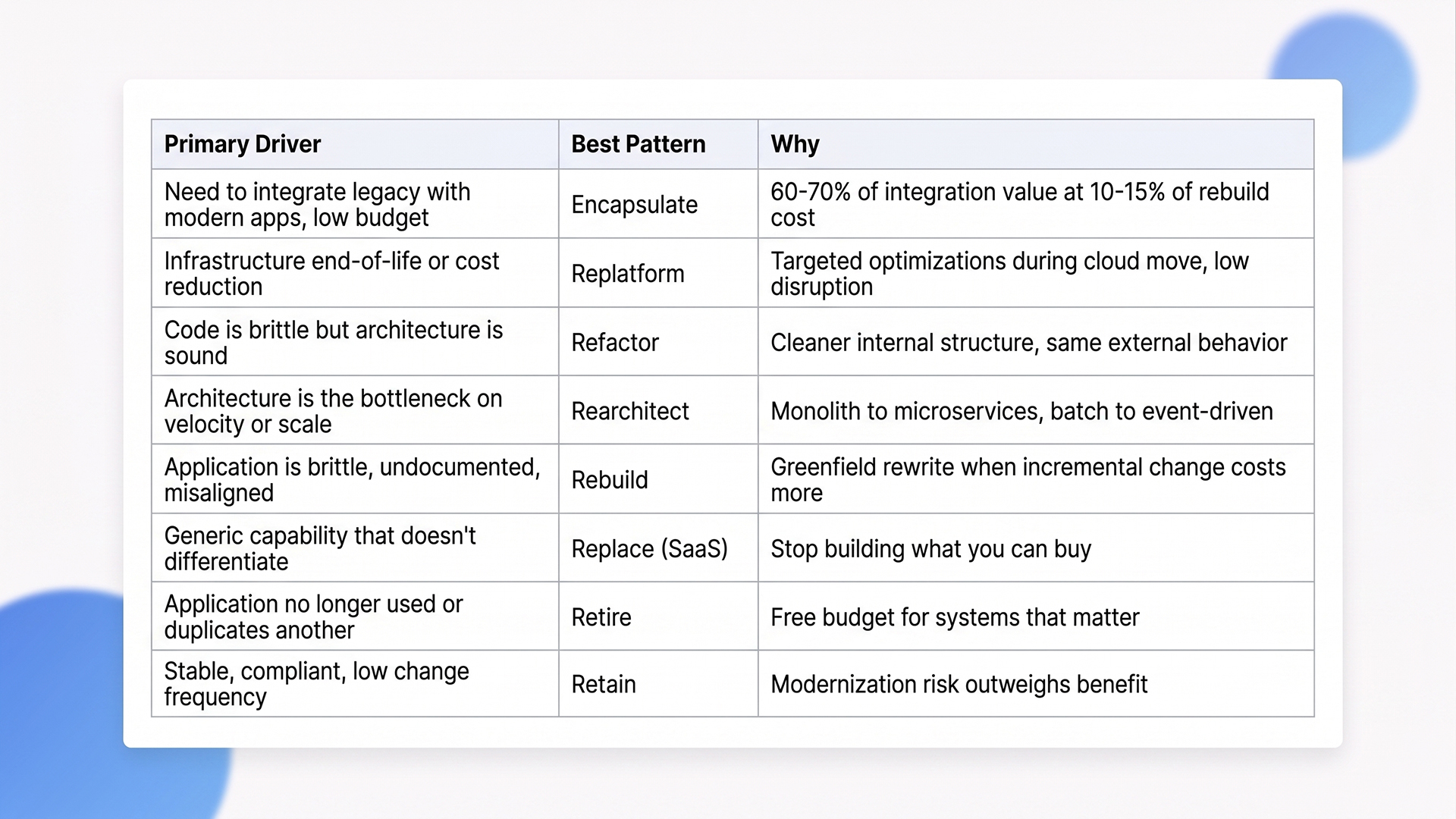
Most portfolios end up using three to five of these patterns across different applications. A portfolio that uses only one pattern is almost always being mismanaged.
What Teams Underestimate Across Every Pattern
These costs and complexity lines apply across most application modernization strategies, regardless of which pattern is chosen.
Data migration is harder than the application work
Legacy systems use outdated schemas, inconsistent references, and undocumented business logic embedded in stored procedures. Even an Encapsulate pattern that doesn’t touch the underlying data still has to map and validate it through the API layer. Replatforming and Rearchitecting both depend on data migration that consistently runs longer than original estimates. Any cloud migration strategy worth scoping plans for incremental migration with automated reconciliation at each step, not a single cutover event.
CI/CD modernization is part of the program, not a phase two
Legacy applications usually run on legacy build pipelines. Modernizing the application without modernizing the delivery pipeline produces a modern application that ships at legacy velocity, which defeats the business case. The right pattern is to modernize CI/CD in parallel with the application work. The AWS and Azure DevOps patterns we’ve covered for cloud-era pipelines are the foundation we apply across modernization engagements, because deployment velocity and observability are what make the new architecture worth the migration cost.
Observability needs to be designed in, not bolted on
Monoliths are easy to observe. Microservices, distributed cloud apps, and event-driven systems require distributed tracing, structured logging, and unified dashboards from day one. Teams that defer observability discover it during the first production incident, when nobody can reconstruct what happened across services. Build observability into the modernized architecture before the first service ships, not after the first outage.
Operational model change is the longest pole
Microservices in production require service ownership, on-call coverage, deployment discipline, and SLO management. None of those existed in the legacy environment. The application can be modernized in months. The operating model around it consistently takes meaningfully longer. Programs that scope only the engineering work discover the gap when production support breaks down post-launch.
Run cost during migration is a real line
During modernization, both the legacy system and the new system are running. The combined operational cost is meaningfully higher than the steady-state cost of either alone. This is unavoidable, but it has to be budgeted. Programs that scope only the build cost discover the parallel-run cost on the first invoice cycle and start cutting corners on the modernization to compensate.
What Modernization Actually Costs Across Patterns
Cost ranges in this space are wide because they depend on application complexity, data volume, integration depth, and team capability. The ranges below are illustrative bands drawn from our own delivery experience for production-grade work on a single mid-to-large enterprise application, not industry-wide benchmarks. Actual project costs depend on scope, region, and team composition.
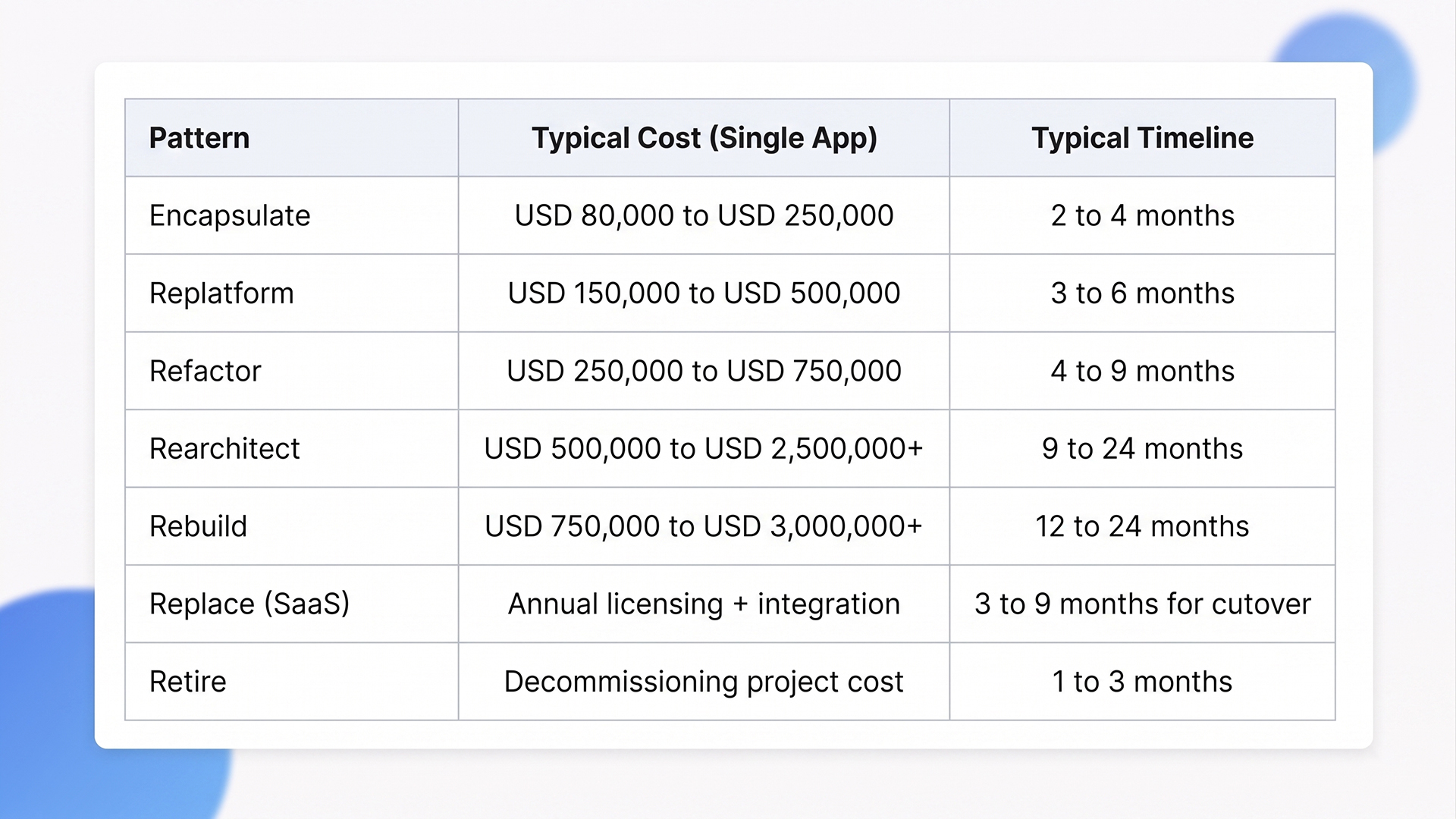
These ranges include modernization work only. Plan for additional parallel-run operations cost during migration on top of the build, plus an ongoing annual operating cost for post-modernization maintenance and operations. From our delivery experience, both lines are non-trivial percentages of build cost and need to be budgeted upfront, not discovered later.
When Modernization Is the Wrong Call
Not every legacy system needs to be modernized right now. Here is when we tell clients to wait or pick a different path.
The system is stable, compliant, and infrequently changed.
Banking core systems, regulated medical devices, embedded controllers. If the system runs reliably, has unbroken audit trails, and rarely changes, the migration risk often outweighs the benefit. Retain is a legitimate strategy.
The organization isn’t ready to operate the target architecture.
Microservices and cloud-native systems require operational maturity that legacy operations teams may not have. Without that capability built first, the modernized system decays faster than the legacy one. Build the operating model before the architecture lands, not after.
The business case rests on technical preference, not measurable outcomes.
“Move to microservices” is not an outcome. “Cut feature delivery time from 8 weeks to 2 weeks” is. Programs scoped against the technology drift. Programs scoped against business outcomes deliver, because the architecture decisions get pressure-tested against value rather than aesthetics.
We start with portfolio assessment, not target architecture. We classify each application against the six patterns, identify the highest-leverage candidates for transformation, and pressure-test the business case. Some applications get retired. Some get rehosted with minimal change. The handful of systems that genuinely justify rearchitecting are sequenced based on business value, technical risk, and team readiness.
From there, the engineering work depends on the pattern. For Replatform and Rearchitect engagements, the planning, transition, and optimization framework we apply for cloud migration sets the cadence in three sequenced steps:
- Dependency mapping first. Identify every system, integration, and data flow the application touches before deciding what moves.
- Workload prioritization second. Sequence applications by business value and technical risk, not by what’s easiest.
- Landing zone design before any application moves. Network, identity, security, and observability foundations land before workloads migrate into them.
For Encapsulate and Refactor work, the engineering pattern is incremental and reversible, with rollback paths preserved at each step. Across all six patterns, observability and CI/CD modernization happen in parallel with the application work, not after, because the operating model is what determines whether the modernized system stays modern.
Across industries (logistics, healthcare, financial services, retail, real estate) we’ve delivered legacy application modernization projects ranging from API encapsulation of mainframe systems to full microservices rearchitecting of monolithic .NET estates. The pattern isn’t the differentiator. The portfolio classification, sequencing, and operational model decisions are.
Planning a modernization program and want a portfolio-level assessment, not a single-pattern pitch?
Our team has run portfolio classifications and pattern-matched migrations across enterprise and mid-market clients for 16 years. We’ll review your estate, identify which systems need which pattern, and give you a sequenced roadmap your team can actually deliver.
Frequently Asked Questions
1. How do I choose the right pattern for legacy application modernization?
In legacy application modernization, start with the binding constraint. If integration with modern apps is the bottleneck, Encapsulate. If infrastructure is end-of-life, Replatform. If code is unmaintainable, Refactor. If architecture is the constraint on velocity, Rearchitect. If the application is fundamentally broken or misaligned with business needs, Rebuild or Replace. If it’s no longer needed, Retire. Most portfolio decisions become clearer once the binding constraint is named honestly.
2. How long does a portfolio-wide modernization typically take?
It depends on portfolio size, pattern mix, and team capacity. Single-application work runs 2 to 24 months depending on pattern. Multi-application portfolio modernizations are usually 2 to 5 year programs structured as a sequence of smaller engagements. The biggest variable isn’t engineering complexity, it’s operational readiness and change management capacity in the receiving organization.
3. What’s the ROI of application modernization?
Forrester’s Total Economic Impact studies report 228% ROI on cloud PaaS modernization over three years, but those returns depend on operational model changes that ride alongside the technical migration. The ROI lives in faster feature delivery, lower infrastructure cost, reduced incident frequency, and the ability to integrate AI and analytics into systems that previously couldn’t host them. A cloud migration strategy that captures only the migration without the operating model change sees a fraction of the modeled return.
4. Should we modernize all applications at once or sequence them?
Sequence them, almost always. Big-bang portfolio modernizations consistently fail, even when individual application migrations are well-scoped. Sequence by business value and technical risk, run two to four migrations in parallel at most, and treat each one as an opportunity to refine the program patterns for the next wave.
5. Can Ariel handle modernization end-to-end?
Yes. We cover portfolio assessment, pattern classification, target architecture design, data migration, CI/CD modernization, observability tooling, and team enablement across all six patterns. Get in touch to scope your program.
The Decision Behind the Decision
The strongest application modernization strategies aren’t the ones with the most ambitious target architecture. They’re the ones that match pattern to system honestly, sequence work against business value, and build operating capability alongside the new platform.
Classify the portfolio. Pick the right pattern for each system. Sequence by business value and technical risk. Modernize CI/CD and observability in parallel with the application work. Treat the operating model change as part of the program. The architecture follows from those decisions, not the other way around.
Ready to scope a modernization program built on portfolio reality, not a single pattern?
Book a free consultation with Ariel’s modernization team. We’ll assess your application portfolio, classify against the six patterns, and design a sequenced roadmap that respects what the work actually costs.