

Every vendor looks great in a portfolio slide. The proposals come back polished, the case studies are persuasive, and the people in the pitch room are senior, articulate, and confident. The hard part of how to choose a software development company is that the things that actually predict delivery success are rarely visible in the sales process. They show up in how the team handles the questions most buyers don’t think to ask.
The Standish Group’s 2021 CHAOS Report found that only 29% of IT projects are considered successful, with 52% challenged and 19% outright failures, and the most consistent pattern across the failures isn’t technology. It’s vendor selection. The wrong partner produces inflated bids, scope creep, key-person attrition, and IP disputes that surface six months in, when the cost of switching exceeds the cost of pushing through. The right partner produces fewer surprises and more durable software. The interview is where the difference is decided.
Key Takeaways
- Vendor selection is the highest-leverage decision in any software project. The wrong partner is more expensive than any technology decision.
- The pitch team is rarely the delivery team. Ask for named team members in the contract, not just in the sales process.
- Vendors who don’t ask hard questions during scoping won’t ask them during delivery either. Question quality is a leading indicator.
- Reference checks are where vendor capability becomes verifiable. Skip them and you’re betting on the proposal alone.
- Process maturity (CI/CD, observability, testing discipline) is more durable than headline technology choices.
- IP, source code ownership, and exit terms decide whether the engagement is recoverable. Negotiate them upfront.
- Cultural and communication alignment is a delivery discipline, not a soft skill. Test it during the interview, not after.
Why Vendor Selection Decides the Project
Most software project failures don’t trace to bad code. They trace to scoping decisions, mismatched expectations, and key-person changes that compound over time. The vendor you select determines how those compounding factors play out, and the questions you ask during evaluation determine which patterns you’ll inherit. The discipline of how to choose a software development company is, at its core, a discipline of asking the questions that surface those patterns before the contract is signed.
The asymmetry in the sales process is real. Vendors know what buyers ask. Buyers don’t always know what they should be asking. The result is interviews that surface vendor strengths and miss the failure modes. The 12 questions below are designed to close that gap. Each one is calibrated to surface a specific type of risk that consistently shows up in projects that go sideways.
If you’re earlier in the procurement cycle and still drafting your brief, the same logic applies to RFP design: better questions produce more comparable proposals. The interview phase is where written answers get pressure-tested in real time, which is why the questions matter as much as the proposals do.
The 12 Questions That Separate Good Partners from Bad Ones
These are the questions to ask a software development company during the evaluation phase, with the kind of answers that signal a partner versus a vendor playing at one. Use them as an interview protocol, not a checklist.
1. Who, by name, will lead this engagement, and what is their availability?
Vendors win engagements with senior architects in the room. Vendors deliver engagements with whoever is on the bench. Ask for named individuals with stated allocation percentages, their relevant project history, and what happens if they rotate off the engagement.
Good answer: Specific names, defined allocation, key-person clauses willingly negotiated.
Red flag: “We’ll assign the right team after we sign” or “flexible allocation based on demand.”
2. Walk us through how you’d decompose this system. Where do you expect bottlenecks?
Strong vendors can articulate architecture in plain language and identify where the risk lives in your project before they’ve started. Weak vendors present sunny scenarios. Force the trade-off conversation early.
Good answer: Specific decomposition, named bottlenecks (data migration, integration auth, scale on a particular service), and how they’d mitigate each one.
Red flag: Generic answers that could apply to any project, or refusal to identify trade-offs.
3. What does your delivery process look like, from backlog to production?
Process maturity is more durable than technology choices. Ask vendors to walk through their branching strategy, code review norms, automated testing coverage, release cadence, and rollback procedures. Then connect it to risk: how does this process make your project more predictable than ad-hoc work would?
Good answer: Documented process, examples of how it’s run on similar projects, clear acceptance criteria per sprint.
Red flag: “We’ll figure it out as we go” or process descriptions that don’t include test coverage or rollback paths.
4. Who owns the source code, infrastructure accounts, and CI/CD pipelines?
This question prevents the most common form of vendor lock-in: code, cloud accounts, and pipelines that live entirely under the vendor’s control. Repositories should sit under your GitHub or GitLab organization with vendor access. Cloud resources should live in your AWS, Azure, or GCP accounts. The vendor builds; you own.
Good answer: Buyer-owned repos, buyer-owned cloud accounts, written handover materials as standard practice.
Red flag: Vendor-hosted repos, vendor-managed cloud accounts, no continuity guarantee.
5. How do you handle change requests and scope creep?
Every software project has scope changes. The question is whether the vendor has a structured process for handling them, or whether change requests turn into renegotiations. A mature vendor has a documented change-request workflow with written estimates, milestone updates, and explicit approval before work starts.
Good answer: Written estimates per change, milestone updates, signed approvals, no surprise invoices.
Red flag: Verbal-only change handling, vague pricing on change orders, retroactive scope additions.
6. What’s your security posture and how do you handle compliance requirements?
Strong vendors have documented security practices, penetration testing cadence, vulnerability disclosure processes, and code review enforcement. They don’t get defensive when asked. If your project sits inside a regulated framework (HIPAA, SOC 2, PCI-DSS, GDPR), the vendor needs concrete experience in that framework, not just awareness of it.
Good answer: Named certifications, regular penetration testing, written security policy, examples of similar regulated projects.
Red flag: “We use HTTPS and a firewall, that’s usually enough.” Vague compliance familiarity without project experience.
7. What happens if a senior engineer leaves mid-project?
Attrition happens. The question is whether the vendor has a documented replacement plan, knowledge transfer protocols, and bench depth to absorb the loss without stalling delivery. Vendors with high attrition or shallow benches can’t answer this question concretely.
Good answer: Documented runbooks, paired engineering practices that prevent single points of failure, named backup engineers, key-person clauses in the contract.
Red flag: “We’d assign someone new and onboard them quickly” without specifics on how knowledge transfers.
8. Can we speak to a current or recent client at a technical level?
Reference calls are where vendor capability becomes verifiable. Ask to speak with at least one CTO, tech lead, or senior engineer at a recent client, not just a marketing or executive sponsor. The technical reference will tell you what production was actually like, what surprised them, and what they’d do differently.
Good answer: Multiple available references, willing to connect you directly without filtering.
Red flag: Hesitation to connect you with technical references, only marketing-facing testimonials, refusal to share production-side perspectives.
9. How do you communicate, escalate, and handle hard conversations?
Cultural and communication alignment is a delivery discipline. Time-zone overlap, escalation paths, and honesty about what’s behind schedule all matter. The strongest vendors are direct about problems, not optimistic about timelines they’re already missing. Test this in the interview: ask about a project that didn’t go to plan and how they handled it.
Good answer: Specific story of a hard project, what went wrong, how they communicated it to the client, what they did differently afterward.
Red flag: “We’ve never had a project not go to plan,” defensive responses, or vague answers about communication norms.
10. What is your approach to testing, observability, and post-launch support?
Production reality is what makes the project worth shipping. Mature vendors design observability into the architecture from the first sprint, not after the first incident. Distributed tracing, structured logging, automated test coverage, and post-launch SLAs should be part of the delivery model, not a phase-five conversation.
Good answer: Specific test coverage targets, named observability tools, written incident response plan, post-launch support model with clear SLAs.
Red flag: Test coverage as an afterthought, observability deferred to phase two, no clear post-launch ownership.
11. How do you price changes, and what’s your pricing model overall?
Pricing transparency separates partners from vendors. Mature vendors have documented hourly rates by role, written change-order pricing, and clear payment milestone structures. They explain trade-offs (fixed-price vs time-and-materials vs hybrid) honestly, even when the answer doesn’t favor their margin.
Good answer: Detailed cost breakdown, transparent change pricing, willing to discuss commercial trade-offs.
Red flag: Round numbers with no breakdown, dramatically below other bids without explanation, vague change-order pricing.
12. What does a good handover from your team to ours look like?
Engagements end. The question is whether the vendor treats handover as a continuous discipline or a phase-five formality. Strong vendors deliver documentation, runbooks, and architecture decision records sprint by sprint. Weak vendors leave you owning code nobody on your team understands.
Good answer: Documentation as a sprint deliverable, structured handover sessions, willingness to operate in a knowledge-transfer mode from day one.
Red flag: “We’ll document everything before final delivery,” which is how knowledge gets locked behind departing engineers.
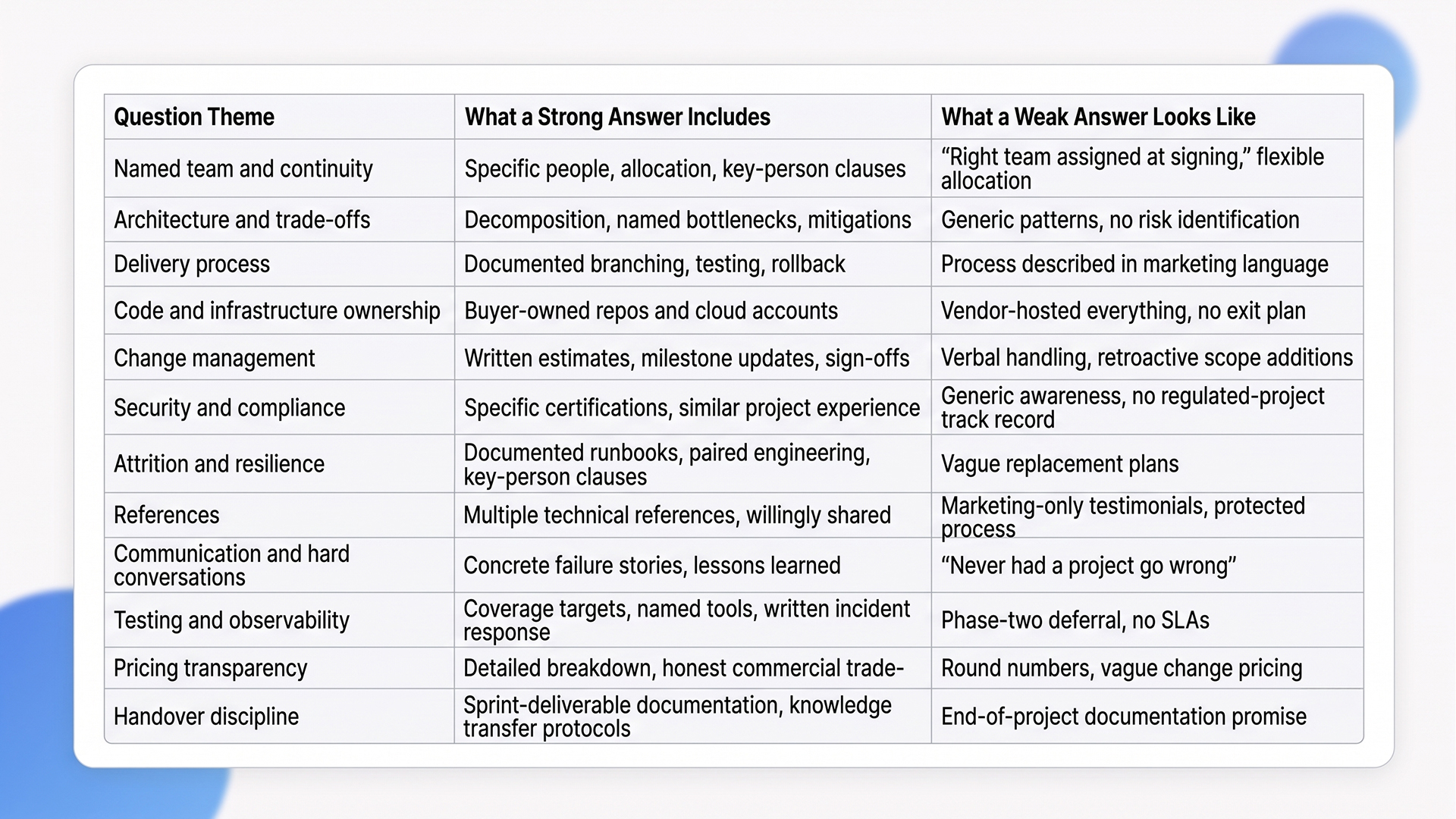
How to Score the Answers
Vendors will give different-quality answers across these 12 questions. The scoring framework below captures what we use when reviewing vendor evaluations on the buyer side. Treat it as a starting point; weight the dimensions that matter most to your project.
How to Evaluate Software Vendors Beyond the Interview
The interview is the highest-signal moment in vendor selection, but it isn’t the only one. The discipline of how to evaluate software vendors extends to the artifacts vendors produce, the references they provide, and the contract terms they’re willing to negotiate. Three additional checks consistently surface real differences between good vendors and average ones.
Reference call discipline
Schedule references with technical stakeholders, not just executive sponsors. Ask three questions every reference call:
- What surprised you, good or bad, about working with this team?
- What would you do differently if you were starting this project again with them?
- How do they handle production incidents and hard conversations?
- The answers to those three questions will tell you more about delivery reality than any case study deck.
Code and architecture artifacts
If the vendor is willing, request a redacted code sample or architecture decision record from a recent project. The artifact tells you whether they actually produce the documentation they claim to value, what their code review standards look like in practice, and whether their architecture work is opinionated or generic.
Contract negotiation behavior
How a vendor negotiates IP ownership, key-person clauses, change-order pricing, and exit terms is itself a signal. Vendors who push back hard on standard buyer-protection clauses are telling you something about how the rest of the relationship will go. The contract is where the partnership becomes real, and the negotiation is where the partnership’s character becomes visible.
Red Flags That Should End the Conversation
Some signals are so consistent across failed engagements that they justify removing a vendor from consideration even if other factors look strong. The patterns below appear repeatedly across vendor reviews and post-mortems published in industry analysis, and they show up in our own delivery work as the early signals of engagements that didn’t go well.
- Bid significantly lower than peers with no explanation. Vendors who price 50% under the market are usually compensated with junior engineers, undisclosed offshore handoffs, or scope-creep recovery models.
- No questions during the proposal phase. Serious vendors ask hard questions before they bid. Silence means either a template response or an inability to think critically about your project.
- The pitch team is different from the delivery team. Senior architects in the room, junior engineers on the project. Always confirm the actual delivery team in writing.
- Vendor-hosted everything. Repositories, cloud accounts, CI/CD pipelines all under their control. This is the structural setup for vendor lock-in and exit difficulty.
- Resistance to standard buyer-protection clauses. Pushback on IP ownership, key-person clauses, or audit rights signals where the rest of the relationship will go.
- “We’ve never had a project go wrong.” Every vendor has had projects go wrong. Vendors who can’t talk about them are either inexperienced or dishonest. Either way, the answer is no.
When Hiring a Vendor Is the Wrong Move
Not every software needs calls for an external partner. Here is when we tell clients to keep the work in-house or take a different path.
The work is core to your competitive differentiation
If a system is what makes your product genuinely different from competitors, the architectural judgment should live inside your company. Outsourcing core differentiation produces speed in year one and a strategic dependency in year three.
Your scope is genuinely undefined
If you don’t yet know what you’re building, an RFP and vendor evaluation will produce inflated bids based on worst-case interpretations. The right move is paid discovery first (4 to 8 weeks, fixed price) with one or two vendors, before committing to a build engagement.
Your project is small or experimental
For projects under USD 50,000 or for time-boxed prototypes, vendor evaluation overhead often exceeds the project savings. Freelance contractors or in-house sprint capacity usually outperforms a formal vendor selection process at that scale.
Your team needs the build experience to grow
Engineering teams develop senior architects by giving them hard problems to solve. Outsourcing every hard problem optimizes for speed at the cost of bench depth. Be deliberate about which projects you keep internal for capability reasons.
How Ariel Approaches Vendor Evaluations
From our delivery experience across enterprise and mid-market clients, the engagements that hold up are the ones where the vendor evaluation surfaced the right risks before the contract was signed. We respond to dozens of evaluations every quarter, and the buyers who run rigorous selection processes consistently end up with better outcomes, regardless of which vendor they pick.
When buyers ask us how we approach vendor evaluation conversations, the principle is consistent: we expect to be asked the hard questions, and we lose engagements where we can’t answer them concretely. The technologies and delivery patterns we use across .NET, Python, React, Angular, Azure, AWS, and 20+ additional stacks are the foundation, but the engagements land cleanly because of how we operate around the technology, not because of the technology itself.
Across this lifecycle, the operating disciplines that consistently make engagements land cleanly are:
- Named team continuity. The architects who scope the engagement stay on through delivery, with key-person clauses protecting the buyer.
- Documentation as a sprint deliverable. Architecture decision records, runbooks, and integration docs ship every sprint, not at the end.
- Buyer-owned everything. Repositories, cloud accounts, and CI/CD pipelines under the buyer’s organization from day one.
- Honest communication about hard problems. We tell clients when scope is drifting, when timelines are at risk, and when the answer is to slow down rather than push through.
Across industries (logistics, healthcare, financial services, real estate, retail) we’ve engaged with buyers running structured how to choose a software development company evaluations and informal vendor reviews alike. The structured evaluations consistently produce better engagement outcomes, regardless of who the buyer eventually picks.
Running a vendor evaluation and want a delivery-grade perspective on the questions that matter?
Our team has responded to hundreds of vendor evaluations across industries and stages. We’ll walk through your evaluation framework, the questions that consistently separate good partners from bad ones, and the contract terms that prevent the most common engagement failures.
Frequently Asked Questions
1. What are the most important questions to ask a software development company?
The highest-leverage questions to ask a software development company cover named team and continuity, architecture trade-offs, delivery process, source code and infrastructure ownership, and reference access at the technical level. The other seven questions in this guide cover specific failure modes, but those five surface the bulk of vendor capability differences. Ask all 12 if you can; ask those five at minimum.
2. How many vendors should I shortlist for a software development engagement?
Three to five for most engagements. Fewer than three doesn’t give you genuine comparison. More than five floods your evaluation team and dilutes vendor effort, because each vendor’s perceived win probability drops below the threshold where they invest in a serious response. Run shortlisting before issuing the RFP, not after.
3. How long should the vendor evaluation process take?
Three to six weeks for most software engagements. The discipline of how to evaluate software vendors suffers when the timeline is compressed below two weeks (which optimizes for speed at the cost of signal quality) or stretched beyond eight weeks (when the strongest vendors disengage because they assume the project isn’t moving forward). Two-week response windows for proposals, one to two weeks for reference checks and finalist presentations, one week for contract negotiation.
4. What’s the most common vendor selection mistake?
Selecting on price without weighting team and process. Low-bid vendors typically compensate with junior engineers, undisclosed offshore handoffs, or scope-creep recovery models. The vendor decision is rarely about price differences of 10 to 20%; it’s about delivery quality differences that compound over the engagement. Weight architecture and team capability above price during scoring.
5. Can Ariel help us run a vendor evaluation?
Yes, we help buyers structure vendor evaluations, including ones where we eventually respond to the RFP and ones where we don’t. The evaluation review is independent of whether we participate as a candidate. Get in touch if you’d like a delivery-grade perspective on your evaluation framework.
The Decision Behind the Decision
The work of how to choose a software development company isn’t sophisticated. It’s structured. The 12 questions above each surface a specific failure mode that consistently shows up when engagements go sideways. The vendors that answer them concretely tend to deliver concretely. The vendors that answer them with marketing language tend to deliver marketing-language outcomes. The interview is where the difference becomes visible.
Ask for the team by name. Force the architecture trade-off conversation. Pressure-test the delivery process. Verify ownership of code, infrastructure, and pipelines. Insist on technical references. Test communication with a real failure story. Negotiate IP, key-person clauses, and exit terms before signing. The vendor decision matters, but the operating discipline around the decision matters more.
Ready to choose a software development partner with the rigor the decision deserves?
Book a free consultation with Ariel’s delivery team. We’ll walk through your evaluation framework, the questions that consistently separate good partners from bad ones, and the operating disciplines that prevent the most expensive vendor mistakes from showing up six months in.