

The outsourcing decision is rarely the mistake. The mistakes are what happens after the contract is signed: the engagement model that doesn’t fit the work, the success metrics nobody wrote down, the IP terms that get glossed over until they matter, the security gaps that surface during the first audit, and the cultural alignment that quietly erodes over months of asynchronous communication.
Mordor Intelligence values the global software development outsourcing market at USD 564.22 billion in 2025, with projections to USD 977.04 billion by 2031 at a 9.60% CAGR, and around 64% of companies worldwide outsource at least part of their software development. The growth isn’t slowing. The cost of getting it wrong isn’t either. From our delivery experience, the most expensive software development outsourcing mistakes rarely show up in the first month. They show up in months six through twelve, when the wrong commitments compound into rework, lost IP, regulatory exposure, or a six-figure write-off on a project that was supposed to ship.
Key Takeaways
- Most outsourcing failures are operational, not vendor-quality problems. The failure modes are predictable and preventable.
- Talent access has overtaken cost reduction as the top reason for outsourcing. Scoping engagements as cost plays produces the wrong vendor selection.
- Around 55% of organizations begin outsourced engagements without defined success metrics. That single gap produces the largest share of disputed deliverables.
- Cultural misalignment is a top-5 reason for offshore project failure. It’s a delivery risk, not a cost risk, and it has to be managed deliberately.
- IP, security, and data residency clauses determine whether your engagement is recoverable. Negotiate them before signing, not during a dispute.
- Around 70% of companies have brought some previously outsourced work back in-house over the past five years. The pattern is real. The cause is almost always operational.
- The right engagement model is workload-driven. Project-based, dedicated team, and staff augmentation each fit different problems. Picking wrong drives most TCO miscalculations.
Why Outsourced Software Engagements Fail
Outsourcing failures rarely look like vendor incompetence. They look like vendors and clients optimizing for different things, with neither party realizing the gap until a deliverable is rejected, a deadline slips, or a security review surfaces something that should have been scoped at the start. Keyhole Software’s analysis of 2026 outsourcing data found that around 55% of organizations begin engagements without defined success metrics, which is the operational gap behind most disputed outcomes. When success isn’t defined upfront, every party defines it retroactively, in their own favor.
The 2024 Deloitte Global Outsourcing Survey reinforces the pattern from a different angle. Cost reduction has dropped from being cited by 70% of executives in 2020 to 34% in 2024, while access to talent and capacity has risen to the top reason for outsourcing. Teams still scoping engagements as cost-cutting exercises end up making vendor decisions that don’t match the actual problem they’re solving, which is usually a capability or capacity gap rather than a labor arbitrage opportunity.
Across the engagements we’ve delivered, recovered, or watched fail at Ariel, the same patterns repeat. The software development outsourcing mistakes we’ll cover next aren’t sophisticated. They are operational. The cost of each one shows up later than the original budget assumed, but the operational fix is almost always available much earlier, if anyone knew to look for it.
Six Outsourcing Mistakes That Cost Six Figures
These are the software development outsourcing mistakes we see most often when reviewing engagements that didn’t go to plan. Each one has a defined cost line, and each one has a discipline that prevents it.
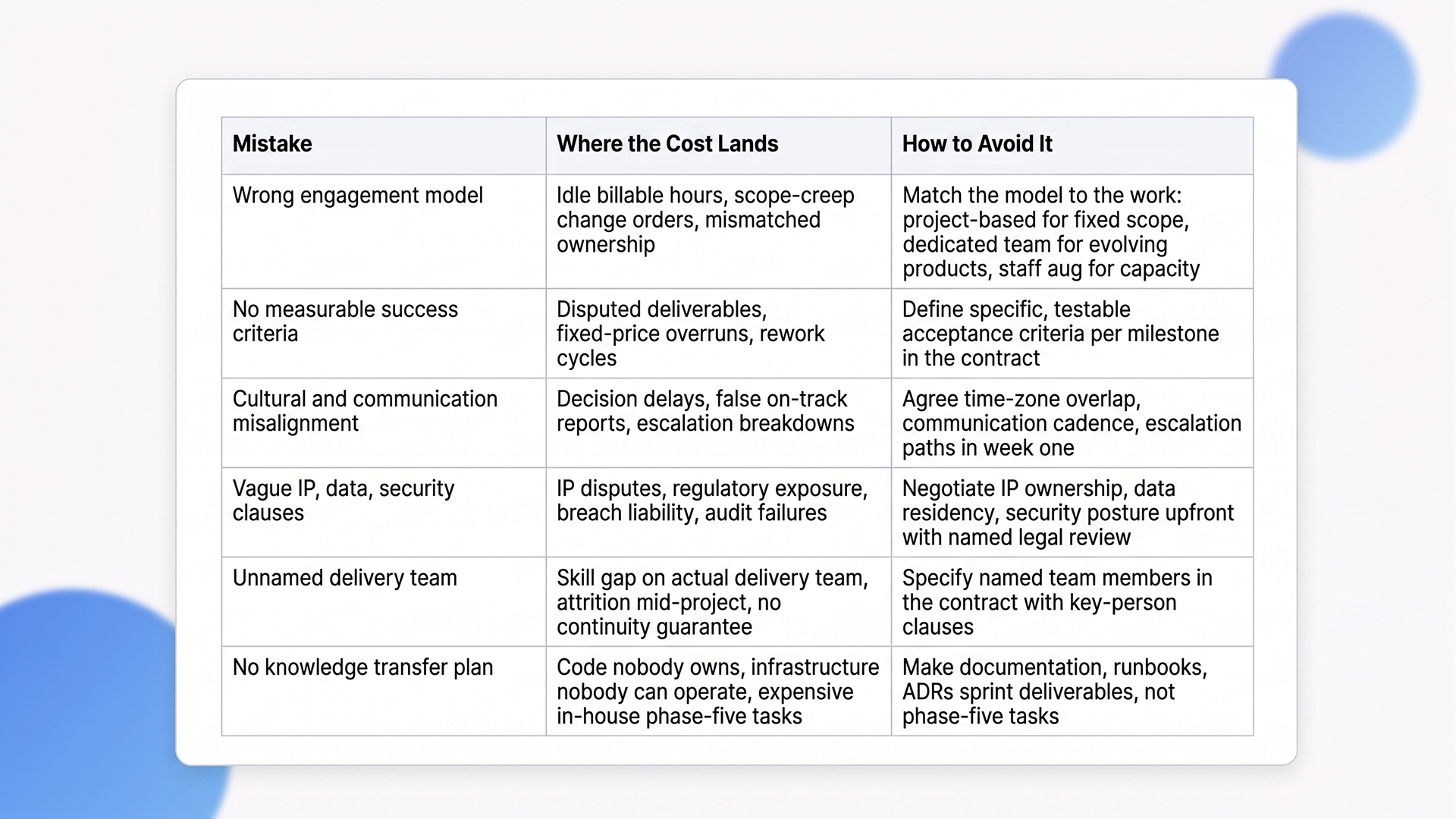
Mistake 1: Picking the wrong engagement model for the work
Project-based, dedicated team, and staff augmentation are not interchangeable. A project-based contract on evolving scope produces inflated bids and acrimonious change orders. A dedicated team on a tightly scoped, time-bound deliverable produces idle billable hours. Staff augmentation on work that requires ownership produces engineers waiting for direction nobody is giving. The how to outsource software development question starts with the engagement model, not the vendor. Get this wrong and you’ll be paying a premium for the wrong shape of capability for the entire engagement.
Mistake 2: Scoping the engagement without measurable success criteria
“Build the platform” is not a success criterion. “Reduce average page load time from 4.2 seconds to under 1.5 seconds across the top 20 customer journeys, with a documented test suite covering each” is. Without specific, measurable acceptance criteria written into the contract, every disputed deliverable becomes a negotiation rather than a verification. This is the failure mode behind the 55% of engagements that begin without defined success metrics, and it shows up most painfully in fixed-price contracts where ambiguity transfers risk to the buyer.
Mistake 3: Treating cultural and communication alignment as overhead
DesignRush’s analysis of offshore project failures lists cultural misalignment among the top five causes, and the cost is operational, not cultural. Time zone gaps that go unmanaged turn a one-day decision into a one-week round-trip. Direct-versus-indirect communication norms that go unscoped produce reports that read as on-track when they aren’t. Writing styles, escalation paths, and meeting cadence all matter. None of them are vendor failures. All of them are scope items that should be agreed in week one, not discovered in month four.
Mistake 4: Vague or absent IP, data, and security clauses
This is the mistake that shows up in court rather than in retrospectives. IP ownership of code, models, training data, derivative works, and pre-existing libraries should be specified in the contract, not assumed. Data residency, sub-processor disclosure, and breach notification timelines need to be aligned with the regulatory frameworks your business operates inside (GDPR, HIPAA, SOC 2, regional data sovereignty laws). Security posture (penetration testing cadence, vulnerability disclosure process, code review enforcement) should be a contractual commitment, not a marketing claim. Among the risks of outsourcing software development, the legal and security ones are the cheapest to address upfront and the most expensive to address after the fact.
Mistake 5: Not naming the actual delivery team
Vendors win engagements with senior architects in the room. Vendors deliver engagements with whoever is available on the bench. The team you were sold is rarely the team that builds your software, and the gap between the two is one of the most consistent sources of dissatisfaction in outsourced engagements. Specify named team members for each role in the contract. Include their relevant project history. Define what happens when any of them rotate off. Include a key-person clause that lets you renegotiate or exit if the named delivery leads change without your consent.
Mistake 6: No structured handover or knowledge-transfer plan
Engagements end. Vendors rotate. Internal teams take over. If knowledge transfer is treated as a phase-five formality rather than a continuous discipline, you end up owning code nobody on your team understands, run by infrastructure nobody on your team can operate on. The fix is to require documentation, runbooks, and architecture decision records as deliverables in every sprint, with handover sessions scheduled before they’re urgent. The 70% of companies that have brought some previously outsourced work back in-house over the past five years almost universally name knowledge ownership and operational continuity as the trigger.
The Cost of Each Mistake, and How to Avoid It
The table below summarizes the failure modes, where the cost typically lands, and the operating discipline that prevents each one. Treat it as a checklist before signing, not a retrospective after the engagement ends.
Risks Beyond the Contract
Some of the risks of outsourcing software development don’t sit inside the engagement at all. They sit in how the work integrates with the rest of your organization, and the engagement scope rarely covers them.
The internal-team capability gap
Outsourcing accelerates delivery. It can also atrophy internal capability if the work is delegated entirely. Teams that outsource everything for three years discover their internal engineers no longer have the architectural depth to evaluate vendor proposals, debug edge cases, or carry out the in-housing they eventually want. The fix is to keep architectural judgment, security review, and product ownership inside the company even when execution is outsourced. Treat the vendor as the build capacity, not the technical brain.
Vendor concentration risk
Outsourcing 60% of your engineering capacity to one vendor produces speed in the first year and fragility in the third. If that vendor’s pricing changes, leadership turns over, or geopolitical risk affects their delivery region, your roadmap is exposed. Mitigation looks like: a second vendor on a smaller engagement to maintain optionality, internal ownership of the most critical systems, and contractual exit terms that let you transition without losing 12 months of velocity.
Hidden currency, tax, and regulatory cost lines
Cross-border engagements come with cost lines that don’t show up in the proposal:
- Currency exposure. FX volatility on multi-quarter engagements priced in foreign currency.
- Withholding tax obligations. Required deductions on cross-border services payments, varying by jurisdiction.
- Transfer pricing scrutiny. Tax authority review of intercompany or cross-border service charges.
- Employment classification risk. Long-running staff augmentation arrangements that may legally cross into employee territory.
None of these are reasons not to outsource. All of them are reasons to involve finance and legal in the engagement scoping, not just procurement and engineering.
AI and ML scope is its own risk surface
If the engagement includes AI or ML components, the risks expand into areas standard software contracts don’t cover:
- Training data provenance. Where the data came from, who owns it, and what consent or licensing covers its use.
- Model IP ownership. Who owns the trained model, derivative models, and weights produced during the engagement.
- Inference logging and audit trails. How model decisions are captured for compliance and explainability.
- Bias testing and evaluation. Pre-deployment and ongoing tests for fairness and accuracy across user segments.
- Ongoing model operations. Drift monitoring, retraining cadence, and version rollback procedures.
Choosing the Right Engagement Model
Most software development outsourcing mistakes trace back to picking the wrong engagement model. The decision lens below captures how we map workload type to engagement structure during scoping conversations with clients.
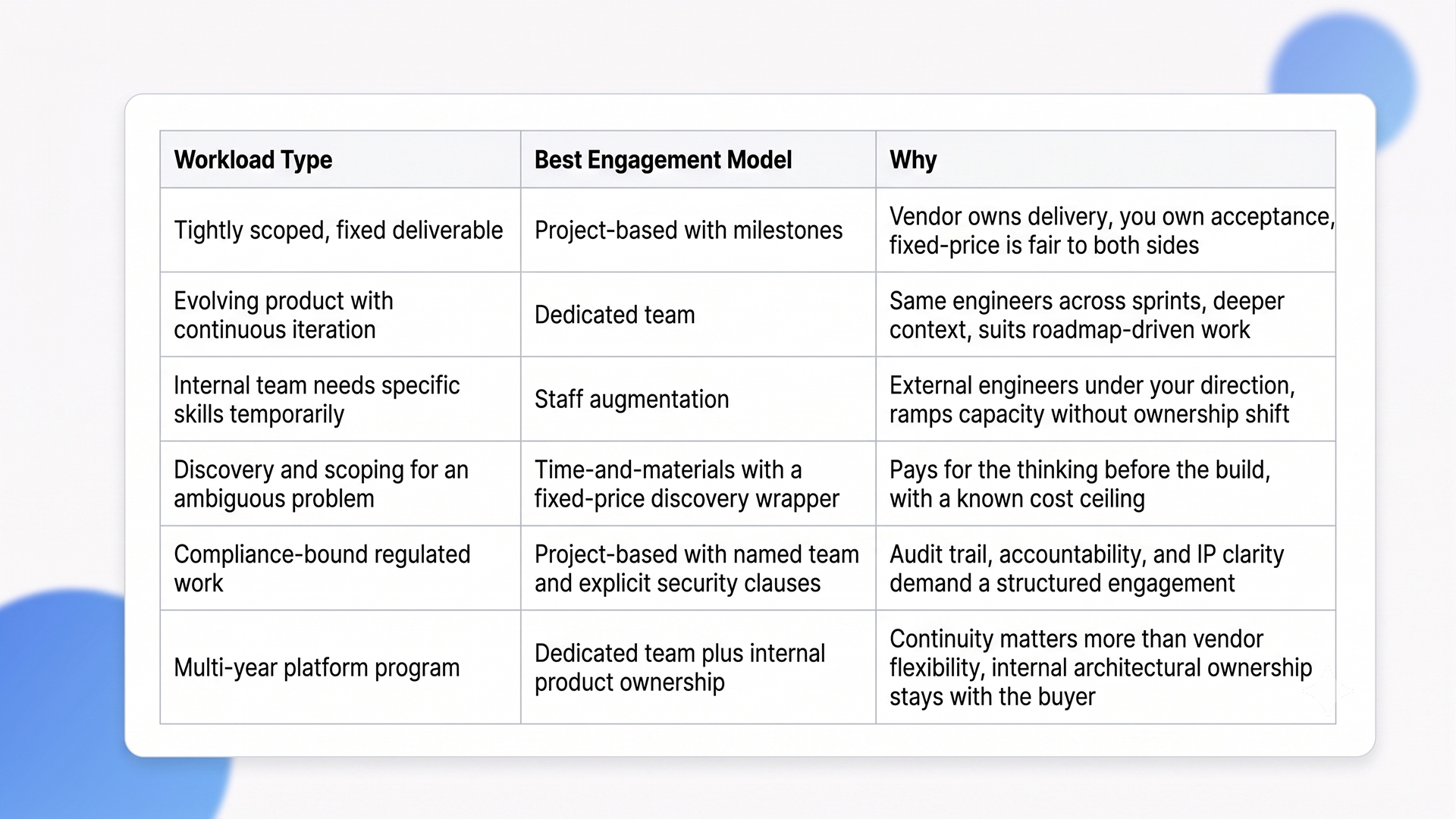
These mappings are starting points, not rules. The deciding factor is workload shape: how scoped the work is, how much context the team needs to carry forward, how regulated the domain is, and how much architectural ownership stays inside your company.
When Outsourcing Is the Wrong Call
Not every engineering need should be outsourced. Here is when we tell clients to keep the work in-house.
The work is core to your competitive differentiation.
If a system is what makes your product genuinely different from competitors, the architectural judgment and product knowledge should live inside your company. Outsourcing core differentiation produces speed in year one and a strategic dependency in year three. Keep the differentiator in-house. Outsource the surrounding capacity.
Your internal team needs the build experience to grow.
Engineering teams develop senior architects by giving them hard problems to solve. Outsourcing every hard problem optimizes for speed at the cost of bench depth. Mid-career engineers don’t grow by reviewing vendor pull requests. They grow by owning systems. Be deliberate about which projects you keep internal for capability reasons.
The regulatory or security posture demands a single chain of custody.
Some compliance frameworks (defense, certain healthcare workflows, regulated financial systems) carry chain-of-custody, clearance, or data sovereignty requirements that make outsourcing structurally complicated. The work can sometimes still be outsourced, but only with significant contractual and operational overhead. If that overhead exceeds the benefit, in-house is the right call.
The scope is too small to justify the management overhead.
Engagements under USD 50,000 often cost more in vendor management, contract overhead, and onboarding time than they save in delivery cost. For genuinely small or experimental work, freelance contractors or in-house sprint capacity usually outperforms a formal outsourcing engagement.
How Ariel Approaches Outsourced Software Engagements
From our delivery experience across enterprise and mid-market clients, the engagements that hold up are the ones scoped against the failure modes above before any code is written. We start with workload type, not vendor capability. The engagement model falls out of the workload analysis. Success criteria get written into the statement of work, not deferred to a kickoff workshop. IP, data residency, and security posture are negotiated before the contract is signed, not during the first audit.
Across this lifecycle, the operating disciplines that consistently make engagements land cleanly are:
- Named team continuity. The architects who scope the engagement stay on through delivery, with key-person clauses protecting the buyer.
- Documentation as a sprint deliverable. Architecture decision records, runbooks, and integration docs ship every sprint, not at the end.
- Weekly delivery reviews against named acceptance criteria. The success metrics are the meeting agenda, not a retrospective topic.
- Internal architectural ownership preserved. Buyers retain product, security, and architectural decision authority. The vendor builds against those decisions.
Across industries (logistics, healthcare, financial services, real estate, retail) we’ve delivered software development outsourcing engagements that range from short fixed-price builds to multi-year dedicated-team partnerships. The delivery framework we apply across every engagement is consistent: workload analysis first, engagement model second, named team and acceptance criteria written into the contract, knowledge transfer treated as a continuous discipline rather than a closing task.
Evaluating an outsourcing engagement and want a delivery-grade scoping conversation, not a vendor pitch?
Our team has scoped, delivered, and recovered outsourced software engagements across multiple industries for 16 years. We’ll review your requirements, the engagement model that actually fits, and the contract terms that prevent the failure modes most teams discover too late.
Frequently Asked Questions
1. What is the most common software development outsourcing mistake?
Beginning the engagement without measurable success criteria. Industry research suggests around 55% of organizations skip this, and the cost shows up later as disputed deliverables, fixed-price overruns, and rework cycles. Define specific, testable acceptance criteria per milestone before the contract is signed.
2. Are the risks of outsourcing software development worse for offshore vs nearshore engagements?
The risks of outsourcing software development change shape, not magnitude. Offshore engagements typically face larger time-zone gaps and cultural alignment work but offer broader talent pools and lower cost. Nearshore engagements reduce communication friction at higher cost. Both succeed or fail on the same disciplines: clear success criteria, named teams, IP and security clauses, and structured knowledge transfer. Geography is a smaller variable than the operating model.
3. How do I write contract clauses that protect against the most common mistakes?
Five clauses do most of the work:
- Measurable acceptance criteria per milestone. Specific, testable conditions that determine when work is accepted.
- Named team members with key-person protection. Renegotiation or exit rights if the named delivery leads change without your consent.
- Explicit IP ownership of code and derivatives. Including pre-existing libraries, training data, and any models produced.
- Data residency and security posture. Aligned to your regulatory framework (GDPR, HIPAA, SOC 2, regional sovereignty).
- Structured handover requirements. Documentation, runbooks, and architecture decision records as sprint deliverables.
None of these are exotic. All of them get glossed over in standard MSA templates. Have qualified counsel review them before signing.
4. How do I outsource software development without losing control of the architecture?
Keep architectural judgment, security review, and product ownership inside your company. The vendor delivers against architectural decisions, not in place of them. This is the discipline that separates outsourced engagements that scale cleanly from ones that produce a strategic dependency. The how to outsource software development question always starts with what you’re keeping in-house, not what you’re delegating.
5. Can Ariel help us scope or recover an outsourced engagement?
Yes. We help clients scope outsourced engagements before they’re signed, and we’ve recovered engagements that stalled mid-delivery. Get in touch if you want a delivery-grade review of either situation.
The Decision Behind the Decision
The software development outsourcing mistakes that cost six figures aren’t sophisticated. They’re operational. The wrong engagement model. The missing success criteria. The cultural alignment is treated as overhead. The IP and security clauses skipped because they felt like procurement detail. The unnamed delivery team. The knowledge transfer deferred to phase five. Each one is preventable. None of them prevent themselves.
Match the engagement model to the workload. Define success measurably before signing. Treat cultural alignment as a delivery discipline, not a soft skill. Negotiate IP, data, and security clauses with named legal review. Specify the team by name, with key-person protection. Make documentation a sprint deliverable. Keep architectural judgment in-house. The vendor decision matters, but the operating discipline around it matters more. Avoiding software development outsourcing mistakes is less about picking the perfect partner and more about scoping the engagement so any competent partner can deliver against it.
Ready to outsource without paying the six-figure mistake tax?
Book a free consultation with Ariel’s delivery team. We’ll review your requirements, the engagement model that actually fits, and the operating disciplines that prevent the most expensive outsourcing failures from showing up six months in.