

React appears on the tech stack page of almost every software development agency. The number of agencies that can actually ship and operate a production-grade React application is much smaller. The gap between “we use React” and “we have shipped React applications that scale, perform, and maintain cleanly across multi-year roadmaps” is the gap that decides whether your project lands or stalls.
According to Stack Overflow’s 2025 Developer Survey, around 44.7% of developers worldwide use React, and the library powers an estimated 11+ million websites globally, including products from Meta, Netflix, Airbnb, and Uber. The popularity of the library is also why react js development company listings on aggregator sites are so dense and so undifferentiated. The hard part isn’t finding agencies. The hard part is separating the ones with deep production React expertise from the ones treating React as one tool among many. The evaluation criteria differ in specific, technical ways that this guide breaks down.
Key Takeaways
- React expertise is technical depth, not marketing claim. The evaluation criteria are specific to the library, not generic to agency selection.
- Production React work depends on patterns most generalist agencies don’t internalize: state management discipline, performance budgeting, component architecture, accessibility, and testing.
- React 19, the React Compiler, and modern frameworks like Next.js have changed what “current React expertise” means. Agencies stuck on Create React App and class components are working from a 2020 mental model.
- Code samples and architecture artifacts tell you more about React capability than case studies do. Ask for both.
- React-specific testing, accessibility, and performance disciplines separate scaling apps from stalling ones. These are interview questions, not assumptions.
- Hybrid stacks (React + Next.js + Node.js + TypeScript + cloud-native deployment) are the production reality. Agencies that only ship React without ecosystem fluency leave too much architecture undone.
- The right agency size depends on your project profile. Boutique React shops, mid-sized full-stack agencies, and large delivery firms each fit different problem shapes.
Why React Expertise Is Different from Generic Agency Capability
Most agency evaluation guides treat all frameworks the same. Hire a software development partner, ask the standard questions, weigh the standard criteria, sign the contract. That approach works for some technologies. For React, it consistently misses what actually predicts production success.
React is deceptively easy to start with. A junior engineer can ship a working component in a day. The ecosystem (Vite, Next.js, the React Compiler, server components, React Query, hundreds of UI libraries) makes it possible to assemble something that looks production-grade quickly. The complexity surfaces later, when state management decisions made in week two become technical debt in month nine, when render performance falls apart at scale, or when accessibility gaps surface during a compliance review nobody planned for. The mark of a serious react js development company is that they’ve felt those failure modes on real projects and built operating discipline around preventing them.
A genuine react js development company has internalized those failure modes. They have opinions on state management, written conventions for component architecture, performance budgets baked into their delivery process, and accessibility tested as a deliverable rather than a phase-five afterthought. The agencies that don’t carry those disciplines build React the same way they build everything else, which produces React applications that look right initially and degrade predictably.
What to Look for in a React.js Development Company
The seven criteria below are the ones that consistently separate genuine React expertise from React-as-a-listing. Use them as a structured evaluation framework when assessing any react development agency you’re considering.
1. Modern React fluency (React 19, server components, the React Compiler)
The React ecosystem changed materially in 2024 and 2025. React 19, the React Compiler, server components, and the shift away from Create React App toward Vite and Next.js as standard tooling are all production realities now. Agencies still building Create React App scaffolds, relying on class components, or treating useEffect as the answer to most state problems are working from a 2020 mental model.
- What to ask: Walk me through how you’d structure a new React project today. What tooling, what state management, what testing layer, what deployment target?
- Good answer: Vite or Next.js as starting point, named state management approach (server state vs client state separation, with specific tools for each), TypeScript by default, automated testing layer named upfront.
- Red flag: Create React App, class components everywhere, no clear state management opinion, testing as an afterthought.
2. State management discipline
State management is where most React projects accumulate technical debt. The right approach depends on what kind of state you’re managing:
- Server state. Data fetched from APIs. Best handled with React Query, SWR, or RTK Query, not raw useState.
- Client UI state. Form values, modals, toggles. Handled by useState, useReducer, or Context for shared state.
- Global app state. User session, theme, cross-cutting concerns. Handled by Zustand, Jotai, Redux Toolkit, or Context, depending on complexity.
- URL state. Filters, search params, navigation state. Handled by the router, not application state.
A serious React shop has opinions on each of these. Generalist agencies often default to Redux for everything or Context for everything, both of which produce maintainability problems at scale. Ask the question. Listen for nuance.
3. Component architecture and design system thinking
React’s component model is its strongest feature and its most common point of failure. Components that mix presentation, business logic, and data fetching in one file produce code that’s hard to test, hard to reuse, and hard to onboard new engineers into. The agencies that build well design components in layers: presentational components, container components, hooks for business logic, and data-fetching utilities kept separate.
- What to ask: How do you separate concerns inside a React component? Walk me through your pattern.
- Good answer: Named separation of presentational vs container components, custom hooks for reusable logic, design system tokens or component library as the foundation.
- Red flag: Everything in one file, business logic mixed with JSX, no design system thinking.
4. Performance budgeting and optimization patterns
React applications scale until they don’t. The point of failure is usually rendering performance: unnecessary re-renders, large bundles, expensive computations on every keystroke, accessibility tree mutations that block paint. Agencies that build for scale know how to measure performance, set budgets, and design components that hit them.
- What to ask: How do you measure and enforce performance in React applications? What tools, what targets?
- Good answer: Lighthouse CI, Core Web Vitals as commit-blocking thresholds, React DevTools profiling, named bundle size budgets, code splitting strategy.
- Red flag: “We optimize when needed” without specific tools or thresholds. Performance treated as phase-two work.
5. Accessibility as a delivery discipline
Accessibility (WCAG conformance, screen reader support, keyboard navigation, color contrast) is a legal requirement in many markets and a quality requirement everywhere. React makes some accessibility patterns easier and some harder. Genuine React expertise includes accessibility testing as part of every PR, not a phase-five audit.
- What to ask: How do you handle accessibility in your React work? What’s tested, when, and how?
- Good answer: axe-core or jest-axe in CI, manual screen reader testing on critical flows, accessibility issues treated as bugs, named WCAG conformance level.
- Red flag: Accessibility addressed only on regulated projects, no automated testing, no manual audit process.
6. Testing layer and CI/CD discipline
Testing in React applications has matured. Vitest or Jest for unit tests, React Testing Library for component tests, Playwright or Cypress for end-to-end, MSW for API mocking. The pattern that scales: test behavior, not implementation. Ask the agency how they decide what to test, what tooling they use, and how testing integrates with their CI/CD pipeline.
- What to ask: Walk me through your testing strategy for a typical React feature. What’s tested, by which tool, at which layer?
- Good answer: Layered testing strategy named explicitly, behavior-focused component tests with React Testing Library, end-to-end coverage on critical flows, CI integration with PR-blocking failures.
- Red flag: Testing scoped at the end of the project, no named tooling, tests focused on implementation details rather than behavior.
7. Ecosystem fluency beyond the library
Production React applications rarely live alone. They sit on a stack that includes Next.js or another framework, a Node.js or .NET or Python backend, TypeScript end to end, a cloud deployment target (Vercel, AWS, Azure), an observability layer, and an authentication system. Agencies that only ship React without ecosystem fluency leave too much architecture undone, which becomes your problem after the project ends.
- What to ask: Walk me through your full stack for a typical React application. What runs in front, what runs behind, what runs around it?
- Good answer: Specific framework choice with rationale, backend integration story, deployment target, observability tooling, authentication approach.
- Red flag: “We focus on the frontend, you handle the backend” without acknowledging the integration work that decides whether the project ships.
How to Evaluate React Development Agencies: A Scoring Lens
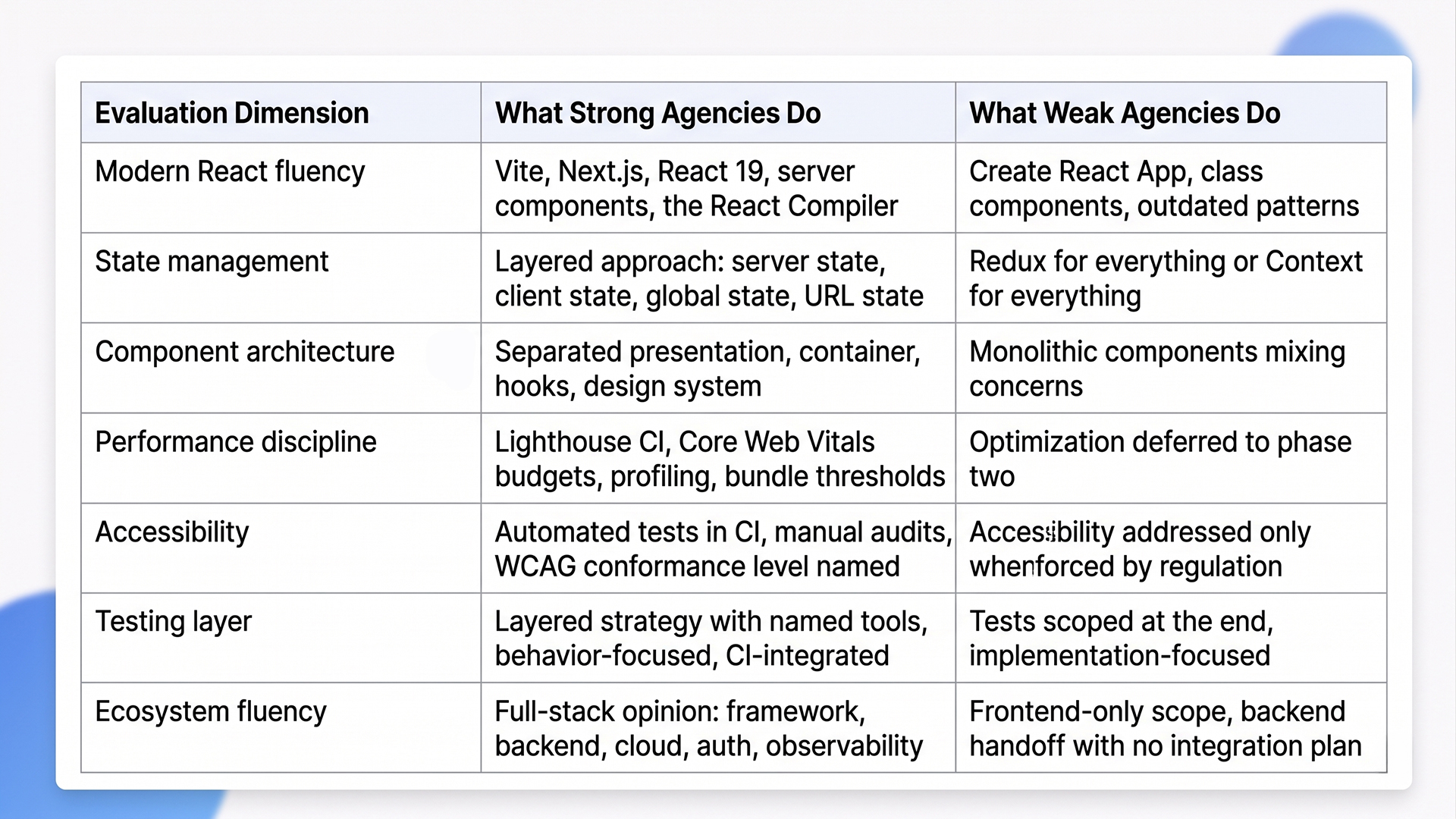
The table below captures the evaluation lens we use when reviewing react development agency candidates with clients. Treat it as a starting framework; weight the dimensions that matter most to your specific project.
Verifying React Expertise Beyond the Interview
The interview surfaces opinions. The artifacts surface practice. Three additional checks consistently separate agencies that talk well about React from agencies that ship well in React.
Code samples or open-source contributions
If the agency is willing, ask for a redacted code sample from a recent React project, or links to open-source contributions from senior team members. The sample tells you whether the patterns they describe in interviews actually appear in their code, what their component structure looks like in practice, and whether their testing standards are real or aspirational. Engineers who write React professionally have written enough to share examples of what good looks like to them.
Live application performance audit
Pick one of the agency’s recent live React projects from their portfolio. Run a Lighthouse audit. Check Core Web Vitals on a slow connection. Open the React DevTools Profiler if the page allows it. The numbers tell you whether the agency actually applies the performance disciplines they describe in their pitch. A pitch about performance budgets paired with a portfolio site that scores 40 on Lighthouse is a meaningful signal.
Technical reference call with a React engineer
Standard reference calls happen with executive sponsors. The high-signal version happens with the React tech lead or senior engineer at a recent client. Ask three questions:
- What’s the React-specific work this agency did particularly well, and what would you have wanted them to do differently?
- How did they handle a hard React performance or architecture problem during the project?
- If you were starting the project again with them, what would you change about the engagement structure?
The answers to those three questions, from a technical reference, will tell you more about React delivery quality than any case study deck.
Choosing the Right Size and Shape of Agency
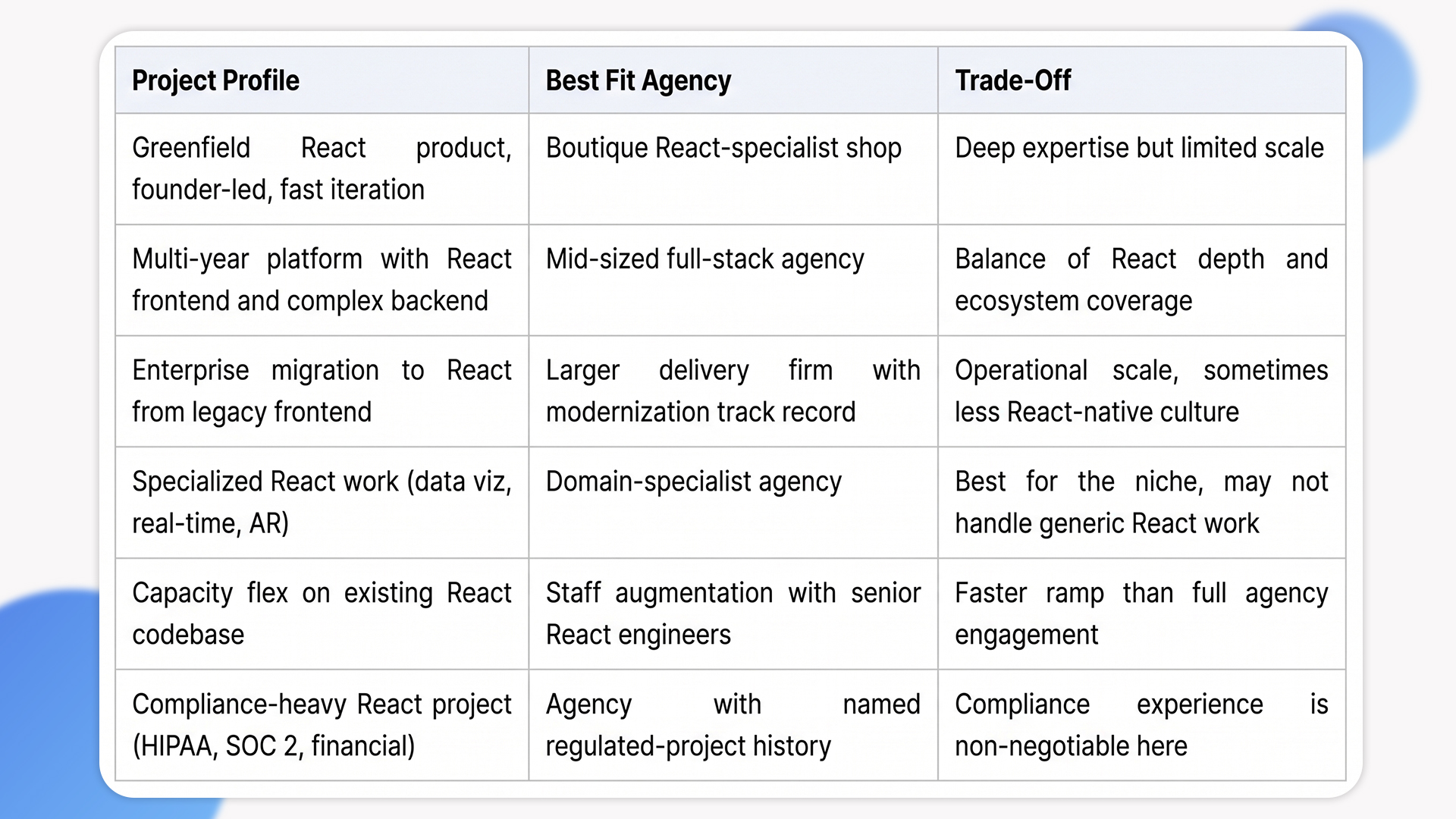
Not every project needs the same kind of react js development company. The decision lens below maps project profile to agency profile, with the trade-offs each one carries.
When Hiring a React Agency Is the Wrong Move
Some situations make hiring an external react development agency the wrong call regardless of the agency’s quality. Here is when we tell clients to take a different path.
Your team has strong React engineers and just needs capacity. In that case, staff augmentation outperforms agency engagement. You keep architectural ownership, your in-house team mentors the augmented engineers, and the engagement ramp is faster because nobody has to relearn your codebase from scratch.
React isn’t actually the right tool for your problem. Some projects are better served by Vue, Svelte, Astro, or native development. If your team is JavaScript-fluent but React is a forced choice (because someone decided it years ago and never revisited), the right move is to evaluate the framework decision before evaluating the agency. Picking the wrong framework first and the right agency second still produces the wrong outcome.
Your scope is so small a freelancer would deliver faster. For React work under USD 25,000 or for time-boxed prototypes, a senior freelance React engineer often outperforms an agency on cost and speed. Reserve agency engagements for projects where the surrounding scope (architecture, testing, deployment, ongoing operations) actually justifies the management overhead.
You haven’t decided what you’re building. If your scope is genuinely undefined, hiring an agency to figure it out for you produces inflated bids based on worst-case interpretations. The right move is paid product discovery first, with clear deliverables, before scoping the build engagement.
How Ariel Approaches React Projects

Across the React engagements we’ve delivered at Ariel, the projects that hold up are the ones where the technical evaluation surfaced the right patterns before the contract was signed. We respond to react js development company evaluations regularly, and the buyers who run rigorous selection processes consistently end up with better outcomes regardless of which agency they pick.
When we engage with buyers running React-specific evaluations, the conversation is usually about helping them sharpen the technical questions before the interview. The delivery culture and operating principles we apply across every engagement are consistent: layered state management, named performance budgets, accessibility tested in CI, ecosystem fluency across React + Next.js + the backend stack the project actually needs. The principle that drives most of our delivery work is that React expertise alone isn’t enough; ecosystem fluency is what makes the project ship.
The operating disciplines that consistently make React engagements land cleanly are:
- Modern React tooling from day one. Vite or Next.js, TypeScript end to end, server components where they fit, no legacy CRA scaffolds.
- State management decided early. Server state, client state, global state, and URL state separated explicitly with named tools for each.
- Performance and accessibility as commit-blocking checks. Lighthouse CI, jest-axe, bundle size budgets enforced in CI rather than reviewed at the end.
- Documentation as a sprint deliverable. Architecture decision records, component documentation, and runbooks ship every sprint, not at the end.
Across industries (logistics, healthcare, financial services, real estate, e-commerce, automotive) we’ve delivered React projects ranging from greenfield SaaS frontends to enterprise migrations from legacy frameworks. The success stories from our recent client work reflect the consistent pattern: the React decisions made in the first sprint determine how the application performs in year two.
Evaluating React agencies and want a delivery-grade perspective on the technical questions that matter?
Our team has scoped, delivered, and operated React applications across enterprise and mid-market clients. We’ll walk through your evaluation framework, the questions that consistently separate genuine React expertise from React-as-a-listing, and the contract terms that prevent the most common React engagement failures.
Frequently Asked Questions
1. How do I tell if a React.js development company actually has deep React expertise?
Three signals separate deep expertise from listing-level capability. First, modern tooling fluency: Vite, Next.js, React 19, server components, TypeScript by default. Second, opinionated state management: a layered approach across server state, client state, global state, and URL state, with named tools for each. Third, code samples or open-source contributions you can review. Engineers who actually write React professionally have written enough to share examples of what good looks like.
2. What’s the difference between hiring a react development agency and hiring individual React developers?
Agencies provide a team with shared conventions, established processes, project management, and accountability for outcomes. Individual developers (whether full-time hires or contractors) require you to provide all of that scaffolding yourself. The right choice depends on whether you have internal engineering leadership to coordinate individuals, whether you need short-term capacity flex or full-project ownership, and whether the work is bounded enough to scope as a project or evolves enough to need an embedded team. Most mature buyers run a hybrid: in-house engineers for core work, agency for project bursts, individual contractors for capacity flex.
3. How much does it cost to hire a React development company?
When you hire react development company partners, cost ranges depend on agency location, project scope, and engagement model. Boutique React shops in North America and Western Europe typically run higher hourly rates with deeper React expertise. Mid-sized full-stack agencies in mixed-cost regions land in the middle of the range with broader ecosystem coverage. Larger delivery firms with offshore-blended teams typically offer lower rates with more variability in React-specific depth. From our delivery experience, the rate differences are smaller than the productivity differences. A team that ships React cleanly at a higher rate often produces better TCO than a team that ships it slowly at a lower rate.
4. Should I hire a React agency or build the team in-house?
If React is a permanent core capability for your product (your competitive differentiation lives in the frontend), invest in in-house React engineers for long-term ownership. If React is needed for a specific time-bound project, capacity peak, or specialist scope outside your in-house team’s expertise, an agency is usually the cleaner answer. Most mature product companies run a hybrid: in-house React engineers own the core, agencies fill specialist or peak-capacity needs.
5. Can Ariel help us evaluate React agencies?
Yes. We help buyers run technical evaluations of React agencies, including engagements where we eventually respond and ones where we don’t. The review is independent of whether we participate as a candidate. Get in touch if you’d like a delivery-grade perspective on your evaluation framework.
The Decision Behind the Decision
Choosing a react js development company isn’t about finding agencies that list React on their tech stack page. It’s about finding the ones that have internalized the patterns that decide whether React applications scale, perform, and maintain cleanly across multi-year roadmaps. The seven criteria above each surface a specific technical capability that consistently shows up when projects go well, and consistently goes missing when projects stall. Buyers who hire react development company partners against these technical criteria consistently end up with stronger long-term outcomes than buyers who optimize on price or marketing alone.
Ask about modern React tooling. Pressure-test their state management opinion. Verify their component architecture in code samples. Test their performance discipline against a live audit. Probe their accessibility process. Listen for ecosystem fluency beyond the library. Insist on technical references with React engineers, not just executive sponsors. The agency decision matters, but the technical evaluation matters more.
Ready to hire a React partner with the technical rigor the decision deserves?
Book a free consultation with Ariel’s React engineering team. We’ll walk through your evaluation framework, the questions that consistently separate good React partners from generalist agencies, and the technical disciplines that prevent the most expensive React project failures from showing up six months in.