

“Should I outsource software development?” is the wrong question. The right question is: “What specific gap am I trying to close, and is outsourcing the fastest, cleanest way to close it?” The yes/no framing produces decisions based on philosophy. The trigger framing produces decisions based on the actual constraint your team is working against.
Across the engagements we’ve delivered, scoped, and reviewed at Ariel, the buyers who get the when to outsource software development decision right almost always trace it back to one of five recognizable triggers. When the trigger is real, outsourcing is the cleanest answer. When it isn’t, the in-house path produces better economics and stronger long-term capability. Knowing the difference is what separates teams that outsource strategically from teams that outsource reflexively and pay for it later.
Key Takeaways
- Outsourcing is a trigger-based decision, not a philosophy. Five specific conditions make it the right call.
- Capability gaps and speed-to-market urgency drive most outsourcing decisions. Cost reduction has dropped sharply as the primary driver.
- In-house developers in the US carry a fully-loaded cost meaningfully higher than headline salary figures suggest, once benefits and overhead are included.
- Hiring cycles for senior engineers consistently run weeks longer than most projects can absorb. Outsourcing closes that gap when the trigger is real.
- The hybrid model (in-house for core, outsourced for capacity and specialization) is the dominant pattern in mature engineering organizations.
- Outsourcing is the wrong call for core competitive differentiation, capability-building work, and small experimental projects.
- Cost structure conversion (fixed to variable) is a legitimate trigger, but only when paired with one of the other four. Cost alone is rarely enough.
Why the Outsourcing Decision Keeps Getting Answered Wrong
Most in house vs outsource development debates collapse into philosophy: control versus speed, ownership versus flexibility, build versus buy. Those framings produce conviction without much insight, because they treat outsourcing as a binary identity choice rather than a context-specific operational decision. Two organizations with identical headcounts and budgets can correctly arrive at opposite answers, depending on what their actual constraint is.
The market has also shifted underneath the decision. According to the 2024 Deloitte Global Outsourcing Survey, cost reduction has dropped from being cited by 70% of executives in 2020 to 34% in 2024 as the primary driver, with access to talent (42%) and meeting customer demands (35%) overtaking it. Buyers still framing the decision purely as a cost play are running on a 2020 mental model. The real triggers are about capability and speed, with cost structure as a secondary effect.
The five triggers below capture what’s actually behind a well-made when to outsource software development decision. When one or more of them is present and material, outsourcing tends to be the clean answer. When none of them are present, the in-house path almost always wins on economics and capability over a multi-year horizon.
The 5 Triggers That Make Outsourcing the Right Call
Trigger 1: Capability gap your team can’t close fast enough
This is the dominant trigger in 2026, and it’s the one most aligned with where the outsourcing market has shifted. Your team is strong, but you need a specific skill set (cloud-native architecture, ML engineering, FHIR integration, embedded systems, a regulated-industry compliance posture) that isn’t on the bench and would take quarters to build internally. Industry research suggests that around 57% of hiring managers struggle to find skilled IT talent, and the gap is sharpest in specialized domains. The trigger is real when:
- The skill is genuinely scarce in your hiring market.
- The project window is shorter than your hiring-plus-onboarding cycle.
- The capability is needed for one project rather than as a permanent function.
Outsourcing converts a multi-quarter hiring problem into a same-quarter delivery problem. The trade-off is that the capability lives outside your team unless you deliberately structure knowledge transfer. This is the single most common when to outsource software development trigger we see in scoping conversations.
Trigger 2: Speed-to-market urgency that hiring can’t match
Some projects have a delivery window that simply doesn’t accommodate a hiring cycle. A regulatory deadline. A product launch tied to a market event. A competitive response that has to ship in a quarter, not a year. Industry data on tech recruitment shows the average software engineer hiring cycle in the US runs around 35 days for the recruitment process alone, with interview cycles averaging 24 days. Add onboarding and ramp time, and a single senior hire can take three to four months from job posting to productive output. Outsourcing closes that gap by shipping a partially-formed team in two to four weeks. The trigger is real when:
- The deadline is fixed and external (regulatory, contractual, market-driven).
- The cost of missing it exceeds the cost of the outsourcing premium.
- The work is well-defined enough to scope quickly without a long discovery phase.
It’s not the right trigger when the urgency is artificial or when the project would benefit from the slower, deeper context that comes from internal hiring.
Trigger 3: Variable or seasonal capacity needs
Some workloads have peaks and troughs that don’t justify permanent headcount. A retail platform with holiday season scaling needs. A regulated business with annual compliance reporting cycles. A SaaS product with a planned multi-quarter feature pushes that taper after launch. Hiring full-time engineers for peak capacity means carrying their cost during the troughs, which inflates the run rate without adding ongoing value. The trigger is real when:
- Capacity needs are predictably variable, not just unpredictable.
- The work is well-scoped enough to onboard quickly when peaks arrive.
- The engineering team would otherwise be over-staffed during quiet periods.
Outsourcing converts capacity from a fixed cost into a variable one that flexes with the workload. The trade-off is that ramp-down is sometimes harder than ramp-up, and the operational discipline of vendor management becomes a permanent function.
Trigger 4: Specialist work outside your core engineering competence
Even strong engineering teams have boundaries. A product company with a deep web platform team often doesn’t have native iOS expertise. A fintech with sharp transaction processing engineers may not have ML infrastructure depth. A healthcare platform team may need FHIR specialists they’d struggle to retain because the work is too narrow for an internal career path. Outsourcing the specialist work lets your in-house team focus on the work where they have genuine depth, while bringing in outside expertise for the specialist scope. The trigger is real when:
- The specialism is distinct from your team’s core competence.
- The work is bounded enough to be delivered as a discrete project.
- The cost of building internal expertise exceeds the value of having it as a permanent function.
It’s the wrong trigger when the specialism is becoming central to your product, in which case in-house ownership matters more than short-term speed.
Trigger 5: Cost structure conversion from fixed to variable
This trigger gets misused, but it’s still legitimate when properly scoped. Pre-revenue startups optimizing for runway. Capital-constrained teams that need to ship without taking on permanent salary obligations. Mid-stage companies that want to validate a new product line without committing to a full team. In each case, outsourcing converts what would be a fixed monthly burn into a variable spend tied to deliverables. The US Bureau of Labor Statistics reported the median annual wage for US software developers at USD 133,080 in May 2024, and the fully-loaded cost (including benefits, equipment, recruiting, and overhead) typically lands meaningfully higher once standard burden multipliers are applied. The trigger is real when:
- The project is time-bound or pre-validation, not an ongoing core function.
- The cost flexibility actually changes your decision-making (more runway, more optionality).
- You’re not sacrificing strategic ownership for short-term cash preservation.
Cost structure alone is rarely enough; it works best when paired with one of the other four triggers.
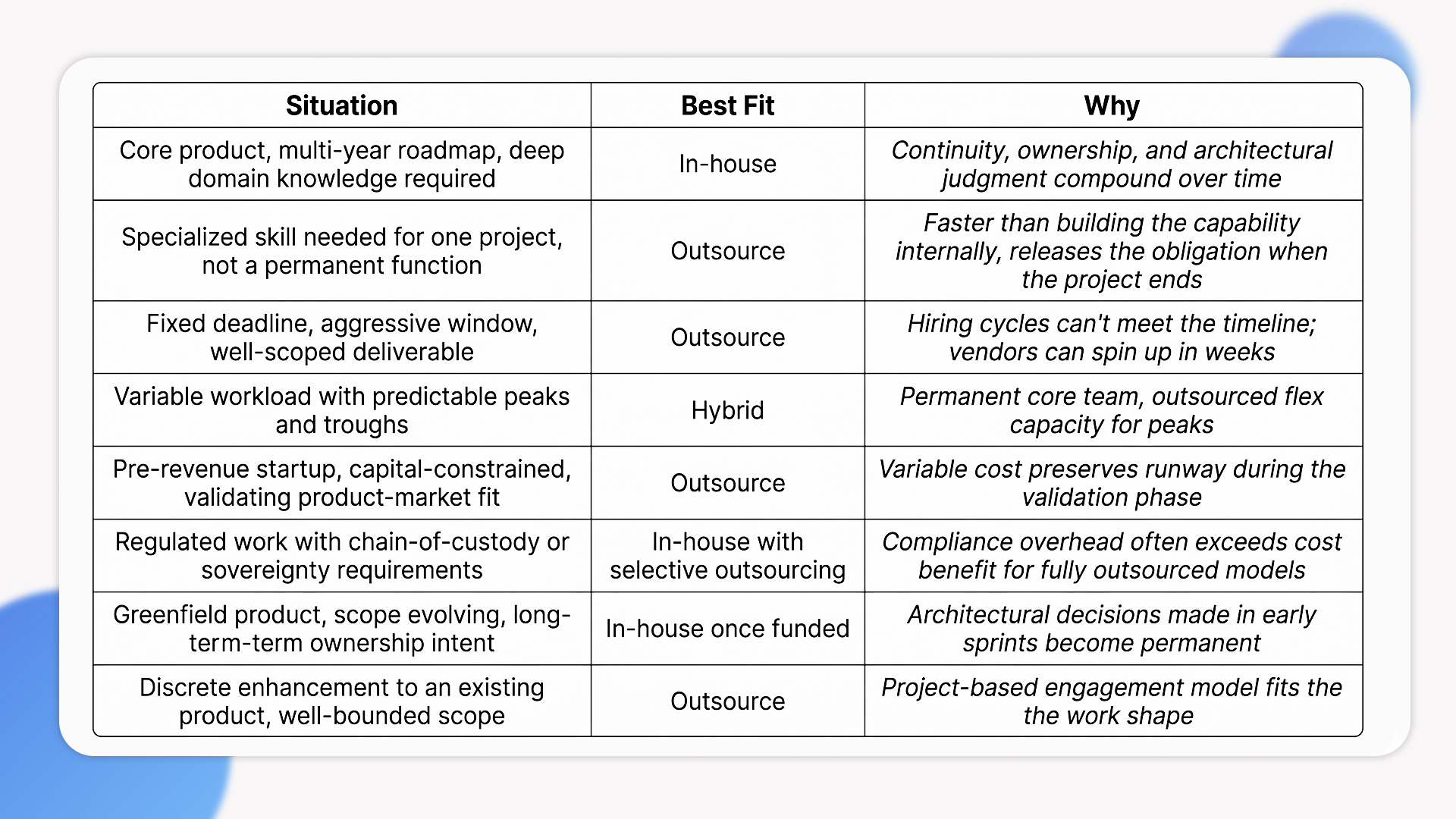
In-House vs Outsource: A Decision Lens
The table below captures how we map workload type to engagement structure during scoping conversations with clients. Treat it as a starting point for the in house vs outsource development decision; the right answer always depends on the specific constraints of your team and project.
The Hybrid Model: When Both Is the Right Answer
In mature engineering organizations, the when to outsource software development question rarely lands on a pure in-house or pure outsource answer. The dominant pattern is hybrid: keep core architectural judgment, product ownership, and competitive differentiators in-house, while outsourcing capacity, specialist work, and time-bound projects to external partners. The hybrid model captures the strengths of both approaches without forcing a choice between them.
In our delivery experience, hybrid engagements work cleanly when three conditions are in place:
- In-house owns the architecture. Major design decisions, security review, and product strategy stay with the buyer’s engineering leadership. The vendor builds against those decisions, not in place of them.
- Vendor work is bounded and well-scoped. Specific projects, named milestones, defined acceptance criteria. Open-ended scope is where hybrid engagements drift.
- Knowledge transfer happens continuously. Documentation, runbooks, and architecture decision records ship every sprint, so when the engagement ends, the in-house team owns the system without dependency.
Hybrid is the right model when the organization needs both the depth that comes from in-house ownership and the speed or specialist capability that comes from a partner. Most mid-stage and enterprise teams end up here, regardless of where they started.
When Outsourcing Is the Wrong Call
Even when one of the five triggers is present, there are situations where in-house remains the better choice. Here is when we tell clients to keep the work internal regardless of the cost or speed advantage outsourcing seems to offer.
The work is core to your competitive differentiation. If a system is what makes your product genuinely different from competitors, the architectural judgment and product knowledge should live inside your company. Outsourcing core differentiation produces speed in year one and a strategic dependency in year three. Keep the differentiator in-house. Outsource the surrounding capacity.
Your engineering team needs the build experience to grow. Engineering teams develop senior architects by giving them hard problems to solve. Outsourcing every hard problem optimizes for speed at the cost of bench depth. Mid-career engineers don’t grow by reviewing vendor pull requests. They grow by owning systems. Be deliberate about which projects you keep internal for capability reasons.
The scope is too small to justify the management overhead. Engagements under USD 50,000 often cost more in vendor management, contract overhead, and onboarding time than they save in delivery cost. For genuinely small or experimental work, freelance contractors or internal sprint capacity usually outperforms a formal outsourcing engagement.
Your data foundation isn’t ready. If your data is fragmented, inconsistently labeled, or locked in silos requiring political effort to unlock, outsourcing builds on top of that foundation accelerates the underlying problem rather than solving it. Fix data quality and access first, then outsource against the cleaner foundation.
How Ariel Approaches the Outsourcing Decision

From our delivery experience across enterprise and mid-market clients, the engagements that hold up are the ones where the outsourcing decision was matched to the right trigger. We start every scoping conversation by understanding the underlying constraint: capability gap, speed urgency, capacity flex, specialist scope, or cost structure. The engagement model falls out of that analysis. The vendor selection comes after.
The buyers who get the decision right typically share a few operating disciplines:
- They name the trigger explicitly. “We need ML expertise we can’t hire fast enough” produces a different vendor evaluation than “we want to ship faster.”
- They preserve internal architectural ownership. Even when execution is outsourced, product strategy, security review, and major design decisions stay in-house.
- They scope knowledge transfer as a deliverable. Documentation, runbooks, and architecture decision records ship sprint by sprint, not at the end.
- They plan for the trigger ending. Outsourcing engagements should have a defined off-ramp, whether that’s full handover or transition to in-house operation.
Across industries (logistics, healthcare, financial services, real estate, retail, automotive) we’ve delivered outsourced engagements that range from short fixed-price builds to multi-year hybrid partnerships. The solutions framework we apply across every engagement is consistent: identify the underlying trigger first, match the engagement model to the trigger, scope knowledge transfer from day one, preserve internal architectural ownership throughout. The platform isn’t the differentiator. The fit between trigger and engagement model is.
Trying to figure out whether to outsource and want a delivery-grade scoping conversation, not a vendor pitch?
Our team has scoped outsourcing decisions for buyers across industries for 16 years. We’ll review your underlying trigger, the engagement model that fits, and whether outsourcing is genuinely the right call or whether the in-house path produces better outcomes for your specific situation.
Frequently Asked Questions
1. Should I outsource software development if I’m a pre-revenue startup?
“Should I outsource software development” depends entirely on what you’re trying to validate. For pre-revenue startups optimizing for runway and speed-to-market on an MVP, outsourcing is often the right call because it converts a fixed cost into a variable one and ships faster than hiring would. Once you’ve validated product-market fit and raised capital to scale, the calculation shifts toward in-house for core differentiation, with outsourcing reserved for specialist work and capacity flex.
2. How do I decide between in house vs outsource development for a long-term product?
For a long-term product where the software is your core competitive advantage, in-house ownership of architecture, product strategy, and key engineering decisions almost always wins on multi-year economics. Outsourcing makes sense for time-bound work around the core (specialist integrations, capacity flex, regulated compliance work, mobile apps adjacent to a web product). Most mature product companies run a hybrid model: in-house for core, outsourced for the surrounding scope.
3. Is outsourcing actually cheaper than building in-house?
Headline rates suggest yes; total cost of ownership is more complicated. In-house developers in high-cost markets carry fully-loaded costs meaningfully above their base salary once benefits, equipment, recruiting, and overhead are included. Outsourcing rates are lower per hour, but vendor management, knowledge transfer, and integration overhead are real cost lines. The honest answer: outsourcing is cheaper for time-bound, well-scoped work with clear acceptance criteria. For ongoing core product work, in-house often wins on multi-year TCO once the team is established.
4. How long does it actually take to hire a senior engineer in-house?
Industry data suggests around 35 days for the recruitment process plus another 30 to 60 days for onboarding and ramp to productive output. So three to four months from job posting to meaningful contribution is a realistic baseline for senior engineers. If your project window doesn’t accommodate that, the speed-to-market trigger is real and outsourcing is usually the cleaner answer.
5. Can Ariel help us decide whether to outsource or build in-house?
Yes. We help buyers run the underlying analysis (trigger, scope, capability gap, timeline) before any vendor decision is made. The review is independent of whether we eventually deliver the work. Get in touch if you’d like a delivery-grade perspective on whether outsourcing fits your situation.
The Decision Behind the Decision
The when to outsource software development question stops being abstract once you anchor it to the five triggers. Capability gap, speed urgency, capacity flex, specialist scope, cost structure conversion. When one or more of these is present and material, outsourcing is usually the cleanest answer. When none are present, the in-house path produces better economics and stronger long-term capability over a multi-year horizon.
Name the trigger explicitly. Match the engagement model to the trigger. Preserve internal architectural ownership. Scope knowledge transfer as a deliverable. Plan for the engagement ending. The vendor selection matters, but the trigger analysis matters more. Outsourcing is a tool. The discipline is in knowing when to pick it up.
Ready to make the outsourcing decision based on real triggers, not philosophy?
Book a free consultation with Ariel’s delivery team. We’ll review your underlying constraint, the engagement model that fits, and whether outsourcing is genuinely the right call for your specific situation.