

Contract structure decides who absorbs scope risk, who owns timeline pressure, and who pays when assumptions move. Most teams treat software development engagement models as a procurement formality, then discover six months in that the model they signed is fighting the work they actually need done. A fixed bid signed against a fuzzy spec turns every clarification into a change order. A time-and-materials contract signed without a delivery cadence turns every sprint into a billing review. The model is the operating contract for the relationship, not a pricing wrapper.
Buyer-side data confirms the cost of getting this wrong. The Standish Group CHAOS Report data shows only 31% of IT projects succeed, 50% are challenged on cost or scope, and 19% fail outright. Deloitte’s 2024 Global Outsourcing Survey reports 80% of executives are planning to maintain or increase third-party outsourcing investment. The volume is rising, the failure rates are not falling, and the gap is almost always in how the engagement was structured before the first commit landed.
This guide will explain the three primary software development engagement models, the operating conditions each one fits, the failure patterns each one creates when misapplied, and the hybrid structures buyers use when no single model covers the work cleanly.
Key Takeaways
- Fixed-price works for tightly-scoped, low-change projects with verified specs. It collapses on anything discovery-shaped.
- Time and materials work when scope evolves through delivery. It demands a buyer-side delivery cadence to control burn rate.
- Dedicated team model software engagements are the right fit for sustained product work and long-cycle modernization. Treat the team as an extension, not a vendor pool.
- Hybrid models (capped T&M, milestone-based T&M, fixed-price-per-sprint) exist because the three primary models do not map cleanly to most enterprise work.
- The model decision is a risk allocation decision, not a price decision. Misallocating risk is the dominant cause of mid-engagement contract renegotiation.
Why Engagement Model Selection Is Risk Allocation, Not Procurement
Every software development engagement model answers four questions: who carries scope risk, who carries estimated risk, who carries velocity risk, and who carries change risk. The three primary models distribute these risks differently, and the distribution is what makes a model fit or fail. McKinsey’s study with the University of Oxford on 5,400 IT projects found large IT projects run 45% over budget and 7% over time on average, with software projects carrying the highest cost and schedule overrun risk. Procurement teams that benchmark on hourly rate or total contract value miss this entirely. The cheaper rate on a misallocated risk profile costs more by month four than a higher rate on the right structure.
From our delivery experience, three failure patterns show up repeatedly when buyers select on price instead of risk fit:
- The fixed-price spec drift trap. Buyer signs a fixed bid against a 12-page SOW, then the business stakeholder requests material scope changes in week six. The vendor invokes change orders for every clarification. The relationship turns adversarial within a quarter.
- The T&M velocity blind spot. Buyer signs a time-and-materials contract without instrumenting velocity, story-point throughput, or sprint-level burn against forecast. Six months in, spend is 60% over plan and the buyer cannot explain why.
- The dedicated team coordination gap. Buyer onboards a six-engineer dedicated team, then runs them through a junior product manager who batches all decisions weekly. The team’s effective velocity is half what the contract assumed.
Risk allocation also drives the contract instruments: change order process, acceptance criteria, payment triggers, governance cadence. The model dictates what those instruments need to do. A fixed-price contract without a tight change order process is unenforceable. A T&M contract without a sprint-level reporting clause is unauditable. A dedicated team contract without ramp-up and ramp-down terms is rigid.
Fixed-Price Engagement Model
Fixed-price is the most common of the software development engagement models buyers default to, and it commits a vendor to deliver a defined scope for a defined fee on a defined timeline. The vendor absorbs scope risk inside the agreed boundary. The buyer absorbs the cost of every clarification or addition that crosses that boundary, through change orders priced at the vendor’s leverage point.
When fixed-price fits
- Tightly-scoped delivery with a complete, signed-off spec, wireframes, and acceptance criteria written before pricing.
- Low-ambiguity work: migrations against a documented schema, integrations against a stable third-party API, regulatory feature builds against a published standard.
- Buyers without delivery oversight capacity. The model trades flexibility for predictability, which fits when the buyer cannot staff active product or engineering management.
- Repeatable work the vendor has delivered before. The more the vendor can pattern-match against past projects, the tighter their estimate, the more aggressive they can price.
When NOT to use fixed-price
- Discovery-shaped work. If the scope cannot be specified before kickoff, fixed-price will price the unknown as buffer or bleed into change orders.
- AI/ML projects, R&D, or first-of-its-kind features. Estimate variance on novel work is too wide to bid responsibly.
- Long-running engagements. Anything past 4-6 months of fixed-price tends to drift through the change order process anyway.
- Active product workstreams where the business owner needs to reprioritize backlogs based on user signal.
Failure modes from delivery
The most common fixed-price failure pattern is signed-off spec staleness. The buyer signs a 60-page SOW in February. By June the business has shifted, three integrations are no longer needed, two new ones are urgent, and the vendor’s change order pricing reflects their lock-in. The second pattern is buffer compression. Vendors who price aggressively to win compress their estimate, then run the engagement against their own internal margin pressure rather than the buyer’s outcome. The work ships on time and on budget while the quality and post-handoff support degrade quietly.
Time and Materials Engagement Model
Time and materials is the second of the three primary software development engagement models and prices the engagement at hourly or daily rates, with the buyer paying for actual hours delivered against ongoing work. Scope risk sits with the buyer. Velocity risk is shared. The model fits any engagement where scope evolves faster than a SOW can describe it.
Fixed price vs time and material: the operating distinction
The fixed price vs time and material choice usually gets framed as a budget question. The operating distinction is different: fixed-price contracts make the vendor the scope owner; T&M contracts make the buyer the scope owner. Under fixed-price, the vendor pushes back on every change request because each one threatens their margin. Under T&M, the buyer is the gatekeeper because every change request increases their burn. The model that fits is the model that matches who is actually best positioned to make scope calls week-to-week.
When T&M fits
- Discovery and prototyping work where the goal is to find the answer, not deliver a known answer.
- Product feature streams with a continuous backlog and a buyer-side product owner running prioritization.
- Integration projects with multiple third-party dependencies. APIs change, data schemas shift, and rigid pricing locks the vendor into work that no longer matches reality.
- AI/ML and data engineering engagements where the work is exploratory by nature and outcomes cannot be specified in advance.
Buyer-side controls T&M needs
T&M without controls drifts. From our delivery experience, every successful T&M engagement we have run for buyers has these instruments in place from week one:
- Sprint-level burn reporting: hours by engineer, by ticket, against forecast, delivered every sprint demo.
- Velocity instrumentation: story points or equivalent throughput metric, tracked across sprints, explained when it dips.
- A buyer-side product owner with authority to reprioritize the backlog without escalating every decision upward.
- Monthly steering review with the vendor delivery lead covering burn against budget, scope against original intent, blockers, and forward forecast.
- Capped T&M ceilings on individual workstreams or epics, so the buyer is not exposed to unbounded burn on a single stream.
When NOT to use T&M
- Buyer cannot staff active product oversight. T&M without a product owner is the most expensive way to build software.
- Procurement-driven environments where the buyer’s finance function requires fixed totals.
- Single-deliverable, well-defined work. T&M’s flexibility is overhead the engagement does not need.
Dedicated Team Model
The third of the three primary software development engagement models is the dedicated team model software engagement, which embeds a vendor-supplied team (engineers, designers, QA, sometimes product) under buyer direction for sustained periods, typically six months and up. The buyer pays a monthly retainer per role. The team operates as an extension of the buyer’s engineering organization.
When the dedicated team model fits
- Sustained product work where the buyer needs ongoing capacity, not project-shaped work.
- Long-cycle modernization: multi-year platform rewrites, monolith decomposition, multi-region rollouts. Our analysis on enterprise application modernization patterns covers the work-shape fit in detail.
- Capacity gaps in scarce skills: staff augmentation in roles where the buyer cannot hire fast enough through their own pipeline.
- Engineering culture extension. Buyers who want vendor engineers to operate inside their stand-ups, sprint cadence, and code review culture rather than as a separate delivery pod.
Operating mechanics buyers underestimate
The dedicated team model software engagement model looks simple (pay a retainer, get engineers), but the operating model is the most demanding of the three. The buyer is not buying delivery; they are buying capacity, and capacity utilization is the buyer’s responsibility. From our delivery experience, three operational gaps show up most often:
- The decision-throughput bottleneck. A six-engineer team needs decisions faster than a weekly stakeholder cadence can deliver. Buyers running dedicated teams through async-only product management see effective velocity drop 30-40% against capacity.
- The onboarding ramp. New dedicated teams need 4-8 weeks of ramp-up before they hit baseline velocity. Buyers who book month-one capacity at full rate against an aggressive roadmap miss every milestone.
- The retention compounding effect. Dedicated teams compound in value across the first 12 months as institutional knowledge accumulates. Treating them as interchangeable resource pools, swapping engineers in and out, destroys that compounding.
Pricing reality
Dedicated team rates vary widely by region and seniority. As an illustrative band from our delivery experience, mid-senior full-stack engineering capacity through Indian providers runs USD 35-65/hour blended; senior architects USD 65-110/hour; specialized AI/ML capacity USD 80-150/hour. These are not industry-wide benchmarks; they reflect what we see across the buyer-side conversations we run. Eastern European and Latin American capacity tends to price 20-50% higher for comparable seniority.
Choosing the right model for your project?
Ariel runs delivery across all three primary software development engagement models (fixed-price, T&M, and dedicated team) and helps buyers structure the contract before the first sprint. Our delivery leads work with your team to map scope, change risk, and oversight capacity to the model that fits.
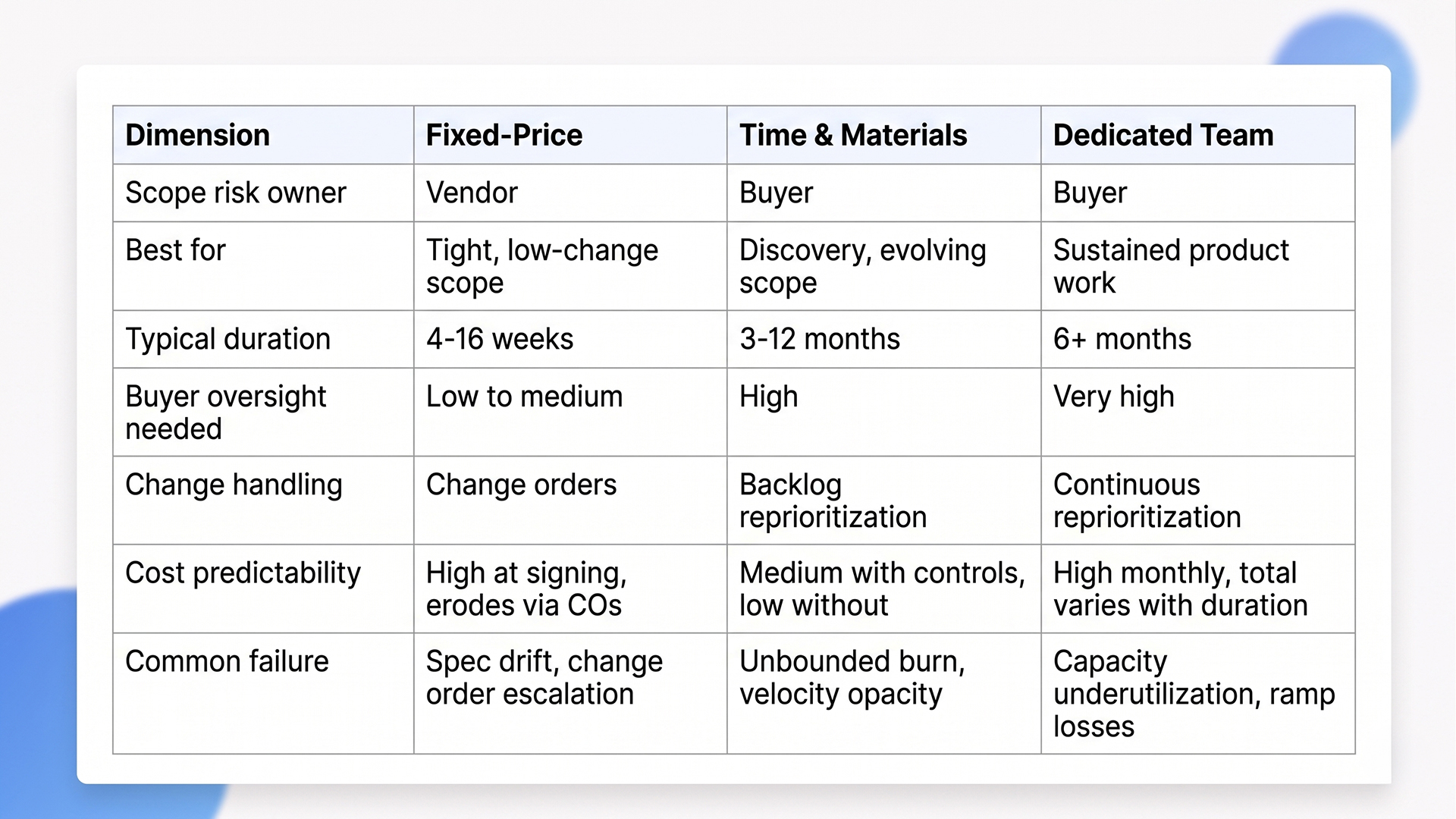
Engagement Model Comparison
This table maps the three primary software development engagement models against the operating dimensions that drive fit. Use it as a first-pass screen, then validate with the buyer-side oversight question in section 7.
Hybrid Engagement Models Buyers Actually Use
Most enterprise engagements do not fit cleanly into one of the three primary software development engagement models. Buyers and vendors structure hybrid models to absorb the parts that do not map. Four hybrids show up most often:
Capped T&M
T&M with a hard ceiling per epic, milestone, or quarter. The buyer keeps scope flexibility; the vendor carries overrun risk past the cap. Fits engagements where the buyer wants T&M’s adaptability but their finance team requires bounded exposure.
Milestone-based T&M
Hourly billing with payment triggers tied to milestone acceptance. The vendor invoices monthly but a portion is held until milestone sign-off. Aligns vendor incentive with delivery outcomes rather than pure hour-logging.
Fixed-price-per-sprint
Each sprint is priced as a small fixed-price unit against a sprint-scoped SOW. The buyer can stop after any sprint without further commitment. Common in early product engagements where the buyer wants to validate the vendor before scaling.
Dedicated team with project-shaped commitments
Dedicated team retainer with quarterly outcome commitments. Not full SLAs, but agreed delivery markers the team commits to inside their capacity. Adds accountability to a model that otherwise leaves the vendor measured only on hours delivered.
How to Choose the Right Engagement Model

Selecting from the available software development engagement models comes down to three sequenced questions. Answer the first one before the second.
1. How stable is the scope?
Fully specified, signed-off, low-change probability: fixed-price is on the table. Evolving, discovery-shaped, or dependent on user feedback: T&M or dedicated team. The fastest disqualifier for fixed-price across software development engagement models is the question, “will the requirements written today still describe the work in three months?” If the answer is no, fixed-price will fight the engagement.
2. How much buyer-side oversight capacity do you have?
Active product owner, weekly steering, sprint-level engagement: T&M and dedicated team are viable. Limited internal capacity, business sponsor without delivery experience: fixed-price reduces oversight burden. The model that fits the work but mismatches buyer capacity will fail through coordination cost.
3. Is this project work or product work?
Project work with bounded scope, defined endpoint, and clear acceptance fits fixed-price or capped T&M. Product work with sustained capacity, evolving roadmap, and no fixed endpoint fits a dedicated team. Procurement teams that try to force product work into project shapes through repeated SOW renewals burn 20-30% of the effective budget on contract overhead from our delivery experience.
Common buyer mistake to avoid
The most common buyer error is selecting on rate, not on risk fit. A USD 28/hour T&M rate looks cheaper than a USD 45/hour dedicated team rate until you discover the T&M engagement runs 3x longer because the buyer cannot supervise it. Total cost of engagement, not unit rate, is what the model decision actually shapes. For buyers vetting vendors, our about page covers the delivery experience and certifications buyers typically validate before contracting.
Frequently Asked Questions
1. What are the three main software development engagement models?
The three primary software development engagement models are fixed-price, time and materials (T&M), and dedicated team. Fixed-price commits to a defined scope at a defined fee. T&M bills hourly against evolving work. Dedicated team places vendor engineers under buyer direction on a monthly retainer. Hybrids such as capped T&M, milestone-based T&M, and fixed-price-per-sprint combine elements of the three.
2. What is the difference between fixed price vs time and material?
The fixed price vs time and material distinction is risk allocation. Fixed-price puts scope risk on the vendor, who absorbs the cost of estimate misses inside the agreed scope. Time and materials puts scope risk on the buyer, who pays for actual hours delivered as scope evolves. Fixed-price suits tightly-scoped work; T&M suits discovery and evolving product workstreams.
3. When should I use the dedicated team model software engagement?
The dedicated team model software engagement fits sustained product work, long-cycle modernization, and capacity gaps in scarce skills. It works when the buyer needs ongoing engineering capacity rather than bounded project delivery. It requires active buyer-side product management. Without it, capacity utilization drops and the retainer cost outpaces output.
4. Which engagement model is cheapest?
There is no universally cheapest model. Fixed-price looks cheapest at signing but erodes through change orders on evolving scope. T&M looks cheapest per hour but can run unbounded without controls. Dedicated team looks expensive monthly but compounds in value across long engagements. Total cost of engagement depends on scope stability, oversight capacity, and engagement duration, not on headline rate.
5. Can engagement models be changed mid-project?
Yes, and from our delivery experience this happens in roughly a third of multi-quarter engagements. Common transitions include fixed-price-per-sprint converting to dedicated team after vendor validation, or capped T&M converting to fixed-price for the final stabilization phase. Build the transition mechanism into the original contract; most renegotiation friction comes from contracts that did not anticipate model evolution.
Conclusion
Engagement model selection is the operating contract of the buyer-vendor relationship, and getting it wrong shows up six months in as adversarial change orders, opaque burn, or underutilized capacity. The three primary software development engagement models (fixed-price, T&M, and dedicated team) distribute scope, estimate, velocity, and change risk differently, and the right model is the one whose risk distribution matches your scope stability, your oversight capacity, and your work shape. Hybrid models exist because most enterprise engagements need a structure the three primary models do not deliver cleanly. Decide on risk fit first, then on rate. To see how Ariel structures these engagements in practice across delivery models, our services page maps the delivery model to the work shape.
Structure your next engagement before the first sprint
Ariel Software Solutions has run delivery across fixed-price, T&M, dedicated team, and every common hybrid for 16+ years. We help buyers map their scope, change risk, and oversight capacity to the contract structure that holds up through delivery, beyond the signing milestone.